
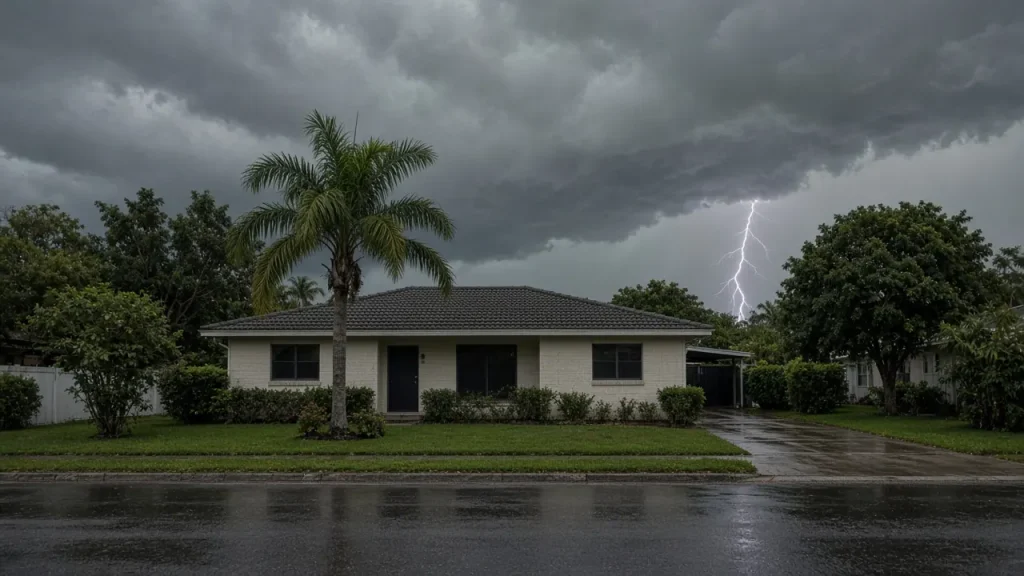
Lightning hit close to the house and now something is dead? A step-by-step guide for Pinellas homeowners: what to check first, what not to touch, when to call an electrician and how to protect the house next time.
Request an after-storm electrical check
Tell us your address and what you need. A licensed electrician will call or text you back.
Smell burning or see scorch marks? Call 911 first. For electrical damage after a storm, call (727) 476-7079 or request service online.
Summer afternoons in Tampa Bay bring thunderstorms almost daily, and a strike on a tree, a utility pole or the house next door can send a surge through your wiring, cable and phone lines. Sometimes nothing happens. Sometimes the TV, the garage door opener, the pool pump and half the outlets in the kitchen stop working at once. Here is how to sort it out safely.
First: safety checks in the first hour
- Smoke, burning smell or warm walls: get everyone out and call 911. Lightning can start a fire inside a wall or attic that isn’t visible at first.
- Wait out the storm. Stay off corded phones and away from plumbing and the panel until the thunder has passed.
- Look, don’t touch: scorch marks on outlets or the panel, a buzzing breaker, or a melted cover plate are reasons to leave that circuit off and call an electrician.
- Outside: stay away from downed lines and anything touching them, and report them to your utility.
Common signs of surge damage
- Several electronics or appliances dead at once, often on different circuits.
- GFCI outlets that tripped and won’t reset, or reset and trip again.
- A breaker that tripped and won’t stay on.
- Lights flickering or dimming in part of the house.
- Smart devices, garage door openers, pool and irrigation controllers that lost their programming or no longer respond.
- A whole-home surge protector with its status light out.
What you can check yourself
Reset tripped GFCI outlets once, including the ones in the garage, bathrooms, kitchen and outdoors, since a single GFCI can feed several other outlets. Check the panel for a tripped breaker and switch it fully off, then on, one time only. If it trips again, leave it off. Unplug electronics you can’t power up rather than repeatedly trying them. Don’t open the panel cover or swap breakers yourself.
When to call an electrician
Call if a breaker won’t reset, a GFCI won’t hold, anything smells hot, you see scorching, or a large share of the house is out while your neighbors have power. A licensed electrician can test circuits, check the panel and the grounding and bonding system, and find damaged receptacles or wiring. See our emergency electrician and breaker and tripping repair services.
Insurance and documentation
Take photos of anything damaged before it is repaired or thrown out, and keep model numbers and receipts. Ask your insurer how they handle surge and lightning claims and what they need from an electrician. We can give you a written summary of what we found and repaired.
Protecting the house next time
Surge protection works in layers: a whole-home device at the panel plus plug-in protectors at TVs, computers and chargers. The 2020 NEC requires a surge protective device whenever a home’s service is installed or replaced, and it makes sense to add one to an existing panel too. No device can survive a direct strike to the house, but layered protection and good grounding limit the damage from the far more common nearby strikes. Read more on whole-house surge protection.
Related: flooded electrical before the power comes back · electrical troubleshooting · home electrical safety checkup
Keywest Lights & Electric is a licensed electrical contractor (EC13014717), woman-owned and based at 6248 Seminole Blvd, Seminole, FL 33772. Our workmanship warranty is 2 years, or 5 years for Member Care Plan members.
Frequently asked questions
Can lightning damage my electrical without hitting my house? Yes. A strike on a nearby tree, pole or line can send a surge into the house through power, cable or phone wiring.
My GFCI outlets won’t reset after a storm. What should I do? Try resetting each one once. If one won’t hold, leave it and call an electrician, since the outlet or the circuit may be damaged.
Does a whole-home surge protector stop lightning? It limits surges from nearby strikes and utility switching. Nothing protects against a direct strike, which is why layered protection and good grounding matter.
Will my insurance cover lightning damage? It depends on your policy. Photograph the damage, keep receipts and ask your insurer what they need from an electrician.