
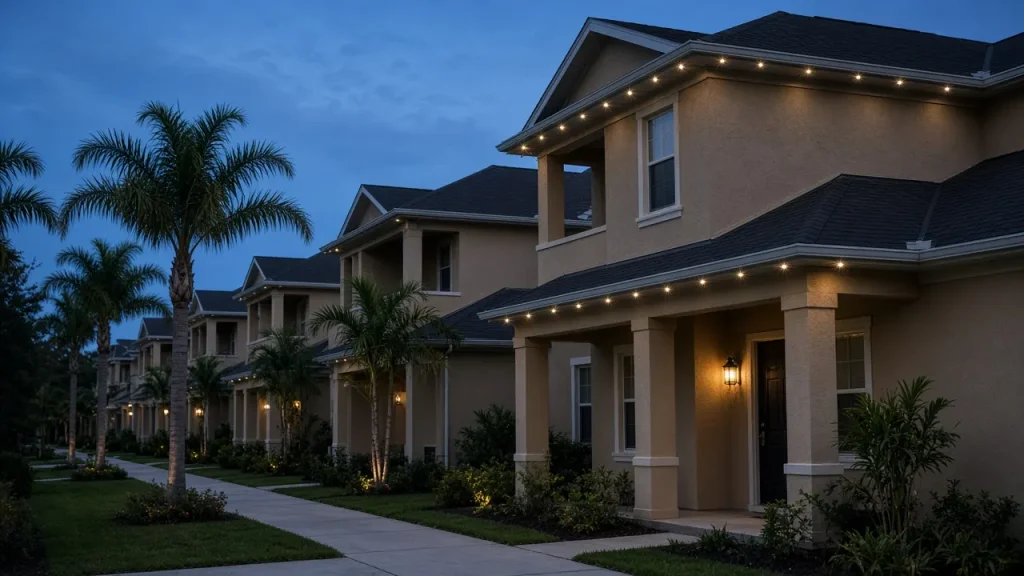
Permanent lights for a condo, townhome or villa in Pinellas: who has to approve them, how shared walls and eaves change the layout, where the power comes from, and what to bring to your association.
Request a free permanent lighting estimate
Tell us your address and what you need. A licensed electrician will call or text you back.
Live in a townhome or villa community? Call (727) 476-7079 or request a free estimate online.
Most permanent lighting advice assumes a detached house with one owner and one set of eaves. Attached homes are different. The eave over your front door may be shared with a neighbor, the outside walls may belong to the association, and the nearest outdoor outlet may sit on a common meter. None of that rules out permanent lights. It just changes the order of the steps.
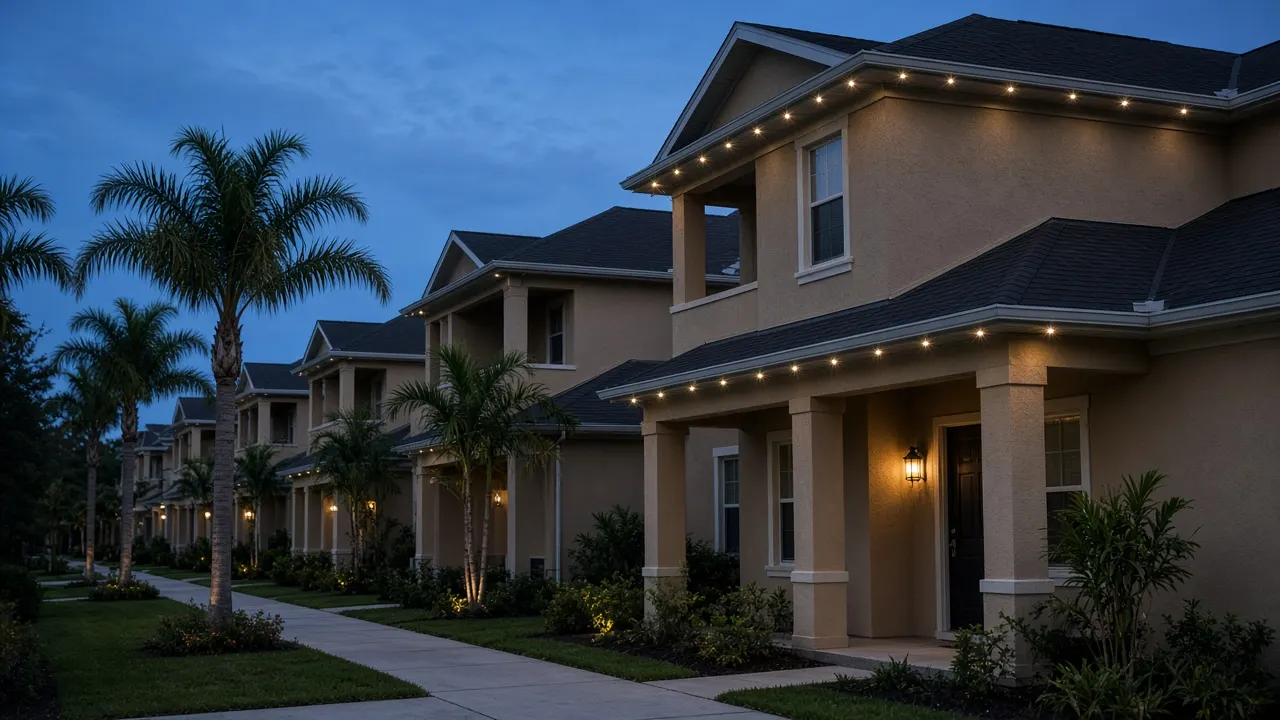
Which homes this applies to
- Townhomes with their own front elevation and a shared side wall.
- Villas and paired homes (two units under one roof), common in Seminole, Largo and Palm Harbor communities.
- Low-rise condos with ground-floor or top-floor units that have an eave of their own.
- 55+ and golf communities with uniform exterior standards.
High-rise condo balconies are a different case: there is usually no eave to mount to, and the association controls the facade.
Step 1: find out who owns the outside
Read your declaration and rules, or ask the manager, which parts of the exterior you own and which are common elements. In many attached communities the walls, soffit and fascia belong to the association even though you live behind them. If so, you need written approval before anything is fastened, and sometimes the board prefers a matching look across a whole building.
Step 2: plan around shared eaves
- Stop the run at the center line between units, or agree with your neighbor to light the whole building as one design.
- Use separate zones for each unit if neighbors share a run, so each household controls its own lights.
- Match the track color to the community’s trim color so it disappears by day.
- Keep the lights under the eaves and soffit and along the sides. They are never mounted on the roof.
Step 3: confirm the power
The controller and its power supply usually plug into an existing outlet in the garage. In attached homes, that outlet may be on your meter or on a common house meter. We check which, because the board may not want a private lighting system running on shared power. If a new outlet is needed on your circuit, a licensed electrician adds it under a permit, with association approval for any exterior work.
What to bring to the board
- A layout drawing or photo markup showing exactly which eaves get track.
- Product information and the track color.
- How the lights are powered, and on whose meter.
- Your planned schedule and brightness, including a shut-off time.
- The installer’s license and proof of insurance.
Our HOA approval guide walks through the review in more detail. Beachfront buildings also follow sea turtle lighting rules from May 1 to October 31 (FWC), so beach-facing zones should stay dark during nesting season.
Whole-building projects
Some associations light an entire building or the clubhouse at once, so the community looks uniform. That is usually simpler than unit-by-unit approvals, and the board controls the schedule. We can quote both ways so the board can compare.
How we work with attached homes
Keywest Lights & Electric is an Authorized JellyFish Dealer. A licensed electrician visits, maps the eaves and the power, and gives you a written estimate and a design preview you can hand to your board. We schedule the install after approval.
Related: JellyFish lighting · ready-by-Christmas timeline · game-day and holiday color schedules · permanent vs. seasonal lights
Keywest Lights & Electric is a licensed electrical contractor (EC13014717), woman-owned and based at 6248 Seminole Blvd, Seminole, FL 33772. Our workmanship warranty is 2 years, or 5 years for Member Care Plan members. JellyFish parts carry a 5-year warranty.
Optional front and back zones
We can give your system a front zone and a back zone as an option. The front carries around each corner, roughly 4 feet down the side, or the full length of a pitched gable under the overhang, so nothing looks cut off from the street. Because the back is separate, it can stay off while the front is lit.
Frequently asked questions
Can I put permanent lights on my townhome? Usually, with your association’s written approval if it owns the exterior. Check your declaration and rules first.
What if my neighbor shares the eave? We stop the run at the unit line, or light both units as one design with separate zones so each household has its own control.
Can the lights run on the community’s power? Only if the association agrees. We confirm which meter the outlet is on before the install.
Are the lights mounted on the roof? No. The track goes under the eaves and soffit and along the sides of the building.