
Request a recessed lighting quote.
Looking for recessed lighting installation in Tampa Bay? Keywest Lights & Electric can help. Tell us which rooms you want lit. The ceiling type (flat. Vaulted. Popcorn. Tongue and groove) and whether there is an attic above. A photo of the room helps. A licensed electrician will call you back.
Is there a local electrician for recessed lighting installation in Pinellas and Tampa Bay? Our woman-owned team at Keywest Lights &. Electric (EC13014717) works throughout Pinellas and Tampa Bay.
Recessed lighting installation in Pinellas and Tampa Bay. We plan the layout. Cut the ceilings. Run the wiring. Add the dimmers and switches. Leave a clean row of lights that matches the room.
Planning new ceiling lights? Call (727) 476-7079. Describe your room.
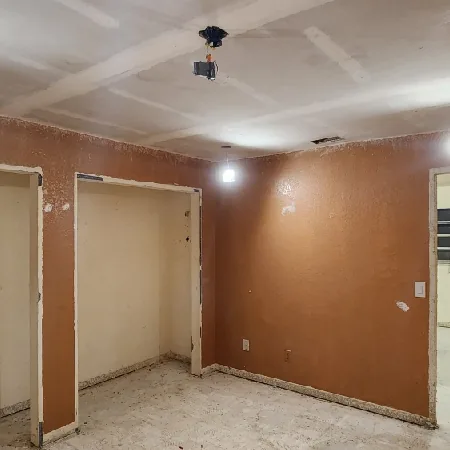
What recessed lighting does for a room.
Recessed lights, often called can lights. Sit up inside the ceiling so the room is lit without a fixture hanging down. In a hallway they wash the walls evenly. In a kitchen they light the counters under the cabinets from above. In a living room on a dimmer they replace a single harsh overhead with soft, adjustable light. A room that relied on one bare fixture can end up with light in every corner.
The difference between a good job and a poor one is almost all planning. Where each light goes, how far apart. Way the joists run. What is in the attic, and which switches control which group.
Housings, wafers and trims.
There are two main ways to put a light in a ceiling today. And we pick one per project:
- Slim LED wafer lights: a thin round light with a remote driver box. Which clamps to the drywall. Good for finished ceilings, shallow joist bays and quick remodels.
- Housing with a separate trim: a metal can that holds the light. With a trim ring that finishes the opening. Good where you want a deeper baffle to cut glare. A sloped-ceiling adapter or a fire-rated enclosure.
- Wet- and damp-rated trims: for showers. Covered lanais. Carports and soffit areas that see humidity or blowing rain.
- Adjustable gimbal trims: lights that tilt to wash a wall. A fireplace or artwork rather than point straight down.
Color temperature matters as much as the fixture. Warm white around 2700K to 3000K suits bedrooms and living rooms. Cooler white around 4000K reads clean in kitchens, garages and workspaces. We bring samples when it helps. We keep every light in a room the same color so the ceiling looks even.
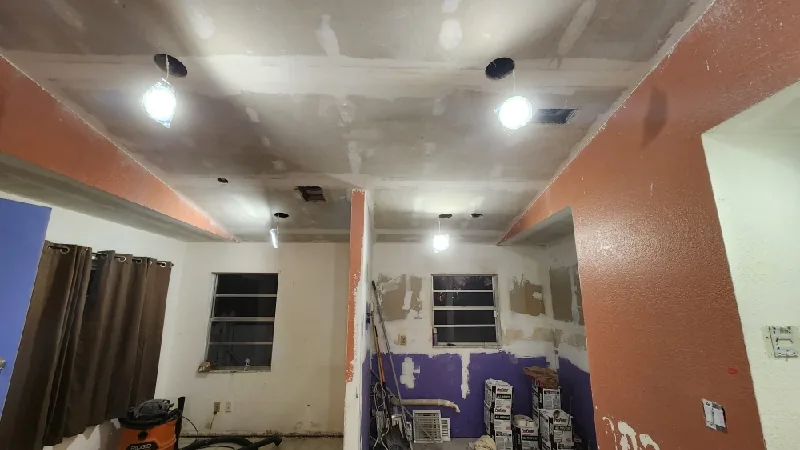
Laying out the lights.
We mark the layout on the ceiling before we cut anything. Using painter’s tape so you can see it from the floor. We check what is above each mark. Ceiling joists, ductwork, plumbing vents, a bath fan or a beam. A light that lands on a joist gets nudged a few inches. The row is adjusted so it still looks straight.
- Even rows: evenly spaced lights. Usually about half the ceiling height apart. Centered on the room or a feature in it.
- Task zones: extra lights over counters. Islands. Desks and reading chairs. Kept off the line of the shadow you cast.
- Wall washing: lights set closer to a wall to light shelves. A mantel or a gallery wall.
- Switching: separate switches or dimmers for each zone. So a kitchen can run bright at the counter and soft in the dining area.
Florida attics and ceilings: what changes the job.
Our attics run hot and humid. Makes the way a light is sealed and rated more important here than in a cooler climate. A leaky can lets conditioned air up into the attic and lets hot. Damp attic air down onto the trim and drywall. We use sealed, airtight housings or sealed LED wafers for ceilings that sit below an attic. IC-rated fixtures wherever insulation will touch them.
Townhomes, condos and two-story homes add their own rules. A ceiling that is part of a fire-rated floor or wall assembly needs fire-rated housings, or the rating is lost. Vaulted and tongue-and-groove ceilings may need sloped-ceiling housings or surface-mounted fixtures instead of cans. We tell you which of these apply before we start.
How a recessed lighting job works.
- Walk the rooms: we look at each ceiling. Check the attic or the floor above. And talk through how you use the room.
- Mark the layout: we tape the positions. Confirm what is above each one and agree on the switch and dimmer plan.
- Cut and wire: we cut the openings. Run cable from the nearest circuit and mount the housings or wafers. Adding a circuit if the existing one is already loaded.
- Test and clean up: we install the trims. Test every dimmer across its range. Vacuum the drywall dust and leave you with the lights on and working.
Recessed lights are often part of a larger project. For a kitchen, see kitchen remodel electrical. For a whole-house refresh with new circuits, see remodel and addition electrical. For pendants, under-cabinet and decorative fixtures, see lighting installation.
Who does the work.
The licensed electrician who installs your recessed lights works for Keywest Lights &. Electric, a woman-owned Florida contractor (EC13014717) based at 6248 Seminole Blvd in Seminole. Home Depot lists us as a preferred contractor. Our installs are backed for two years, or five on a Member Care Plan. We answer emergency calls around the clock.
Putting a fan in the same room? See ceiling fan installation.
Dimming a row of lights? See dimmer and switch installation.
Recessed lighting installation in Tampa Bay for new layouts and ceiling work.
Recessed lighting installation in Tampa Bay is laid out for the room. Then the housing or wafer is chosen for the ceiling we actually have. Florida attic heat and insulation already noted here change the can and the clearance. A catalog photo is not the whole quote.
Recessed lighting FAQ.
Can you add recessed lights to a ceiling that already has drywall? Yes. Most of our recessed jobs are in finished ceilings. We cut a round hole for each light. Fish the cable through the attic or between floors. Use remodel housings or slim LED wafers that clamp to the drywall. Patching is limited to the holes for the lights. And a new switch usually means one more small opening.
How many recessed lights does a room need? It depends on ceiling height. What the room is used for and how bright you want it. A common starting point is to space lights about half the ceiling height apart and keep them roughly that far from the walls. Then add more over kitchen counters, desks and reading chairs. We mark the layout with you before cutting anything.
Are recessed lights safe in an insulated attic? They are when the housing is rated for it. Where insulation touches the fixture we use IC-rated housings or sealed LED wafers. We keep cable and insulation clear of any fixture that is not. We also use airtight. Sealed trims on ceilings below an attic so the light does not leak cooled air up into the heat.
Can recessed lights go on a dimmer? Yes. With a dimmer that matches the LED load. Mismatched dimmers cause buzzing. Flicker or lights that will not dim to a low level. We pair the dimmer with the lights we install and test it across its range before we leave.
Can I put recessed lights in a bathroom. A porch ceiling or over a shower? Yes. With the right fixture. Showers, lanais, screened porches and soffits need lights listed for damp or wet locations. Shower areas should sit on a GFCI-protected circuit. We choose the trim for each spot and explain what goes where.
Do you replace old can lights with LED? Yes. Older incandescent cans can be fitted with LED retrofit trims where the housing is sound, or swapped out completely when the housing is damaged. Rusted or leaking air. We check each can for scorch marks, loose wiring and insulation contact first.
Ready to light up a room? Call (727) 476-7079 or use the form above and tell us about your ceilings.
See also: All services. Residential electrician. Lighting installation. Ceiling fans and fixtures. Kitchen remodel electrical. Outlets and dedicated circuits. Pinellas Park recessed lighting project.
Call or text (727) 476-7079. We take on projects up to $2 million and carry $1 million in bonding.