
Request a ceiling fan installation quote.
Looking for ceiling fan installation in Tampa Bay? Keywest Lights & Electric can help. Tell us which rooms need fans, the ceiling height and type. Whether there is already a light or fan there. A photo of the ceiling helps. A licensed electrician will reply.
Is there a local electrician for ceiling fan installation in Pinellas and Tampa Bay? That’s Keywest Lights &. Electric, a state-licensed (EC13014717), woman-owned electrical contractor serving Pinellas and Tampa Bay.
Ceiling fan installation in Pinellas and Tampa Bay. We replace light fixtures with fans. Add new fan boxes and wiring. Fix wobble and failing controls. Leave the fan hanging solid with every speed working.
Need a fan hung or replaced? Call (727) 476-7079. Describe the room.
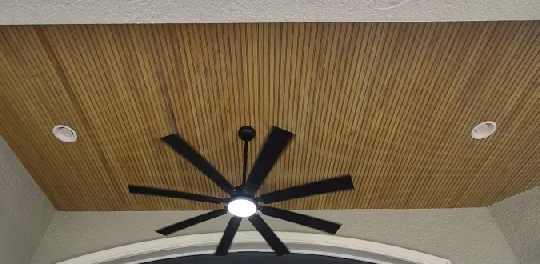
Why a fan is more than a heavier light.
A ceiling fan weighs more than a light fixture. And it pulls and sways every time it runs. The box it hangs from has to carry that load for years. A standard light box. Held by two small screws into thin drywall or a stud plate. Was not made for it.
That is why the most important part of a fan installation is the part you cannot see. A fan-rated box, anchored to a joist or to a brace that spans two of them. Everything else, the blades. The light kit. The remote. Is only as good as what holds it up.
What we install and replace.
- Fan in place of a light fixture: we swap the box for a fan-rated one. Set the brace and hang the fan with the right downrod length.
- New fan where there is no box: new cable. New box and a switch or remote. With the ceiling patched around the small opening.
- Fan swaps: an old. Noisy or wobbling fan taken down and replaced. With the box checked and upgraded if it is not rated.
- Controls: wall controls, speed switches. Remote receivers and smart fan switches that match the fan. So the motor runs the way it should.
- Outdoor and lanai fans: damp- and wet-rated fans on covered porches, lanais and screened patios.
Bringing your own fan is fine. If you are choosing one. We can recommend a blade span and downrod for the room. For general fixtures, smoke detectors and lighting, see ceiling fans, fixtures and smoke detectors.
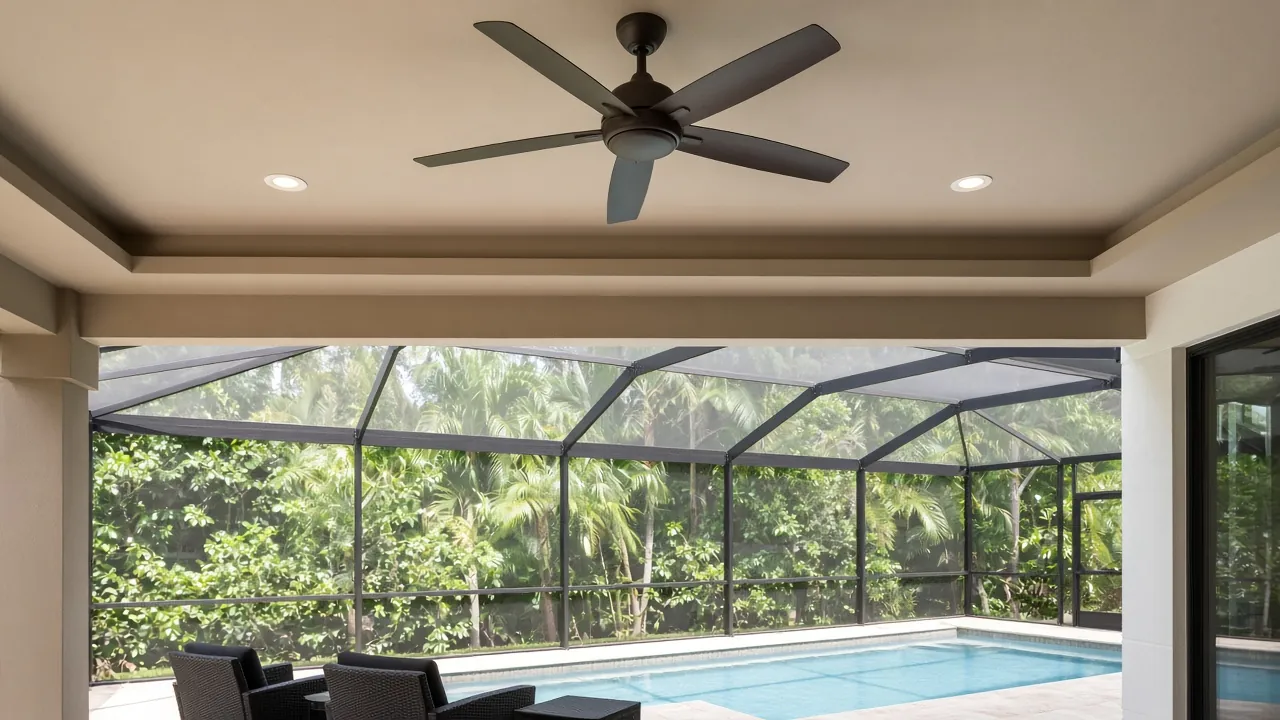
Matching the fan to the room.
Size and height decide how well a fan actually works. A small fan in a big living room barely moves the air. And a large fan in a small bedroom feels like a draft. As a rough guide. A bedroom or office does well with a fan 44 to 52 inches across. And a great room or lanai wants 52 inches or more, or a pair of fans.
- Low ceilings: a flush-mount, or hugger, fan keeps the blades well above head height.
- Tall and vaulted ceilings: a longer downrod brings the fan down to where it moves air. And a sloped-ceiling adapter keeps it hanging straight.
- Light kits: LED kits last far longer than old bulbs and can be dimmed when the control allows it.
- Reverse switch: useful in winter to push warm air down from the ceiling at low speed.
Florida fans: heat, humidity and salt air.
A fan runs for most of the year in Tampa Bay. It gets far more hours than in cooler states. A fan in a bedroom and one on a lanai live in very different conditions. Indoor fans do not belong on open or semi-open patios. Where humidity, rain blown in sideways and salt air corrode motors and warp blades. A fan that is listed for damp or wet locations is built for that. We hang it on a box and wiring suited to the spot.
Fans also help with cooling costs when you raise the thermostat a couple of degrees and let moving air make up the difference. That only works when the fan is the right size. Spins true and runs on a control that lets you set it where you like.
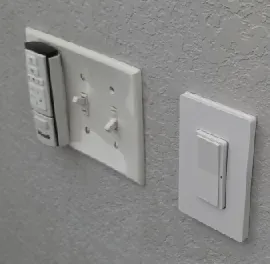
How a ceiling fan job works.
- Look at the ceiling: we check the box. What it is fastened to. The ceiling height and where the switch is.
- Plan the control: we decide on one switch. Two switches or a remote. And whether a new cable run is needed.
- Set the box and hang the fan: we fit the fan-rated box and brace. Assemble the fan. Balance the blades and connect it.
- Test every speed: we run the fan through its speeds and the light through its range. Check for wobble and noise, and clean up.
Fans often go in alongside other ceiling work. See recessed lighting installation for row lights, or outlets and dedicated circuits when a room needs more power at the wall.
Who does the work.
The licensed electrician who hangs your fan works for Keywest Lights &. Electric, a woman-owned Florida contractor (EC13014717) based at 6248 Seminole Blvd in Seminole. Home Depot lists us as a preferred contractor. Our installs are backed for two years. And we answer emergency calls around the clock.
Fan and light on one wall plate? See dimmer and switch installation.
Need a fan for the bathroom? See bathroom exhaust fan installation.
Florida summers make fans essential. And lanai. Porch and pool-cage locations need damp- or wet-rated models. We check ceiling height, blade clearance and the box rating before hanging anything. Can add wall controls or remote receivers.
Ceiling fan installation in Tampa Bay on a box that can carry the weight.
Ceiling fan installation in Tampa Bay is only as good as the box and the structure above it. A light-fixture box is often not rated for a moving fan. A wobbly install usually starts there, not at the blades. We set a fan-rated box. Confirm the joist or brace. And match the fan to the room size and the ceiling height. Including damp-rated units for lanais and covered porches.
A securely mounted, listed fan on a legal circuit is the code requirement. We still check the wall control. The light kit and whether a humid lanai needs a damp or wet rating. The fan is quiet and the motor lasts. Replacing a fixture with a fan, or swapping a failing unit. Is the same visit when the wiring is already at the box.
Ceiling fan installation FAQ.
Can ceiling fan installation in Tampa Bay use the existing light box? Only if that box is fan-rated and solidly supported. Many light boxes are not. We check before we hang the fan. We replace the box or add a brace when it is not up to the job.
Can you put a ceiling fan where there is only a light fixture now? Yes. It is one of our most common jobs. A fan is heavier and moves, so the light fixture box is not enough. We replace it with a fan-rated box that is anchored to the framing or a brace between the joists. Then hang the fan from it. Where the attic is not reachable we use a brace that goes in through the ceiling opening.
Can you add a fan where there is no ceiling box at all? Yes. We run new cable from a nearby circuit or switch. Cut in a fan-rated box. And add a wall control. In a finished ceiling we fish the cable through the attic or between floors and patch only the small opening we need.
Do I need a special switch for a fan and light? Often yes. A fan and its light can be run from two separate switches. From one dual control, or from the remote that comes with the fan. Dimmers made for lights can hum or damage a fan motor. We match the control to the fan and test the full speed range before we leave.
Why does my ceiling fan wobble. Can that be fixed? Wobble usually comes from a loose blade bracket. An unbalanced blade. A bent downrod or a box that is not secured to the framing. The first three are quick checks. If the box moves, the fix is a proper fan brace. That is a safety item because a fan that works loose can fall.
Can you install a ceiling fan on a lanai or covered porch? Yes. With the right fan. Covered patios and lanais need a fan listed for damp or wet locations. Has sealed motors and blades made to take humidity and salt air. We mount it on a fan-rated box and connect it on a GFCI-protected circuit where required.
Do you haul away the old fan? Yes. We remove the old fan or fixture, cap off or reuse the wiring as needed. Take the old unit with us unless you want to keep it.
Ready for a fan that stays put? Call (727) 476-7079 or use the form above and tell us about the room.
See also: All services. Residential electrician. Lighting installation. Ceiling fans and fixtures. Recessed lighting installation. Outlets and dedicated circuits. Emergency electrician.
Call or text (727) 476-7079. We take on projects up to $2 million and carry $1 million in bonding.