
Who handles Christmas light installation in Indian Shores? In Indian Shores, call Keywest Lights & Electric, a woman-owned business with Florida license EC13014717. The trip from 6248 Seminole Blvd to Indian Shores runs about 4 miles.
When the menorah comes out, the app can move from JellyFish permanent lighting to Indian Shores Festival of Lights house lights at sunset.
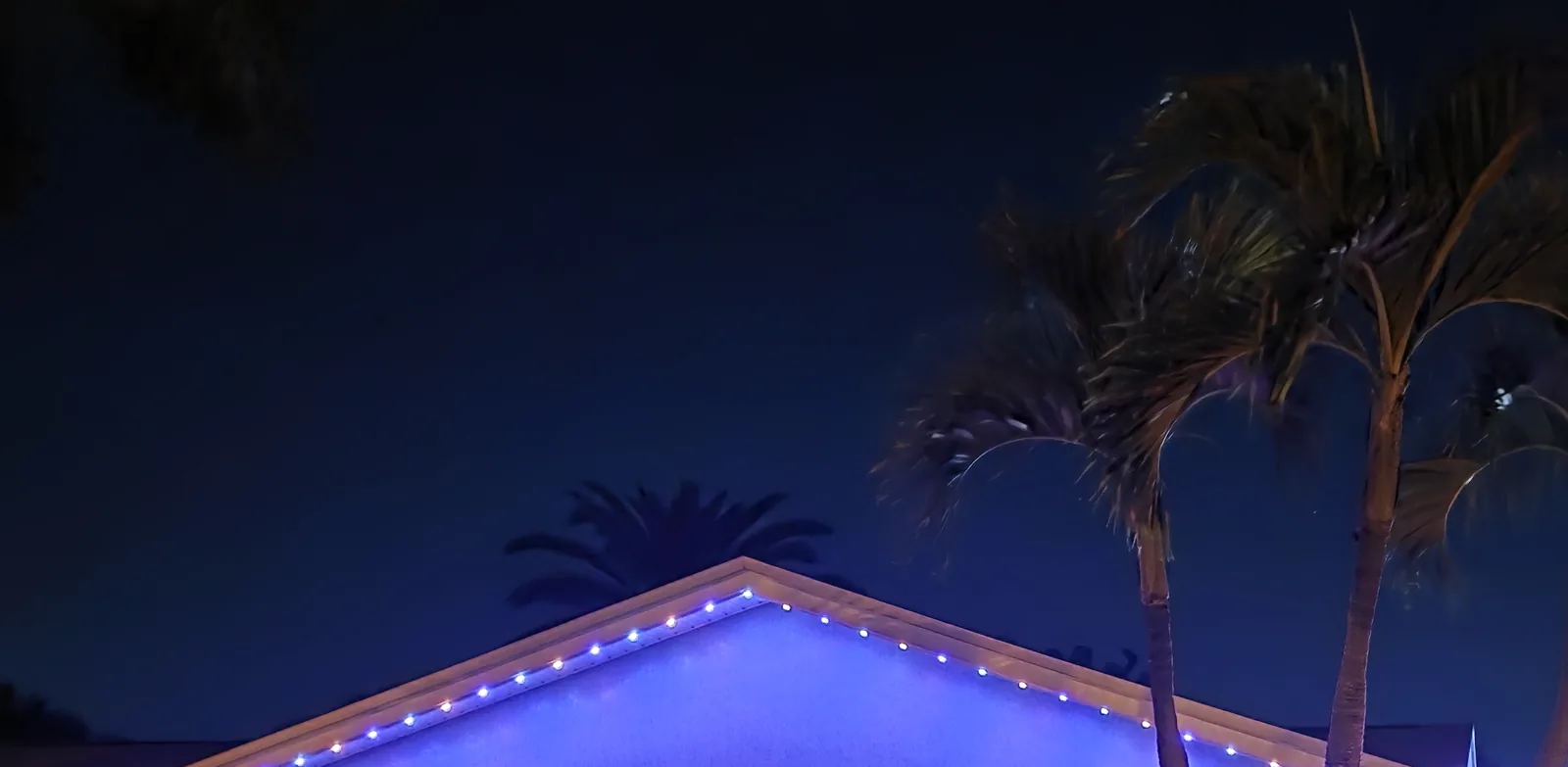
Free Design Preview in Indian Shores.
Free design preview, Indian Shores. All it takes is one photo of the front of your house in “Photo of your home (optional)”, as JPG, PNG or HEIC up to 10 MB.
Send a Photo of My Home or call or text us at (727) 476-7079.
See the glow before you commit: request a free JellyFish mockup of your Indian Shores home.
JellyFish Lighting for Indian Shores homes and condos.
Request an Indian Shores JellyFish estimate.
Tell us your Indian Shores address, whether it’s a condo or a house, and which side of Gulf Blvd it’s on. A licensed electrician will call or text you back.
In Indian Shores, almost everyone lives in a condo. American Community Survey figures (2020–2024) put 57.4% of the town’s housing units in buildings of 20 or more units. The homes are mainly 1970s and ’80s construction, 31.6% and 31.2% respectively. The median resident is 58.1. So a permanent lighting project here needs a condo board’s approval for the owner’s own unit. On the Gulf side it has to work around sea turtles. Keywest Lights & Electric (KWLE), a woman-owned firm licensed in Florida (EC13014717), plans those projects from 6248 Seminole Blvd, about 4 miles off as the crow flies.
Board members and owners can call or text (727) 476-7079.
Neighboring areas have their own pages too: Kenneth City JellyFish permanent lighting and Treasure Island JellyFish permanent lighting. Other Indian Shores services: electrical service upgrades for Indian Shores and generator installation in Indian Shores.
Ready for permanent holiday color in Indian Shores? Reach (727) 476-7079 or request a free estimate online.
On a holiday deadline? Book your Indian Shores home early. After you sign, we order the JellyFish material and set your install date as soon as it is in. For Indian Shores, early December is the practical booking cutoff.
Nearby: permanent Christmas lights in Indian Rocks Beach, permanent Christmas lights in Redington Beach, permanent Christmas lights in Belleair Beach. Need other electrical work? Indian Shores electrician, permanent Christmas lights in Pinellas County, free design preview.
Who installs Christmas light installation in Indian Shores?
Permanent Christmas lights in Indian Shores are installed by Keywest Lights & Electric from our Seminole shop, about 4 miles inland. We’re licensed (EC13014717), woman-owned and an Authorized JellyFish Dealer. On the beach we keep the track tucked back under the overhang, along the eaves and gable rakes, out of direct sun and wind.
We are an Authorized Dealer of JellyFish Lighting, not JellyFish Lighting itself.
A unit owner’s project, step by step.
Here is a realistic path from first conversation to a lit unit:
- Interest: you ask your board about lighting your own unit.
- Site walk: we walk your unit with you, marking the soffits and eaves that can carry track, beach sight lines and a possible controller spot.
- Draft plan: a written layout for your unit with zones, the controller location, everyday and holiday settings, and a nesting-season schedule.
- Board review: the board reviews the plan for your unit as its governing documents require.
- Approval and install: once your unit is approved, KWLE’s licensed crew installs. We don’t use subcontractors.
- Hand-off: you receive app access, written instructions and the saved calendar.
Turtle-first layout.
State wildlife guidance (FWC) for anything seen from the sand comes down to three words: low, shielded, long. Long means wavelengths over 560 nm only, the amber-to-red end of the spectrum, produced directly rather than through a gel or filter. Since JellyFish builds its colors from red, green and blue diodes, we don’t call it compliant. The layout handles it instead.
Every run visible from the sand becomes its own zone and is scheduled off during nesting season, while street- and Intracoastal-facing runs carry the everyday white and holiday scenes. The town has a turtle protection ordinance on its books, and the plan is written to match it.
The two-zone option.
Two zones are an extra KWLE option on any project. For a Gulf-front unit, a second zone lets the sand-facing runs switch off by calendar while your street-side eaves keep glowing.
Where track goes on a condo.
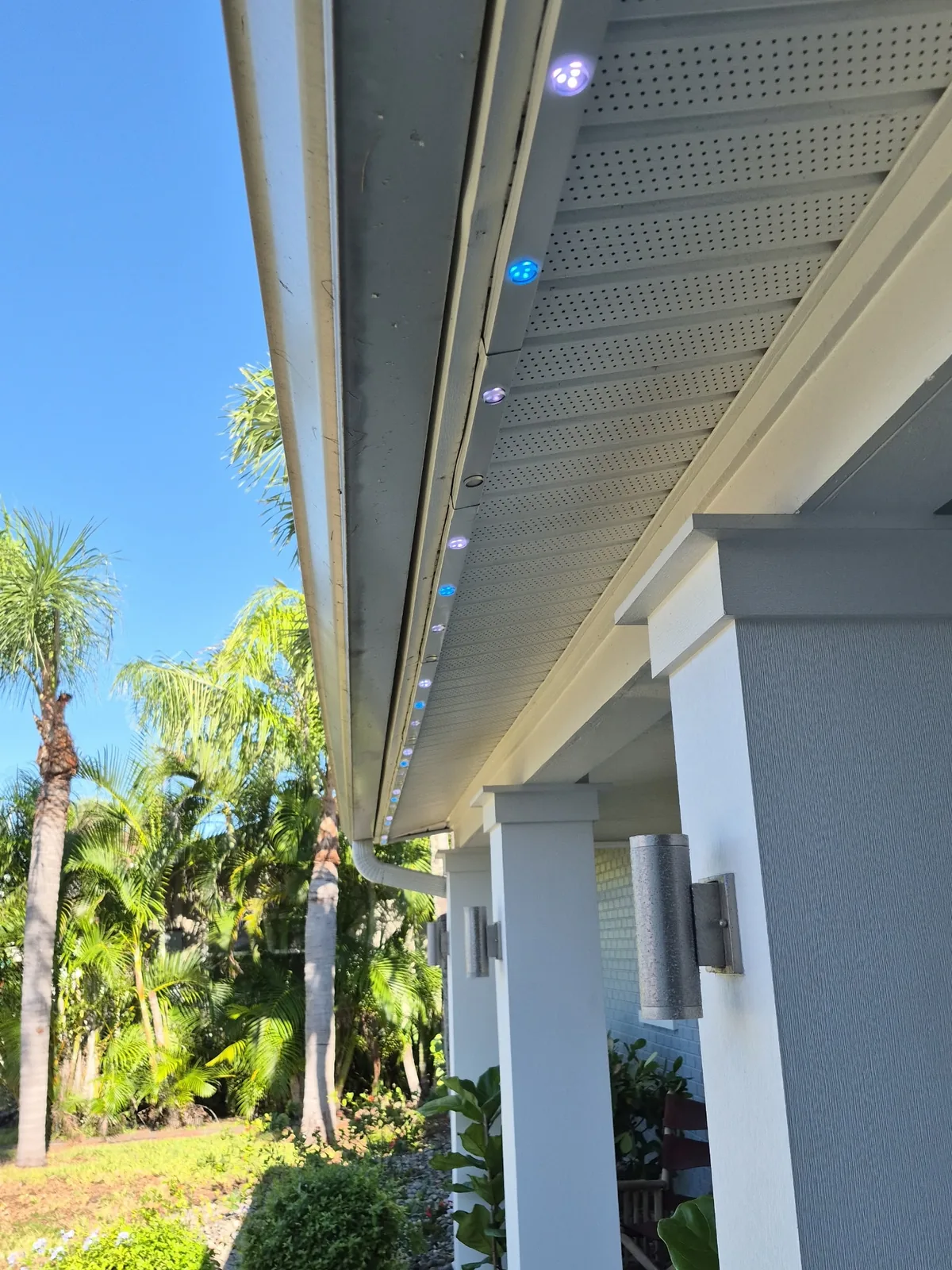
Track needs an overhang: it rides under the eaves and, on buildings that have them, up gable rakes. No light sits on a roof and no screw goes through roofing. On a condo, that means your own unit’s entry or low eave rather than the tower itself. The track is color-matched to the soffit, so in daylight it’s hard to spot.
Controllers and power.
Your controller needs a protected indoor home with an existing outlet, such as your garage or storage room. As licensed electricians, we test the receptacle and breaker and check what else shares the circuit. If the location needs electrical work first, we write it up for you and the board.
For the few houses.
Only 6.5% of Indian Shores homes are detached houses. For those owners, the controller goes in the garage on an existing outlet, the track goes under the eaves and up the gable rakes, and the same zone approach applies if the house faces the beach.
What residents see.
On the street side, guests see a soft warm-white outline on your unit’s eaves every evening. In December, permanent Christmas lights come on in a classic multicolor or a crisp white twinkle. A short list of permanent holiday light scenes, perhaps the Fourth, Halloween and New Year’s Eve, rounds out the calendar. On the beach side, the lights stay dark during nesting season, and outside it, they follow whatever the board approves.
What a board packet includes.
- Photos of each proposed run on your unit, marked where track starts and stops.
- A zone map showing which runs face the beach and which face the street or the Intracoastal.
- Your controller location, with the existing outlet and our test results.
- A sample calendar: everyday white, holiday dates and the nesting-season schedule for the beach zone.
- Warranty terms for parts and workmanship.
- A short product summary, including the quarter-inch profile, soffit-matched track and 2700K accent setting.
With that in hand, the board can see exactly what’s proposed for your unit and decide with confidence.
Older buildings, careful inspections.
A building from the 1970s or ’80s has decades of exposure behind it. Salt air and sun take a toll on soffits, fascia and exterior electrical. Before proposing any run, we inspect the material the track would fasten to, and before naming any controller location, we test the receptacle there. Anything that needs repair goes in writing, so you and the board can plan for it.
Storm notes.
Weather Service records put Helene’s coastal Pinellas surge, in September 2024, at roughly 4 to 7 feet over MHHW, with Zone A under evacuation orders. Milton’s arrival weeks later widened the orders to three zones. JellyFish requires nothing from you during an evacuation. Lights are sheltered beneath the eaves, and the controllers sit indoors.
Winter residents and absentee owners.
If your unit sits empty part of the year, that’s another argument for a system that runs on its own. The calendar handles sunset timing, the holiday changes and the nesting-season blackout of the beach zone. Nobody has to be in residence to flip a switch. If you want someone else to run it, app access is shared in minutes.
Choosing spacing and white.
Light spacing options are six, nine or sixteen inches. On eaves seen up close, 9 or 16 inches looks tidy. On long runs viewed from the road, 6 inches reads as a continuous line. Whites range from a warm 2700K to a cooler 5000K.
Gentle light for the balconies above.
Eave lighting on a unit can sit below neighbors’ balconies. To keep it from bothering anyone, we suggest JellyFish’s low output setting, which its HOA guidance puts at 21 lumens or lower, with a warm 2700K white, dimmed further late at night.
For your association’s review, we assemble:
- A JellyFish product information page for the board.
- A track finish matched to the soffit or fascia.
- Your home photo showing the planned eave and gable-rake lines.
- Where the controller mounts in the garage and what powers it.
- Our EC13014717 Florida electrical contractor license.
Your board decides; we make sure it has everything to review.
Permits.
Permits in Indian Shores come from the town itself; KWLE files whatever the job requires on our license.
Warranty.
Owners get two warranties: JellyFish’s 5-year parts warranty for the hardware, and KWLE’s workmanship warranty for labor, 2 years, or 5 with Member Care. Elsewhere you’ll often see workmanship covered for only 1 year. KWLE’s runs 2 years because we stand behind our installs, and JellyFish adds a 5-year manufacturer warranty. Put simply, Indian Shores owners get 5-year parts coverage from JellyFish and a 2-year workmanship warranty from KWLE.
Found us with Christmas light installers? We cover Indian Shores.
Clean professional Christmas light installation on an Indian Shores house comes down to careful spacing along the eave line and gable rakes. Ask for JellyFish lights and we kick off with a free mockup of your Indian Shores home before anything is mounted.
Plan your permanent Christmas light installation with the photo-based preview first, then decide which eave edges you want lit. An Indian Shores front yard looks finished at night once permanent Christmas lights trace the eaves and each sloped gable rake. The appeal of JellyFish Lighting for an Indian Shores household is that one install covers each holiday on the calendar.
Single-family homes on the Intracoastal side.
Most of Indian Shores lines Gulf Boulevard. The houses on the bay side, along the Intracoastal Waterway and the short canal streets, are a different project from anything facing the beach. Their eaves face the water and the boat traffic rather than the sand. Some are raised homes with a tall first floor. On a raised house we measure both levels and often light only the main roof eave and gable rakes, leaving the ground-level parking area plain. Light on the water side is seen from boats and docks, so a steady warm white usually suits it better than a moving pattern.
Ready before the winter residents arrive.
If you split the year between here and up north, it helps to have the lights set up before you come down for the season. Because the system runs from the app, the timeline does not need you on site for every step. We can measure with a neighbor or manager providing access, review the layout with you by phone and photo. Hand the app over remotely when the work is done.
Once the proposal is signed, we order your JellyFish material and schedule the install. For 2026 that leaves room to be lit by Thanksgiving on Thursday, November 26, for Hanukkah from sundown on December 4, or by Christmas Eve on Thursday, December 24.
Install day on a short canal street.
The bay-side streets off Gulf Boulevard are short, often dead-end, and lined with driveways, boat trailers and plantings close to the pavement. On install day our crew needs room for a work vehicle and space to set ladders along each eave. A little planning keeps the street clear.
Before the date, we confirm where the vehicle can park without blocking a neighbor’s driveway. We ask you to move cars, kayaks and outdoor furniture away from the walls we will be working along. If your street ends at a shared turnaround or a launch spot, we keep it open. Letting the neighbors know which day we are coming is a simple courtesy that saves a knock on your door.
We clean up as we go. By evening the street looks as it did that morning, apart from the new track tucked under your eaves.
Letting the sunset finish first.
Sunset is an event in Indian Shores. People walk out to the beach accesses off Gulf Boulevard to watch it. On the bay side the sky over the water keeps changing color well after the sun is down. A lighting schedule can respect that. Instead of switching on at the exact moment of sunset, the everyday scene can start a little later, once the afterglow has faded and the street actually needs light.
In winter that later start still lands early in the evening. In midsummer it pushes the lights toward 9 p.m. On the water-facing eave, a low first hour keeps the house from competing with the colors over the Intracoastal. Brightness can rise a step once it is fully dark. None of this changes the beach-zone rules, which keep any run seen from the sand off during nesting season whatever the clock says.
We set the start time with you at the hand-off. You can shift it in the app.
Next to a public beach access.
If your Indian Shores house sits beside one of the public beach accesses off Gulf Boulevard, one side eave faces a path that people use from morning until well after dark. That side acts like a beach side in one way and a street side in another.
During sea turtle season, from May 1 through October 31, any run that can be seen from the sand follows the turtle plan. A side eave along an access path can often be seen from the beach end of the path. So we walk out and look back at the house from the sand before deciding which zone that side joins.
Outside nesting season, a soft warm white along that eave lights the edge of the path a little for people walking home after the sunset, without shining into their eyes. We keep that run at a low setting and steady rather than animated, because it sits close to eye level for everyone passing by.
Working on the beach side without touching the dune.
On a Gulf-front house, the beach-facing eave can only be reached from the sand side. Between the house and the beach there may be a dune planted with sea oats, sea grapes and other native plants.
Those plants hold the sand in place. Florida law protects them: sea oats and sea grapes may not be cut or removed without the landowner’s consent, and damaging dune plants seaward of the state’s coastal construction control line generally requires a state permit. So our ladders and equipment stay on the deck, the walkway or open sand, never on the dune. Nothing is trimmed to make room.
If a beach-side eave can’t be reached without stepping into the planted dune, we leave that run off the plan and tell you why. When we can, we schedule beach-side work outside nesting season, and we pack out every clip and scrap before we leave.
Chile’s Fiestas Patrias in September.
Chile’s Fiestas Patrias fall on September 18 and 19. The 18th marks the first national government junta of 1810 and the 19th honors the army. In 2027 they land on a Saturday and a Sunday. In Chile, families head to the fondas for empanadas and dance the cueca. If you’re celebrating in Indian Shores, the flag gives you the palette: red, white and blue, with a single white star.
Run wide red, white and blue blocks along the street-side eave. Let a short white run over the front door stand in for the star. Mid-September is still sea turtle nesting season, (May 1 to October 31 here). Every run visible from the sand stays dark at night and only the street- and Intracoastal-facing eaves carry the colors. The beach-zone schedule doesn’t change for a holiday.
Mid-September sunsets come around 7:30 p.m. The flag colors come on as the sky fades. Save the scene, put both nights on the app calendar, and on Monday the eave returns to everyday white.
St Brigid’s Day and the first sign of spring.
St Brigid’s Day is February 1, an old Irish marker of the start of spring that was known in earlier times as Imbolc. Ireland made it a public holiday in 2023, and in 2027 it falls on Monday, February 1. Families weave Brigid’s crosses from rushes and hang them by the door.
If you have Irish roots and a house in Indian Shores, the eave can mark the day with green and white, plus a soft gold over the entry like the first light of a longer evening. Keep the scene steady and warm; nothing about the day calls for flashing. February falls outside nesting season for sea turtles, which means the runs facing the beach can join in, too, as far as the town rules and any association rules allow.
Early February sunsets come around 6:10 p.m. The scene can begin at sunset and run through the evening, with an off time you choose. If you spend part of the winter up north, you can start the scene from the app on your phone. Save it with a clear name and put February 1 on the app calendar so it’s ready next year.
Looking for JellyFish permanent Christmas lights near Indian Shores? See also South Highpoint, Ridgecrest, West Lealman.
Indian Shores FAQ.
How long does a JellyFish install take in Indian Shores? A typical one-story Indian Shores unit or house is often done in a day’s work. Taller buildings or longer eave plans can take longer. You get a schedule after we measure for the free estimate.
Is a search for permanent lights near me in Indian Shores the right place to begin?
Start with the free preview image on this page. We then visit Indian Shores to measure for permanent lights on house eaves and set up the phone app.
What happens during permanent holiday lights at an Indian Shores address?
For permanent lighting installation, we confirm the layout, fasten the rail along the eave edges and gable rakes, connect the control box and walk you through the app.
Can I add lights to my own balcony? No. JellyFish mounts under eaves, and on a condo those are common elements, so it’s a board decision.
Will the beach side ever be lit? Only outside nesting season, and only if the board and town rules allow it.
Who changes the scenes? You, the unit owner, plus anyone you share the app with.
Can I start small? Yes. You could begin with part of your unit’s eaves and add more later, with board approval.
What if one light fails? The rest stay on, thanks to the redundant data line, and the part is under warranty.
Is KWLE woman-owned? Yes. KWLE is a woman-owned business.
My house is on the Intracoastal side. Can the water-facing eave be lit? Usually yes. We check on the visit whether any of it can be seen from the beach during nesting season, and a steady warm white toward the water usually suits it.
Can you set everything up while I am still up north? Yes. Someone just needs to give us access. We review the layout with you by phone and photo and set up the app with you remotely when the work is finished.
Can the lights wait until the sunset glow fades? Yes. We can start the everyday scene a little after sunset instead of right at it. You can shift that time in the app.
What should I do before install day on a canal street? Move cars, kayaks and furniture away from the walls, and let neighbors know the date. We confirm parking so no driveway is blocked.
Our house is next to a beach access path. Does that side follow turtle rules? If that eave can be seen from the sand, yes. We check the view from the beach end of the path and zone that side to match.
Will your crew walk on the dune to reach the beach-side eave? No. Ladders stay on the deck, walkway or open sand, and nothing on the dune is trimmed. If a run can’t be reached that way, we leave it off.
Can the Gulf side be lit for Fiestas Patrias in September? No. September is still sea turtle nesting season, which runs through October 31. Any run seen from the sand stays off at night. The red, white and blue goes on the street side.
Can the whole house be lit for St Brigid’s Day? February 1 is outside nesting season. The beach-side runs can show green, white and gold that evening too, as far as the town rules and any association rules allow.
More JellyFish pages: Pinellas County JellyFish lighting · JellyFish Lighting overview.
Data: condo share, construction decades and median age for the town come from the American Community Survey (data.census.gov). Surge and evacuation details: Weather Service Tampa Bay reports for Helene (weather.gov) and Milton (weather.gov). Turtle lighting guidance: FWC criteria (myfwc.com).
Our own Gulf-beach work and the license behind it.
Condo owners and their boards in Indian Shores want to know who is responsible for the work. For us, that’s Mark Einstein, co-owner and the licensed electrical contractor (EC13014717) on every install, together with Carol Einstein, who owns 51% of the family business. Our About page has the background a board packet may ask for.
Besides lighting, we’re the electricians for urgent electrical problems in Indian Shores, panel upgrades on the island and EV charging. North and south of town, there are pages for Redington Shores and home battery backup in Indian Shores permanent lights.
Let us sketch an eave plan for your Indian Shores house. (727) 476-7079 or use the free estimate form.
Which suits an Indian Shores home: permanent lights or yearly hang-and-remove service?
With hang-and-remove service, strands go up before the holidays, come down after, and the same visits repeat every season. A JellyFish system on an Indian Shores home is installed one time along the eaves and gable rakes, remains there and switches scenes from your phone for Christmas, other holidays and everyday white. For a single December, seasonal hanging works. For lights every year with no ladder work, permanent is the better fit.
JellyFish Lighting is a trademark of its owner. Keywest Lights & Electric is an independent Authorized Dealer, not JellyFish Lighting itself.
Call or text (727) 476-7079.