
Need 240v outlet installation in Indian Shores? A licensed, woman-owned crew from Keywest Lights & Electric will add a 240-volt receptacle in an Indian Shores condo garage, a ground-floor storage bay or one of the single-family lots on the island. The Seminole shop sits about 4 miles inland, just over the Tom Stuart Causeway.
Request 240v outlet installation in Indian Shores
Tell us what you need and where the work is. A licensed electrician will reply with next steps and a time to visit.
Our Indian Shores pages also cover breaker panel replacement, permanent Christmas lights, EV charger installation and a backup generator install. Owners here also book commercial electrician and commercial generator installation.
Call or text (727) 476-7079 · open 24/7 for emergencies · request a quote online
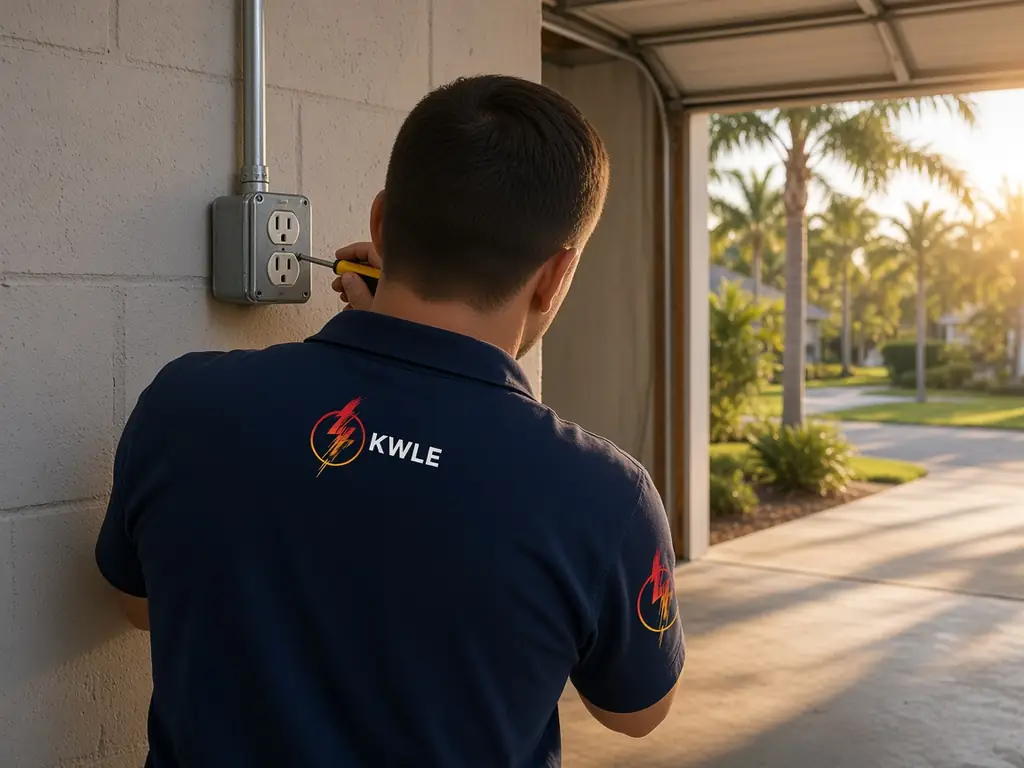
240v outlet installation in Indian Shores: match the outlet to the nameplate
The receptacle, the breaker and the wire have to agree with the motor or appliance you want to run. We copy the amperage and the plug type from the nameplate, then we build that circuit and no other. Typical jobs on this island are an electric dryer in a tight closet, a range in a condo kitchen, a spa heater, a boat-lift motor and a pedestal in a parking bay.
A narrow town with compact mechanical spaces
- Florida electrical contractor license EC13014717, licensed & insured
- Woman-owned business based at 6248 Seminole Blvd, Seminole FL 33772
- 2-year workmanship warranty, 5 years with a Member Care Plan
- SPAN Authorized Installer and Home Depot preferred contractor
- Open 24/7 for electrical emergencies: call or text (727) 476-7079
Indian Shores has only about a third of a square mile of land, with the Gulf to the west and the Intracoastal to the east. Most dwellings are stacked condos, not wide detached houses. The 240-volt work still appears, just in smaller rooms: a laundry niche, a ground-level cage, a lift pedestal by the seawall. A dedicated circuit keeps those loads off the lights and the everyday receptacles.
Receptacle families we install
- Four-pole 14-50 faces: many dryers, some ranges, some portable chargers.
- 14-30 faces: older dryer cords still in use in mid-rise units.
- 6-series faces: private-garage tools and window equipment.
- Hardwired disconnects: lifts, heaters and motors that should not rely on a cord cap.
- In-use covers: any device that sits in a wet or blowing garage.
We begin at the cabinet, not at the wall
The first look is the unit panel or the garage disconnect. Plenty of buildings here went up in the 1970s and 1980s, and the interior may already be packed, or the breaker style may be awkward to match. We read the directory, look for discoloration on the bus and estimate spare capacity. If a new two-pole breaker will not fit honestly, we write the choices down instead of crowding the cabinet.
Routing cable through a finished mid-rise
In a condo the distance can be short, yet the path may cross a rated wall, a finished closet or a wet parking level. We pick a route the association will accept, choose a gauge that covers both current and length, and tag both ends. A lift or a dock pedestal out at the waterline needs a wet-location raceway and a thicker feeder than a closet dryer.
Weather, salt and flood height
This town is entirely in a flood hazard area, and open parking levels catch salt spray. For a receptacle by a lift, a carport or a seawall we specify a corrosion-resistant box, a cover that shuts over the cord and fasteners that survive this air. Ground-fault protection goes in where the rules require it, and we mount the assembly as high as the site allows.
Boards, common walls and written approval
Roughly three quarters of the housing units here are in buildings with ten or more dwellings. A parking-bay receptacle often sits on common property. We send a brief scope, a simple one-line sketch and a parts list so a manager can sign off before anyone drills. Work in a shared garage waits for that signature.
Empty seasonal bays
About half of all units in town are used only part of the year. When the owner is away we arrange access with whoever holds the keys and restore the bay when we finish. An unused space is often the easiest place to pull cable, and the circuit can be ready before the next stay.
On site, in order
A marked truck arrives, we walk the path with you or the manager, and we agree on the face, the breaker and the route. Only the circuits we need go off. We prove voltage, grounding and trip function, show the meter reading and update the directory.
Separate loads, separate breakers
A dryer and a lift on one two-pole breaker will bother you at the worst moment. Give each heavy load its own circuit. In a cramped bay a small branch panel can put a shutoff within a step of the machine.
Reach, labels and late-night use
About two in five year-round residents are 65 or older. We place the receptacle so the cord does not drape over a curb, mark it clearly and, when asked, add a lighted switch at the door so the bay is usable after sunset.
Count the electric heat already on the panel
About 95 percent of occupied homes here heat with electricity. That load is already on many mains in January and on sticky summer afternoons. We include it in the count before we add another 240-volt circuit, so the service is not riding the limit.
Inspection record
A new 240-volt circuit usually needs paperwork. We file it, meet the inspector and close the item so you have a record if the unit sells or an underwriter asks what changed.
A tidy close
In a finished unit we cut cleanly, patch openings and carry scrap out. Covers sit flush, labels are readable, and spare conductors are landed or capped, not left in a loop on the slab.
Details that make the first trip count
Please tell us the appliance or motor and the nameplate amperage, whether the spot is inside a unit, in a shared garage or out by the water, how long the path looks, and whether the wall is finished. We will pack the right enclosure and breaker the first time.
Feeders we will not under-size
A lift motor or a dryer on a thin feeder can warm the cable long before a breaker opens. We measure the run, inspect what is already there and say so if it is light. Upsizing the cable on purpose is better than a warm conduit in a salt-air garage.
Questions we hear in Indian Shores
How do you pick the breaker for a condo 240-volt receptacle? The nameplate and the plug type set the size. We pair the breaker and the conductors with that load.
May a boat lift ride on the dryer breaker? No. Each heavy load deserves its own circuit. We can add a second run or a small branch panel.
Does a garage receptacle need board approval? It often does, when the wall, the meter room or the parking stall is common property. A short scope usually satisfies the manager.
Who files the paperwork? We do, when the work requires it, and we stand by for the inspector.
Can you install this while the unit is closed for the season? Yes, if someone can let us in. Plenty of owners book the gap between stays.
How close is the shop? About 4 miles, in Seminole. Call or text (727) 476-7079 and we will offer the next open window.
Crews roll out from our shop on Seminole Blvd, about 4 miles from town, and work along the Gulf shore, the Tom Stuart Causeway, Gulf Boulevard and the Intracoastal. We also take calls in Indian Rocks Beach, Bay Pines, North Redington Beach, Largo and Redington Shores.
Back to the service: 240V Outlet Installation in the Tampa Bay area. For a full list in this town, visit Indian Shores electrician services.
Nearby towns: Seminole · Bear Creek · Bay Pines · South Highpoint
Call or text (727) 476-7079 for 240v outlet installation in Indian Shores, or book online. Shop hours 7 AM–5 PM, weekend service, 24/7 emergency calls.