
Planning 240V outlet installation in Seminole? Keywest Lights & Electric runs new 240-volt circuits and fits the right receptacle for chargers, dryers, ranges, welders and workshop tools. We are licensed, woman-owned and based on Seminole Blvd, so site visits are short trips for us.
Request 240v outlet installation in Seminole
Tell us what you need and where the work is. A licensed electrician will reply with next steps and a time to visit.
Besides this, we do commercial electrical work, generator hookups, eave lighting and charger circuits around Seminole. Crews here also do commercial generator installation.
Call or text (727) 476-7079 · open 24/7 for emergencies · request a quote online
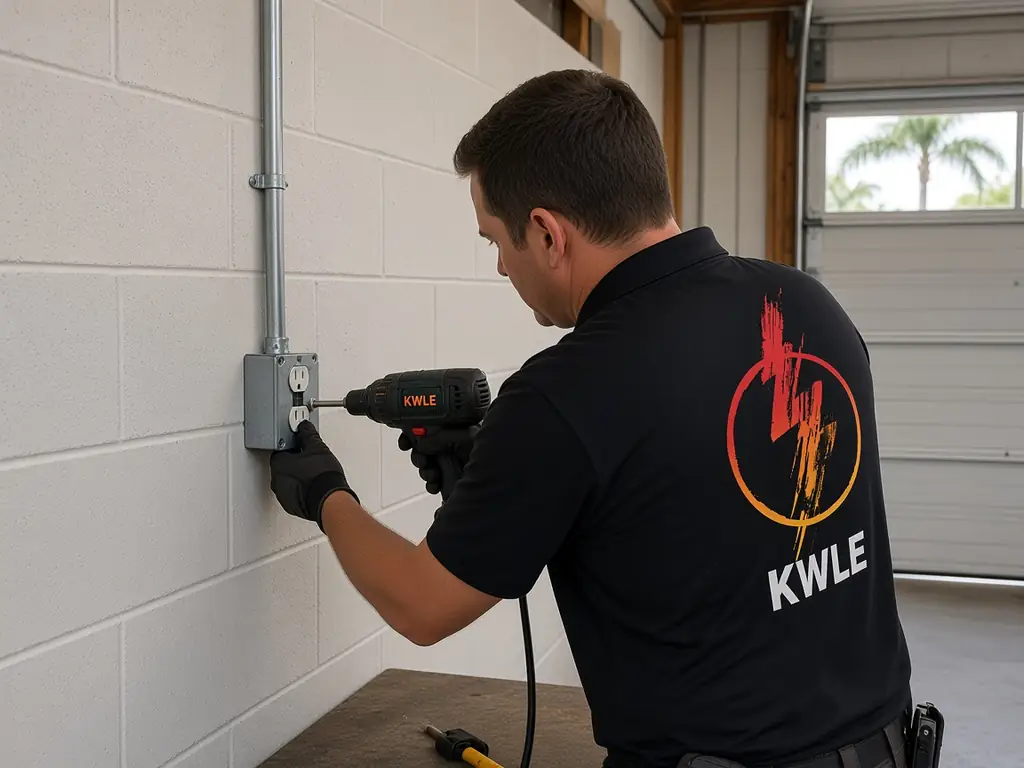
What 240V outlet installation in Seminole involves
A 240-volt outlet is not just a bigger plug. It needs its own two-pole breaker, a wire sized for the load, and a receptacle whose shape matches the device. The shape tells you the amperage and the wiring style, and a wrong match can overheat a cord or a breaker. We start with the appliance label, measure the run from the panel, and check how much room the panel has left.
Receptacles we install most
- 14-50: the common choice for EV chargers, RV hookups and some ranges
- 14-30: a four-wire dryer receptacle in most newer laundry rooms
- 10-30: an older three-wire dryer outlet we often find in 1970s homes
- 6-50: welders, plasma cutters and some air compressors
- 6-20 and 6-30: window air conditioners, table saws and small shop tools
Wire, breaker and panel space
- Florida electrical contractor license EC13014717, licensed & insured
- Woman-owned business based at 6248 Seminole Blvd, Seminole FL 33772
- 2-year workmanship warranty, 5 years with a Member Care Plan
- SPAN Authorized Installer and Home Depot preferred contractor
- Open 24/7 for electrical emergencies: call or text (727) 476-7079
The breaker protects the wire, so the two must agree. A 50-amp circuit typically calls for 6-gauge copper, while a 30-amp circuit uses 10-gauge. Long runs may need heavier wire to keep voltage drop low. If the panel has no open slots, we look at a subpanel, or at a panel upgrade when the main is already crowded. We tell you early, before the work is scheduled, so nothing comes as a surprise on install day.
Seminole garages, lanais and carports
Most requests here come from garages and carports, since that is where chargers, welders and compressors live. Many Seminole homes are single-story block houses from the 1970s, where we can often run conduit along a garage wall and across the attic to the panel. Outdoor and damp locations need a weather-resistant enclosure, and the code calls for ground-fault protection on 240-volt receptacles in garages and outdoors.
Manufactured homes and condos
About 13% of homes in Seminole are manufactured homes. In those, a new 240-volt outlet often means checking the feeder size before adding load. In condos, the work stays inside your unit, and the association may need to approve exterior conduit. We bring a short letter that explains the plan, the wire size and the protection, so a board can approve it quickly.
Matching the cord to the outlet
A common headache is a cord that does not match the wall. Dryer cords come with three or four prongs, and a house with a three-wire outlet needs a change before it can take a four-wire cord safely. We handle that conversion, test the result and label the circuit so the next owner knows what it serves. For welders and compressors, we check the plug type on the tool first.
Planning for the next appliance
Many owners ask for one outlet and end up wanting two. If you may add a charger next year, it costs far less to run conduit once than twice. We can pull a second cable or size the conduit for a future circuit, and we note it on the panel directory. That keeps the garage wall tidy and avoids a second round of drywall patching.
Testing, labels and inspection
We torque every lug to the label value, test voltage leg to leg and leg to neutral, and confirm the ground-fault device trips when tested. Each breaker is labeled at the panel. New circuits are permitted, and we schedule the inspection for you, so the work is on record.
After the install
We walk you through the outlet, show you where the breaker sits and leave the paperwork with you. If a tool or charger arrives later, call and we will confirm that it matches the circuit. Call or text (727) 476-7079 to describe your appliance.
What goes on the truck for a 240-volt job
- Tools: torque screwdriver, clamp meter, voltage tester, fish tape, conduit bender, hole saw set
- Parts: two-pole breaker, copper conductors, PVC or metal conduit, junction box, weatherproof cover, strain-relief connector
- Checks: breaker size against wire gauge, neutral and ground continuity, panel schedule, torque values, ground-fault trip test
- Paperwork: permit application, load calculation, inspection booking, labeled panel directory
Voltage drop, grounding and neighbors on the panel
On long garage runs, voltage sags under load and a charger or welder may fault or run slowly. We calculate the drop and step up the conductor size when the distance calls for it. We also confirm the grounding electrode system and the main bonding jumper, because a clean ground path keeps tools and cars safe. If a neighbor circuit shares the same panel bus, we balance the legs so one side does not carry the entire house.
Common questions
Can I plug an EV charger into a 240V outlet? Yes, on a circuit built for it. A 14-50 receptacle on its own 50-amp breaker works for many chargers. A hardwired charger is another option, and we can explain the difference.
Do I need a permit for a new 240V outlet? Yes, a new circuit needs one. We pull it, make the connection and arrange the inspection.
Can you convert a three-wire dryer outlet to four-wire? Usually. It means running a new cable with a separate ground to the outlet. We confirm the panel setup first, then swap the receptacle and the cord end.
How long does the job take? A short run from a nearby panel often takes a few hours. Longer runs, trenching or panel work take more time, and we give you a clear schedule with the quote.
Will a 240V circuit overload my panel? We run a load check first. If the panel is near its limit, we recommend a subpanel or an upgrade instead of adding risk.
Can you install the outlet outdoors? Yes. We use a weatherproof box, a cover rated for use while a plug is in, and a ground-fault device where the code requires one.
Our trucks leave the shop on Seminole Blvd and work near Bay Pines Boulevard, the Pinellas Trail, Largo Road, Walsingham Road, Tyrone Boulevard. We also serve Redington Shores, Madeira Beach, North Redington Beach, Indian Shores, Bardmoor, Redington Beach, Largo and Gulfport.
Up: 240V Outlet Installation across Tampa Bay · For everything we do locally, see Seminole electrical service.
Nearby: Bay Pines · Madeira Beach · Redington Beach · North Redington Beach
Call or text (727) 476-7079 for 240v outlet installation in Seminole, or book online. Business hours 7 AM–5 PM, weekend service, 24/7 emergency calls.