
In Pinellas County, the air conditioner is the hardest-working appliance in the house. It runs most of the year, often for hours at a stretch, and the electrical parts that feed it sit outside in sun, rain, sprinkler spray and salt air. When something on that electrical side wears out, the AC can quit on the hottest day of the week.
Keywest Lights & Electric handles the electrical side of air conditioning for homes in Seminole, Largo, Clearwater, St. Petersburg, Pinellas Park, Dunedin and the beaches: the breaker, the circuit, the outdoor disconnect and the wiring that runs to the condenser. This guide explains what each part does, the warning signs to watch for, and when it’s time to call an electrician instead of (or along with) your AC company.
Request a quote
Tell us what you need and where you are. A licensed electrician will call or text you back to set a time. For an emergency, call (727) 476-7079, 24/7.
The electrical parts that keep your AC running
Most central air systems in our area have the same basic setup:
- A dedicated breaker in your panel. The outdoor condenser gets its own 240-volt dedicated circuit. It’s usually a two-pole breaker, and it shouldn’t share that circuit with anything else.
- The circuit wiring. Wire runs from the panel to the outside of the house. Its size has to match the breaker and the unit’s requirements.
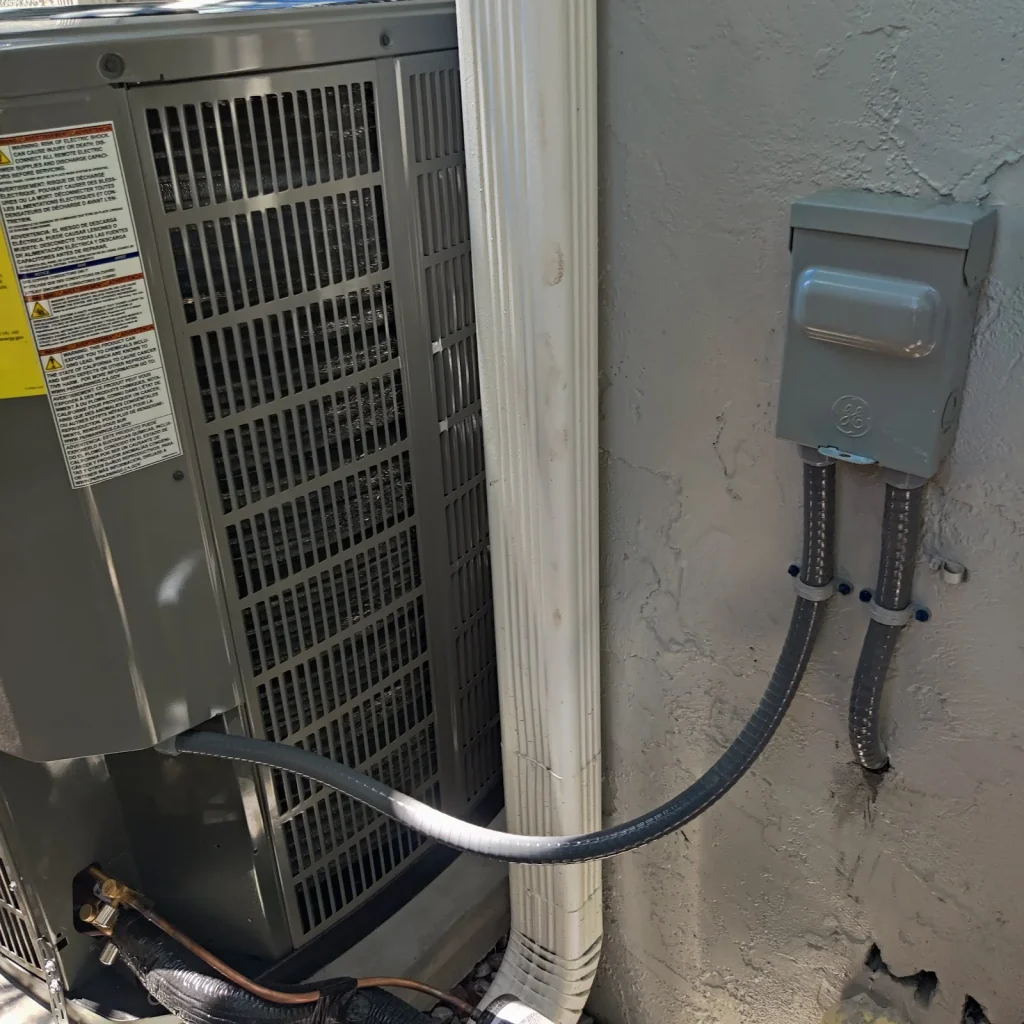
- The outdoor disconnect. This is the gray box mounted on the wall near the condenser. It lets a technician shut off power right at the unit so they can work on it safely.
- The whip. A short run of flexible, weather-rated conduit carries the wires from the disconnect into the condenser.
- The air handler circuit. The indoor unit, in a closet, garage or attic, has its own circuit too, and often electric heat strips that draw a lot of power on cold mornings.
Every air conditioner has a nameplate that lists what it needs, including the minimum circuit size and the largest breaker allowed. The breaker and wire feeding the unit should match those numbers. A breaker that’s too small trips. One that’s too large may not protect the wire the way it should.
Warning signs on the electrical side
Some AC problems are refrigerant or mechanical issues, and those belong to your HVAC company. These signs point to the electrical side:
- The AC breaker trips when the unit starts or after it runs for a while
- A rusted, cracked or swollen disconnect box, or a cover that won’t close
- Burn marks, melted plastic or a hot smell at the disconnect or the panel
- A whip that’s cracked, crushed, pulled loose or chewed where it enters the unit
- Lights dimming hard every time the AC kicks on
- The outdoor unit is dead while the thermostat and indoor fan still work
- Buzzing or humming from the disconnect or the breaker
If you see scorching or smell burning plastic, turn the AC off at the thermostat and call an electrician. Don’t keep resetting a breaker that trips again and again. It’s tripping for a reason.
Why AC disconnects wear out so fast here
Outdoor electrical parts have a hard life in Tampa Bay. Salt air near the Gulf and the bay speeds up corrosion. Sprinklers hit the same wall every day. Sun cracks older plastic covers and conduit. Lawn crews and string trimmers nick whips at ground level.
Inside the disconnect, corrosion on the terminals or the pull-out block creates resistance. Resistance makes heat, and heat makes the connection worse over time. That’s how a disconnect ends up with melted parts even though the AC itself is fine. On older homes, especially near the beaches, it’s common to find disconnects that are rusted through at the bottom.
Replacing a worn disconnect and whip is usually a straightforward job. Waiting until it fails in August is what turns it into an emergency.
Getting a new AC unit? Check the electrical first
When a system gets replaced, the new unit doesn’t always need the same circuit as the old one. Size, efficiency and type all change the electrical requirements. Before a new unit goes in, or right after, it’s worth having an electrician confirm that:
- The breaker and wire match the new unit’s nameplate
- The disconnect is in good shape and rated for the new unit
- The whip and connections are new, tight and weather-rated
- The panel has room, and the home’s service can handle the load (if not, a panel upgrade may come first)
This matters even more if you’re adding a heat pump, upgrading heat strips, or putting in a second system for an addition or a converted garage. We’re glad to work alongside your AC contractor so the electrical side is ready when the new equipment shows up.
Surge protection for your AC
Modern AC systems have circuit boards, and variable-speed systems have even more electronics. A power surge from the utility or a nearby lightning strike can damage them. A whole-house surge protector at the panel helps protect the AC along with the rest of the home’s electronics. It’s an easy add-on when we’re already working on the AC circuit.
What happens on an AC electrical service call
When you call Keywest Lights & Electric about the electrical side of your AC, here’s what to expect:
- We listen first. What’s the AC doing, when did it start, and has the breaker tripped?
- We check the circuit. Breaker, wire size and connections at the panel, compared with the unit’s nameplate.
- We open the disconnect. We look for corrosion, heat damage and loose connections, and test voltage at the unit.
- We inspect the whip and where it enters the condenser.
- We explain what we found in plain language and give you the options before any work starts.
- We make the repair with weather-rated parts. When the work needs a permit, we pull the permit and handle the inspection.
If the problem turns out to be inside the AC unit itself, we’ll tell you so you can call your HVAC company. For breakers that trip on other circuits too, see our guide to electrical troubleshooting in Pinellas, or book an electrical safety checkup for the whole house.
Why homeowners call Keywest Lights & Electric
Keywest Lights & Electric is a licensed, insured, woman-owned electrical contractor serving Pinellas, Pasco, Hillsborough and Manatee counties. Every job comes with a 2-year workmanship warranty, and Member Care Plan members get a 5-year workmanship warranty plus 7% off labor and materials. Financing is available through Acorn Finance, subject to credit approval, and you can check your options without affecting your credit score.
AC breaker tripping, a rusty disconnect, or a new unit on the way? Call (727) 476-7079, reach us through our contact page, or request service online at keywestlights.com. We’ll make sure the electrical side of your air conditioner is safe, sized right and ready for a Florida summer.
About the author: Mark Einstein, Florida licensed electrical contractor, Keywest Lights & Electric.