
When the sun goes down, most Pinellas yards go dark in a hurry. The palms you paid to have planted disappear, the front walk turns into guesswork, and the side of the house where the trash cans live becomes a place nobody wants to walk at night. A good outdoor lighting plan fixes all of that, and it doesn’t have to look like a stadium.
Keywest Lights & Electric now designs and installs outdoor and landscape lighting for homes in Seminole, Largo, Clearwater, St. Petersburg, Pinellas Park, Dunedin and the beach communities. This guide walks through how to plan a system that looks good, holds up to Florida weather and does what you need it to do, whether that’s curb appeal, safer steps or a better-lit back yard.
Request a quote
Tell us what you need and where you are. A licensed electrician will call or text you back to set a time. For an emergency, call (727) 476-7079, 24/7.
Start with what you want the lighting to do
Before anyone talks about fixtures, it helps to decide what each part of the yard needs. Most outdoor lighting falls into three jobs:
- Ambiance: palms and trees lit from below, a soft wash on the front of the house, a glow in the planting beds. This is what makes a home look finished at night.
- Safety: path, step and driveway lights so people can see where they’re walking, plus good light at every door.
- Security: brighter flood lights or motion lights on garages, side yards and back corners, aimed to cover doors and camera views.
Most homes want a mix. Ambiance lighting usually runs on a schedule in the evening, while security lighting is often set up with motion sensors so it stays dim or off until someone walks up. Thinking about it this way up front keeps you from over-lighting the front yard and under-lighting the side gate.
How low-voltage landscape lighting works
Most of the landscape lighting we install is low-voltage LED. A transformer, mounted near a GFCI-protected outdoor outlet, steps household power down to a safer low voltage. Direct-burial cable then runs out to each fixture in the yard.
There are a few real advantages to that setup. The cable doesn’t need to be buried as deep as household wiring, the yard is safer to dig in later, and fixtures can be moved when a palm grows or a bed gets replanted. LED fixtures also use far less power than the old halogen landscape lights many homes still have.
Common fixture types include:
- Palm and tree uplights at the base of the trunk, aimed so the fronds glow without shining into a neighbor’s window
- Path, step and driveway lights spaced so walkways read clearly at night without a runway effect
- Wash and grazing lights that bring out stucco, stone, columns and texture on the front of the house
- Bed and accent lights for hedges, crotons, sculptures and water features
- Dock and seawall lights for waterfront lots, on properly protected circuits
We split the system into zones on the transformer so the front, the back and the pool area can run on different schedules, and we size each cable run so the last fixture on the line is as bright as the first.
Lights on the house: soffits, coach lights and the entry
Not everything outdoors is landscape lighting. Some of the most useful lights are mounted on the house itself and run on regular household wiring.
Soffit downlights are small wet-rated recessed lights in the eaves. They wash the walls and light the ground around the house, and they nearly disappear during the day. On a Florida ranch or block home, they’re one of the cleanest ways to light the whole front.
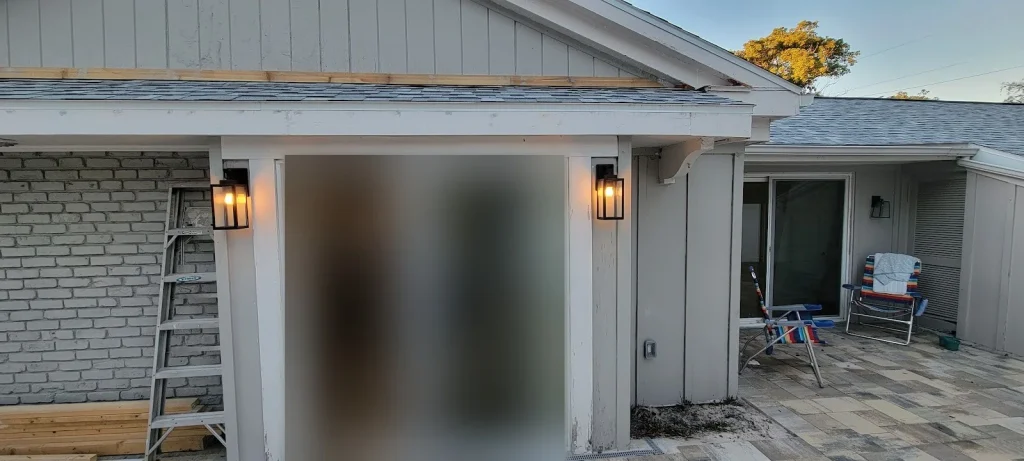
Coach lights and porch lights frame the doors and make the entry feel welcoming. The photo with this article is a good example: a pair of lantern-style coach lights we installed beside a new patio slider, so the doorway is lit and the step onto the pavers is easy to see after dark.
If you’re after color, holiday scenes and app control along the roofline, that’s a different product. Our permanent roofline lighting service pairs well with soffit downlights and a landscape system.
Pool cages and lanais
For a lot of Pinellas families, the screened pool cage or lanai is where evenings happen, and the original lighting is often one fixture by the back door. Adding lights mounted on the enclosure frame, wet-rated lanai fixtures or a ceiling fan with a light can make the space usable well after sunset. Lighting and outlets near a pool have their own code rules for distance and GFCI protection, so we lay those out before the first hole is drilled.
Avoiding glare (and keeping the neighbors happy)
The difference between lighting that looks professional and lighting that looks like a parking lot is mostly aim and brightness. A few rules of thumb:
- Light the object, not the eyes. Uplights should hit the trunk and canopy, not shine across the street or into a window.
- Use shielded fixtures and lower output where the yard faces a neighbor’s house.
- Go softer than you think. A few well-placed lights usually look better than many bright ones.
- Aim after dark. We set fixtures during the day, then come back at dusk with you to adjust each one.
Built for salt air, sprinklers and summer storms
Pinellas yards are rough on outdoor electrical parts. Sprinklers soak fixtures every week, salt air near the Gulf and the bay corrodes painted metal, and summer lightning sends surges through anything connected to the house. When a landscape system goes dark, the cause is often a corroded splice or a connection that let water in.
That’s why we choose fixtures made for wet, coastal locations, seal every connection with waterproof connectors, keep transformers up off the ground and aim sprinkler heads away from fixtures where we can. Whole-house surge protection is also worth considering, since it helps protect LED drivers and transformers.
When you need a new outlet or circuit
A plug-in transformer needs a GFCI-protected outdoor outlet with a weatherproof in-use cover. If there isn’t one where the transformer should go, we add it. A bigger system, line-voltage flood lights, soffit downlights or dock lighting may need a new circuit from the panel. New outlets, circuits and line-voltage fixtures generally need an electrical permit, and we pull the permit and handle the inspection. As a licensed electrical contractor (EC13014717), we do the electrical work behind the lights, not just the fixtures. See our outlets, GFCI and dedicated circuits service for more on that side of the job.
Timers, photocells and smart control
Nobody wants to reset an outdoor timer after every time change. Your options include:
- Dusk-to-dawn photocells that turn lights on when it gets dark
- Astronomical timers that follow sunset through the year automatically
- Zone schedules on the transformer, for example front yard until midnight and pool area until 10 PM
- Motion sensors that bring security lights to full brightness only when someone walks up
- Smart switches that put outdoor lights in the same app as your thermostat or cameras
What an outdoor lighting visit looks like
- Call or request service and tell us what you’d like lit.
- We walk the property with you, mark fixture and transformer locations, and check the outlet or panel that will power the system.
- You get a written estimate with the fixtures and any electrical work listed separately.
- On install day, cable is buried, fixtures are set, outlets or circuits are added where needed, and every zone is tested.
- After dark, we aim the lights with you and set the timers, photocell or app schedule.
Our installation work carries a 2-year workmanship warranty, or 5 years for Member Care Plan members, who also get 7% off labor and materials.
Outdoor lighting FAQ
Can you fix or add on to the landscape lights I already have?
Usually. Dark sections are often a corroded connection, a cut cable or a failed transformer timer. We trace the run, repair what we can and tell you when an old system is worth replacing instead of patching.
Do you work on homes outside Seminole?
Yes. We’re based in Seminole and work across Pinellas County, including Largo, Clearwater, St. Petersburg, Pinellas Park, Dunedin and the beaches, plus planned projects in Pasco, Hillsborough and Manatee counties.
Ready to light up your yard?
Keywest Lights & Electric is a licensed, insured, woman-owned electrical contractor based in Seminole. Call (727) 476-7079 or request service online at keywestlights.com, and we’ll set up a time to walk the property with you. You can also learn more on our outdoor and landscape lighting page or reach us through our contact page.
About the author: Mark Einstein, Florida licensed electrical contractor, Keywest Lights & Electric.