
Looking for recessed lighting installation in Greenbriar? Recessed lighting installation in Greenbriar means housings, remodel cans, thin wafers, and trims in a finished ranch ceiling. Attics here are often shallow and already packed with insulation, so the housing has to be listed for that space. We mark the layout with you, we cut with a template, and we match the dimmer to the new lamps so a kitchen or a living room does not flicker.
Request recessed lighting installation in Greenbriar
Tell us what you need and where the work is. A licensed electrician will reply with next steps and a time to visit.
Our Greenbriar pages also cover commercial electrician, commercial generator installation, EV charging circuits, generator interlock transfer switch, JellyFish eave lighting, a new breaker panel, permanent lighting, a battery backup system, solar wiring support, generator installation, 240v outlet installation, aluminum wiring repair, apartment multifamily electrical and appliance wiring hookup.
Call or text (727) 476-7079 · open 24/7 for emergencies · request a quote online
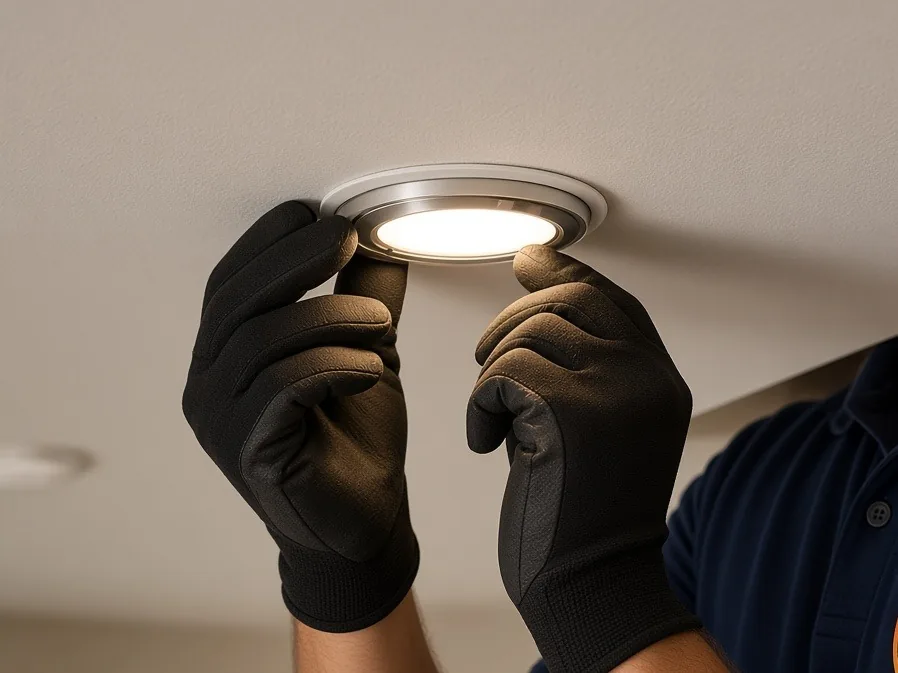
Recessed lighting installation in Greenbriar means housings that fit a shallow ranch attic
A commercial grid ceiling is not the condition here. A 1960s or 1970s ranch often has a low attic, a popcorn texture, or both. When the attic is closed we use a remodel can or a thin wafer. When we can get into the attic we set an airtight, insulation-contact housing. A surface fixture belongs on the lighting-installation page. Exterior eave work belongs on the permanent-lighting page, or on the existing JellyFish page when that is the product you want.
Room layouts we mark before any cut
A kitchen grid that follows new cabinets. A living-room square. A hallway run. A few wafers in a finished bedroom. We mark the ceiling with you first. A joist that sits where a can was wanted is called out, and the layout is shifted. We do not notch a joist in a way it cannot take.
Closed-ceiling cans, attic-set housings, and thin wafers
- Florida electrical contractor license EC13014717, licensed & insured
- Woman-owned business based at 6248 Seminole Blvd, Seminole FL 33772
- 2-year workmanship warranty, 5 years with a Member Care Plan
- SPAN Authorized Installer and Home Depot preferred contractor
- Open 24/7 for electrical emergencies: call or text (727) 476-7079
A remodel can clamps to the drywall when the attic stays closed. A new housing is set from the attic when we have access, with a listed airtight box and a trim that fits the ceiling thickness. A thin wafer is used when the depth is too shallow for a can, and its driver is tucked in a joist bay where a later swap is still possible.
Texture, popcorn, and a clean opening
A popcorn or a textured ceiling shows a ragged hole if the template is rushed. We score the texture, we cut clean, and we say so if a later touch-up should be done by a finisher. We do not smear compound over a proud trim and call it done.
Branch capacity and the dimmer
A kitchen that already carries a heavy lighting load may need a new switch leg or a new branch. We measure the existing circuit and say so if it cannot take six more lamps. The dimmer is matched to the wafer or the can lamp. If the existing dimmer will not see the new load, we change it or we tell you before we cut.
The ceiling file we leave behind
The layout, the housing type, and the dimmer model go into the ceiling file. A new can, a new wafer, or a new dimmer is listed by room. A later owner can see which housings are airtight before opening the attic.
After the rings are seated
We test every new opening and the dimmer range once the rings are seated. A new opening that fails after the first evening should be reported at (727) 476-7079, with the room named. Installation labor is two years, or five with Member Care.
Photos that help a layout
A picture of the room and the ceiling, the street, and a rough count of openings you want. Note whether the attic is reachable. Say if a dimmer is already in the room.
A sloped-ceiling or a shallow insulation-contact housing is chosen when the roof deck sits close to the finish. A flangeless or trimless ring is used only when the ceiling can be finished to that ring. A popcorn ceiling usually wants a modest flange. A fire-rated housing is used when the listing and the ceiling assembly require it, not as a default in every ranch hall.
An LED wafer with a remote driver is labeled at the driver so a later fail is not a hunt through the attic. A can with a thermal trip is given clearance from packed insulation if the listing requires it. A spare trim of the chosen finish stays in the van so a scratched ring does not delay the handoff. A trailing-edge dimmer is chosen when the wafer listing asks for one. A leading-edge dimmer that will not see the new load is replaced, not left to flicker.
A baffle or a reflector trim is chosen to match the room, not as a leftover from the truck. A wet-rated housing is used in a bath or a covered porch when the listing requires it. An old incandescent can with a rusted housing is pulled and replaced; we do not drop a retrofit trim into a can that has already overheated.
A hanger-bar or a C-channel is used to set a new housing between joists when we have attic access. The aperture and the baffle or specular reflector are chosen to match the room, including a black baffle in a media room when that is what you want.
A gimbal or an adjustable eyeball is used where a wall or a piece of art needs to be aimed, not as a default in a flat kitchen grid. An oversize goof-ring is used only to cover a slightly large cut, not to hide a ragged hole. A truss heel or a shallow joist bay is measured before a deep can is promised. A vapor-barrier penetration, when we have to make one, is sealed as the housing listing allows.
A plaster-frame or a new-construction pan is used only when the ceiling is open; we do not open a finished ranch ceiling just to set a pan. A slot-aperture or a pinhole trim is a special order, and we say so before the layout is marked. A haze or a white baffle is the usual living-room choice; a specular ring is used when you want more punch over a worktop. Insulation baffles, when a can needs clearance, are set so the thermal trip can still work. An old thermal cutoff that has already opened is a reason to replace the housing, not to keep resetting it.
A ceiling medallion is not used to hide a bad cut. When a can would spit light up the slope, a listed sloped wafer is used instead. An IC-AT or similar airtight mark is checked on the housing stamp before it goes into an insulated bay. A driver lead is stapled loosely so it is not pinched under a joist. A trim spring that has lost its tension is replaced, not bent back into a weak hook.
Common questions
What if we cannot get into the attic? We use remodel cans or thin wafers. We tell you which option fits the depth we find.
Can a housing stay and just get a new ring and lamp? Yes, when the housing is sound. A rusted or a non-airtight housing is replaced instead.
What if the current dimmer flickers with the new lamps? We test that. If the dimmer will not see the new lamps, we change it or we tell you before we cut.
What photos help before a layout? A photo of the room, a rough count of openings, and a note on whether the attic is reachable.
How do we pick a time? Send the room photo on the contact form, or telephone (727) 476-7079. Mention the rooms and the count.
The drive from our shop at 6248 Seminole Blvd is about 13 miles. In Greenbriar we work along the Safety Harbor side, the Dunedin side and the Clearwater edge of the community. From here we also reach Dunedin, Safety Harbor, Clearwater, Oldsmar and Palm Harbor.
Up: Recessed Lighting Installation across Tampa Bay · For everything we do locally, see Clearwater electrical service.
Nearby: Tierra Verde · South Highpoint · Bear Creek · Indian Shores
Call or text (727) 476-7079 for recessed lighting installation in Greenbriar, or book online. Business hours 7 AM–5 PM, weekend service, 24/7 emergency calls.