
Ready to stop worrying about the next outage in Greenbriar? Keywest Lights & Electric provides generator installation in Greenbriar for single-family homes and businesses of every size. We are about 13 miles from our Seminole shop. Options run from a code-approved inlet for your portable to a fully automatic standby unit, and up to commercial machines rated 150 kW, 250 kW or more. Florida license EC13014717.
Request a generator quote in Greenbriar
Tell us about the property and what you want to keep running. We reply with next steps and a time for the site visit.
Call or text (727) 476-7079 · open 24/7 for emergencies · request a quote online
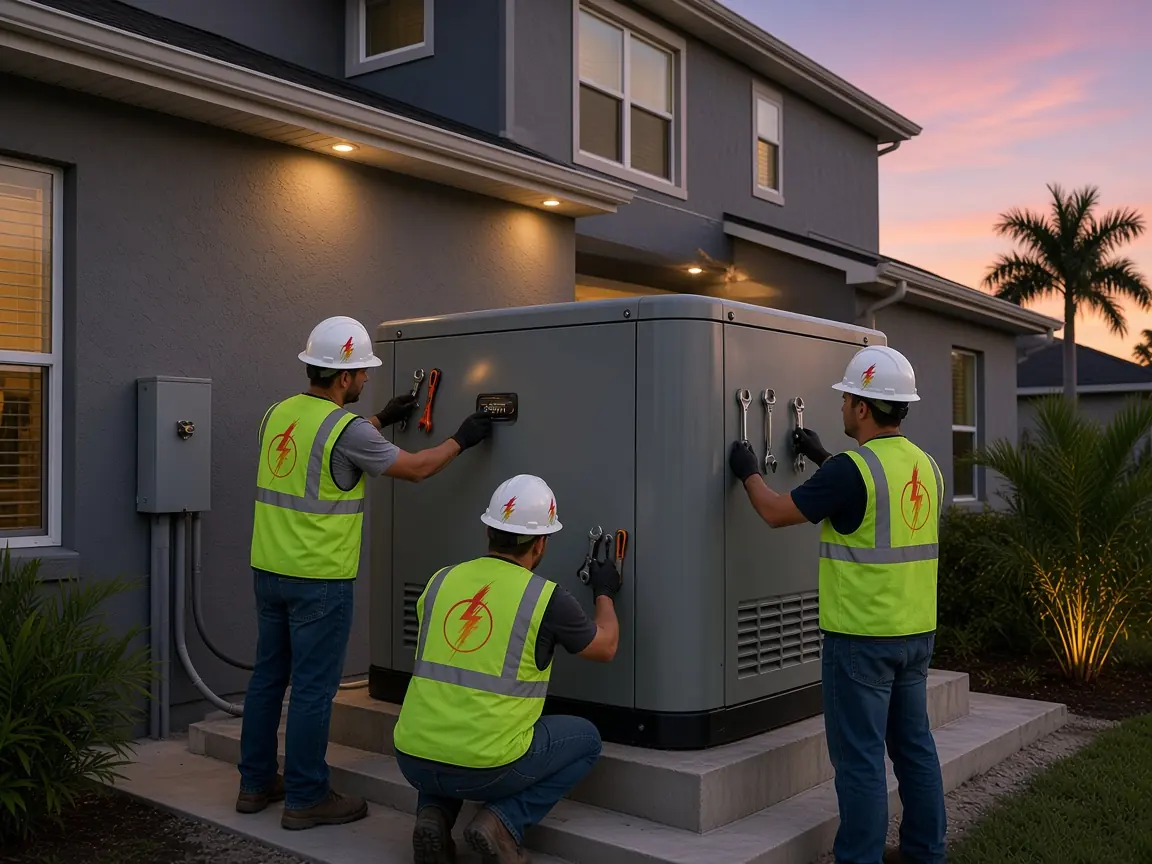
Generator installation in Greenbriar starts at the panel
Greenbriar is a neighborhood of houses. Census figures show about 91 percent of homes are single-family detached, and the median year built is 1973. Roughly 77 percent went up before 1980. That tells us a lot before we arrive. Many of these homes still have original or early replacement panels, often 100 or 150 amps, with tandem breakers squeezed into every slot. A generator ties into that panel. If the panel is worn, the generator inherits its problems. So we start every visit by opening the cover, checking the bus, testing grounding and measuring the service.
Three ways to back up a detached house
Detached homes on their own lots give us room to choose. Here is how the options compare.
| Setup | How it starts | What it powers | Good fit when |
|---|---|---|---|
| Portable plus inlet and interlock kit. | You roll it out and start it. | Chosen circuits | You own a portable and want low effort to set up. |
| Partial-home standby | Starts by itself in seconds. | An essentials subpanel. | You want automation for key rooms. |
| Whole-home standby with SPAN. | Starts by itself in seconds. | The house, with loads managed in turns. | You want comfort without lifting a finger. |
- Florida electrical contractor license EC13014717, licensed & insured
- Woman-owned business based at 6248 Seminole Blvd, Seminole FL 33772
- 2-year workmanship warranty, 5 years with a Member Care Plan
- SPAN Authorized Installer and Home Depot preferred contractor
- Open 24/7 for electrical emergencies: call or text (727) 476-7079
- Projects up to $2 million, with bonding up to $1 million
The inlet route
A weatherproof inlet mounts on an outside wall. A listed sliding plate on the breaker panel keeps the main breaker and the generator breaker from ever being on together. That protects line crews and your equipment. The cord runs from the portable to the inlet, not through a window. It is the simplest path to legal backup and a solid first step.
The standby route
A standby generator sits on a pad outside and connects to an automatic transfer switch. When the grid fails, the unit starts, the switch moves your home over and power returns in seconds. When the grid comes back, it switches back and shuts down after a cool-down. You do not need to be home. Weekly self-tests keep it ready.
SPAN makes a mid-size unit work harder
A SPAN smart panel can serve as the new main panel. During an outage, it watches generator load and turns heavy circuits on and off in turns. The water heater waits while the AC starts. The dryer waits while the range runs. That lets a smaller standby unit carry more of the house without overloading. You can also change priorities from your phone.
Natural gas or propane
Standby units run on natural gas or propane. Not every road has a gas main. A propane tank has to sit set back from doors, windows and property lines. We coordinate with fuel providers and handle the electrical side so the project lands as one plan.
Businesses and larger buildings
Offices, medical practices, restaurants, churches and light industrial buildings all lose money when the power fails. We design commercial generator systems sized from real load data, with automatic transfer switches, distribution and controls. We handle anything from a modest office unit to 150 kW, 250 kW and bigger plants. Bid documents can go to proposals@keywestlights.com.
Permits and inspections
Every generator, inlet and transfer switch in Pinellas needs an electrical permit, and the fuel side is approved separately. We draw the plans, file everything, coordinate fuel installers and meet inspectors. You get copies of each approval.
Our process
- Call or text (727) 476-7079.
- Site visit and panel inspection.
- Load list and fuel review.
- Written proposal with options.
- Permits filed
- Installation and fuel hookup.
- Inspection, live transfer test and owner training.
Above the code minimum
Code is the floor, not the goal. We use larger conductors where heat or distance call for it, torque-mark every lug, add whole-home surge protection and label each disconnect so anyone can find it in the dark.
Other services in Greenbriar
We also offer panel replacement, whole-house surge protection, transfer switch and interlock work and our round-the-clock emergency electrician. For silent backup, see Greenbriar battery backup. For the electrical side of a solar array, see Greenbriar solar installation.
Nearby cities
We also install generators in Clearwater, Dunedin and Safety Harbor.
Running a portable the safe way
Park the portable 20 feet or more from the house, with the exhaust aimed away from doors, windows and vents. Plug into the inlet. Open the main, move the plate over, close the backfeed breaker, pull the starter and add circuits one at a time, heaviest last. When utility power returns, reverse the order. We leave a printed card in the panel door that lists each step.
Carbon monoxide kills quietly
Never run a generator in a garage, carport or screened porch, even with the door open. CO has no smell or color. Put battery CO alarms near every sleeping area. Never backfeed through a dryer outlet; that can send dangerous voltage onto the lines where crews are working.
Weekly exercise and alerts
Standby units run a short self-test each week, usually for a few minutes at a set time. Most models report status to a phone app, so you know if the battery is weak or a fault appears.
Service keeps it ready
An engine that sits without care may not start on the night you need it. Oil, filters, spark plugs, coolant on liquid-cooled units and the starting battery all need regular attention. Members of our care plan get a spring tune-up with a loaded run, and their two-year workmanship warranty becomes five.
Upgrading a 100 amp service
Many 1970s homes still run on 100 amps. A generator job is the right moment to step up to 200 amps. One project can cover the panel, the service and the transfer equipment, and the larger service leaves room for an EV charger or a heat pump later.
Pad placement on a detached lot
Single-family lots give room, but rules still apply. The unit needs clearance from openings, property lines and the gas meter. Pads sit slightly higher than the surrounding soil to shed water, and keep it where service techs can reach it. Placement facing away from bedrooms keeps weekly tests from waking anyone.
Seasonal owners
About 9 percent of homes here are seasonal. A standby unit protects an empty house: the fridge stays cold, the dehumidifier runs and the alarm stays powered. Remote alerts tell you the unit ran and when the grid came back.
Medical needs come first
If someone at home uses oxygen, CPAP or refrigerated medicine, those circuits get top priority. For those families, a unit that starts on its own is often the right answer.
Questions to have ready
- What rooms would you cool first?
- Is anyone on oxygen or CPAP?
- What portable, if any, is in the shed?
- Is there a gas meter on the house now?
- Any remodel, car charger or new panel coming?
Commercial testing and handover
Before a commercial system goes into service, we test it under load. Resistive load banks hold the engine at set output while we log voltage and hertz. We time the transfer, trip each alarm and hand over a signed sheet of readings.
Staging big motors
Compressors, chillers and pumps draw a heavy surge when they start. If they all start together, a generator can stall. We use transfer controls to bring the largest motors on in sequence, with life safety, security and IT circuits first.
Greenbriar generator questions
Do you install generators in Greenbriar? Yes. Portable hookups, automatic home units and large business systems are all available there.
How far is your shop from Greenbriar? Our Seminole Blvd shop is about 13 miles away.
Does a generator need a permit? Yes. Our office pulls it, lines up the gas or propane sign-off and meets the inspector.
Should I start with an inlet or a standby unit? An inlet with an interlock is the simplest legal setup. A standby unit adds automatic starts and transfer.
How is the generator sized? We add up the appliances you want running. Load control through SPAN lets a smaller engine stretch further.
Can a standby unit run my whole house? It can, if it is sized for it. SPAN can help a smaller unit cover more by managing heavy loads.
Do you service generators after installation? Yes, through yearly care-plan visits that include a loaded run.
Related: generator installation across Tampa Bay · SPAN smart panel installation · solar electrical work in Greenbriar · battery backup in Greenbriar · Pinellas County service area. Nearby: generators in Clearwater · generators in Dunedin · generators in Safety Harbor.