
Need 240V Outlet Installation in Greenbriar? 240v outlet installation in Greenbriar is a listed 240-volt receptacle for one load, usually a dryer, a range, or a garage tool, landed on its own breaker in an older detached house. It is not a service change and it is not a charger circuit, though those conversations can follow if the can is already tight.
Request 240v outlet installation in Greenbriar
Tell us what you need and where the work is. A licensed electrician will reply with next steps and a time to visit.
From the same shop we also handle EV charger installation, permanent Christmas lights, panel replacement, a battery backup system, solar wiring support, generator installation and aluminum wiring repair for Greenbriar homes. Homeowners here also book commercial electrician and commercial generator installation.
Call or text (727) 476-7079 · open 24/7 for emergencies · request a quote online
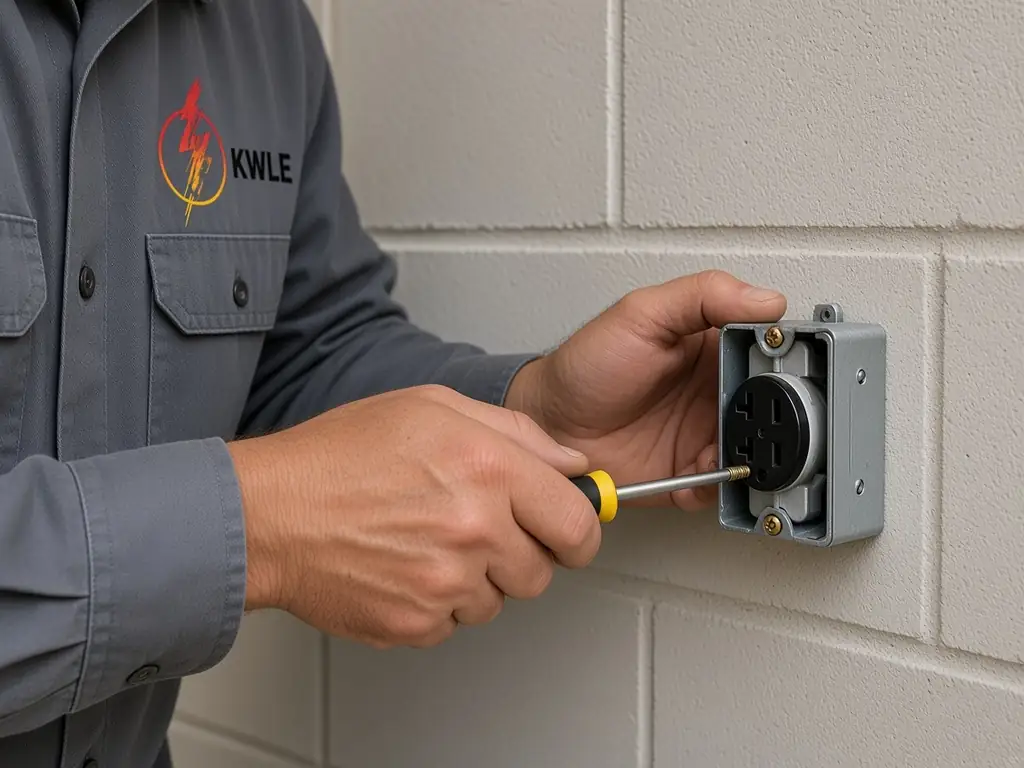
240v outlet installation in Greenbriar is a listed 240-volt point for one load, not a service change
A new 240-volt point here is usually a short run in a 1960s or 1970s house: a dryer in the garage or the laundry alcove, a range in the kitchen, or a welder receptacle in the garage. We copy the nameplate and the NEMA configuration. We will not land a 14-50 receptacle on a 30-amp breaker, and we will not reuse a three-prong dryer outlet when the listing and the code path for that job call for a four-wire point.
Nameplate, breaker and the path through an older wall
The opening check is the nameplate and the existing can. A 30-amp dryer, a 40-amp range, and a 50-amp garage point are not interchangeable. We pick the breaker, the conductor, and the receptacle from that nameplate. In a house with electric heat, spare spaces and spare capacity both matter. A tight can may mean the 240-volt point has to wait on a panel conversation. We will say that before we cut a wall.
Laundry alcoves, garages and a small inland lot
- Florida electrical contractor license EC13014717, licensed & insured
- Woman-owned business based at 6248 Seminole Blvd, Seminole FL 33772
- 2-year workmanship warranty, 5 years with a Member Care Plan
- SPAN Authorized Installer and Home Depot preferred contractor
- Open 24/7 for electrical emergencies: call or text (727) 476-7079
Most of these houses are detached, on small inland lots, with the laundry in a garage or a short hall. A run along the Clearwater edge of the community is still a house run, not a commercial bay. We keep the path as short and as clean as the framing allows. A weather-tight cover is used when the receptacle sits on an outside wall. An indoor laundry point stays in a dry, listed box.
How the 240-volt file is kept
A new 240-volt run is logged in a circuit folder as new work. You receive the breaker number, the receptacle type, and the nameplate we copied. Put the house number on the sheet, not a carton city. Swapping only the receptacle on an already-correct circuit is a short device stop.
When the new receptacle is first used
We energize the new point only after polarity and the landings check out. If the new breaker trips when the appliance is first turned on, reach the shop at (727) 476-7079 and name the appliance. We come back to that run. Coverage on our workmanship is two years; joining Member Care makes that five years.
What to include in a 240-volt request
The street, the load (dryer, range, or garage tool), and a photo of the nameplate if you have it. A snapshot of the existing panel helps when the cover can stay on. Tell us if you are replacing a three-prong outlet or starting a new point. Do not remove a live cover for a picture.
Parts we pack for a single 240-volt point
Listed 240-volt receptacles, the matching breakers, and the cable for a short house run are packed at the shop. A spare lug kit comes along.
A 14-30, a 14-50, and a 6-50 are different devices. We bring the one the nameplate calls for, not a “universal” outlet we invent. A range cord and a dryer cord are the owner’s or the appliance shop’s unless you have already asked us to supply one.
A garage point on an outside wall gets a weather-tight cover and a listed box. An indoor alcove point does not need that cover, and we will not add one just to use a part.
Compressors, four-wire dryer points and a short laundry alcove
Welder plugs, spa disconnects and a three-prong leftover
A welder receptacle in the garage, if that is the load, is a different NEMA device than a dryer point and is quoted from that nameplate. A spa disconnect is a different visit and a different listing; we will not treat a spa as a dryer outlet. When an old three-prong dryer point is being replaced, we pull a four-wire run if that is what the job requires, and we retire the ungrounded slot instead of leaving both in the laundry wall. The retired box is covered and noted in the circuit folder.
A 240-volt run may use 8 AWG or 6 AWG NM-B, a wet-location box, a WR-rated device, an in-use cover, or a cable clamp, depending on the wall and the nameplate. We pack the path we measured, not a generic kit.
Locknuts and anti-short bushings are used where a connector enters a metal box. A cable staple is placed only where the framing gives a fair path. We do not hide extra loops in an insulated attic just to stash slack.
An old-work box or a pancake box is used only when the wall will not take a new-work can. A fish tape and glow rods help a short hidden path. We do not saw a finished floor to hide a 240-volt run that can travel through the garage.
A twist-lock, if the load calls for one, is a listed receptacle, not a homemade adapter. A surface raceway is used only on a finished wall that cannot be opened fairly. We do not use an extension cord as a permanent 240-volt feed.
A weather-in-use cover is used outdoors. Indoors, a listed thermoplastic or nylon face is chosen for the room, not a metal plate on a damp wall. We leave a short service loop in the box, not a coil in the wall cavity.
On a lanai wall that stays damp, a liquidtight whip is used, not a dry indoor sleeve. A bakelite or porcelain body is not reused outdoors. A sawhorse and a canvas runner protect terrazzo or quarry tile while a box opening is cut. Greenfield is only a short protected run, not a substitute for a full raceway. A mudroom or pantry cut is checked against beadboard or shiplap so the face can be patched fairly.
A garage compressor point is sized from its nameplate, just like a dryer, but the receptacle and the cover may differ if the wall is unfinished. A laundry alcove in these houses is often tight, so the new four-wire dryer point has to clear the appliance and the shutoff. We mock that clearance before we cut the opening. A range point in the kitchen is a different walk-through and is quoted from that nameplate, not from the dryer card.
Other pages a 240-volt job may lead to
A charger circuit, a panel upgrade, and an appliance hookup that also needs a gas or water step each live on other pages. If the can cannot carry this 240-volt point, we will pause the run and review a can change first.
Common questions
Can you put a dryer and a range on one 240-volt receptacle? No. Each listed load gets its own circuit sized from its nameplate.
Will you leave a three-prong dryer outlet in place? Only when that is still the correct, listed setup for that existing circuit. A new run is landed as a four-wire point when that is what the job requires.
Is this the same as a car-charger circuit? No. A charger has its own page and its own listing. This page is a dryer, a range, or a garage tool point.
What should we send with a 240-volt request? The street, the load, and a nameplate photo if you have one. A panel snapshot helps. Note whether this is a new point or a replacement.
Who keeps the circuit notes? Our shop holds the circuit folder and sends you the breaker number and the receptacle type. A new 240-volt run is logged as new work.
How do we get the 240-volt visit on the calendar? Book from the form on this page, or text the shop at (727) 476-7079. Name the load (dryer, range, or garage tool) so we can pack the right receptacle.
The drive from our shop at 6248 Seminole Blvd is about 13 miles. In Greenbriar we work along the Safety Harbor side, the Dunedin side and the Clearwater edge of the community. From here we also reach Dunedin, Palm Harbor, Oldsmar, Clearwater and Safety Harbor.
Up: 240V Outlet Installation across Tampa Bay · For everything we do locally, see Clearwater electrical service.
Nearby: Tierra Verde · South Highpoint · Bear Creek · Indian Shores
Call or text (727) 476-7079 for 240v outlet installation in Greenbriar, or book online. Business hours 7 AM–5 PM, weekend service, 24/7 emergency calls.