
Ready for ceiling fan installation in Seminole? Keywest Lights & Electric hangs and wires ceiling fans in Seminole homes, from bedroom units to lanai fans built for damp air. We are licensed and woman-owned, and our shop is on Seminole Blvd. We use fan-rated boxes so your fan stays put.
Request ceiling fan installation in Seminole
Tell us what you need and where the work is. A licensed electrician will reply with next steps and a time to visit.
If you are planning more work, see our Seminole pages for EV charging, generators, commercial service and JellyFish lighting. We also handle commercial generator installation.
Call or text (727) 476-7079 · open 24/7 for emergencies · request a quote online
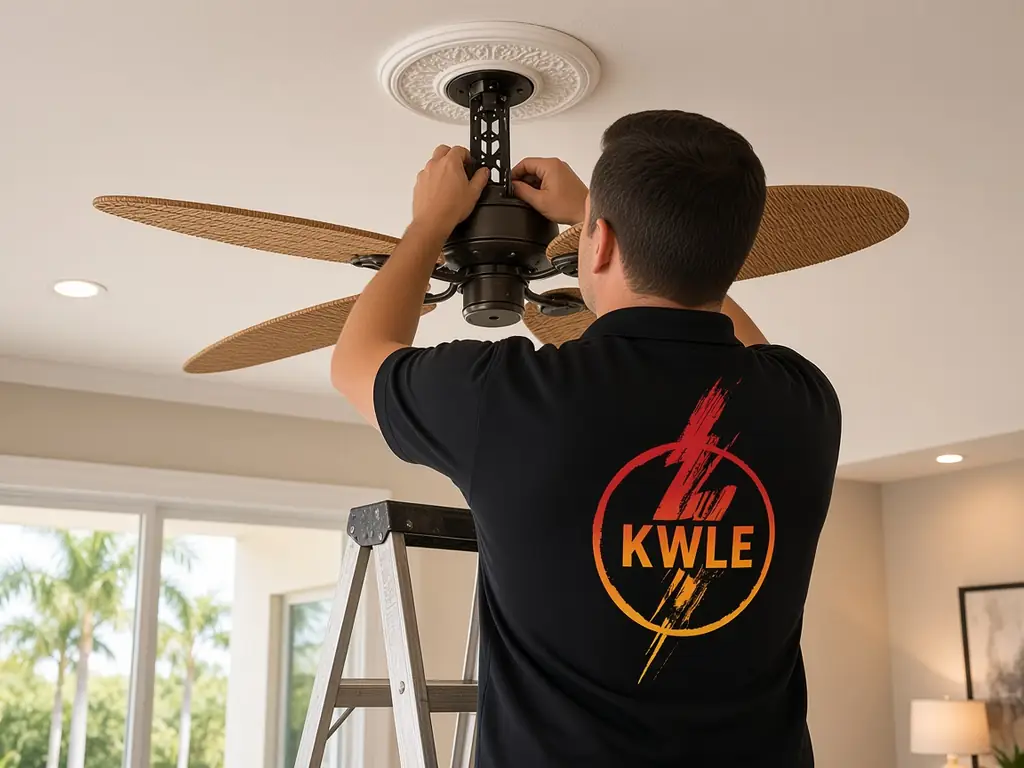
Ceiling fan installation in Seminole: the box matters most
A fan weighs more than a light and it moves. A standard light box can crack under the load and drop the fan. We install a box marked for fan support, or a brace that spans the joists, so a fan runs smoothly for years. If you have an existing fan in a plain box, we swap the box first.
What we handle
- New fan, new wiring: a switch loop, a box and cable run through the attic
- Fan replacement: the same location, a new fan, a better box
- Lanai and porch fans: damp- or wet-rated models and weather-safe wiring
- Vaulted and tall ceilings: downrods, sloped-ceiling adapters and longer cables
- Controls: wall switches, remote kits, dimmers for the fan light kit
Wiring choices
- Florida electrical contractor license EC13014717, licensed & insured
- Woman-owned business based at 6248 Seminole Blvd, Seminole FL 33772
- 2-year workmanship warranty, 5 years with a Member Care Plan
- SPAN Authorized Installer and Home Depot preferred contractor
- Open 24/7 for electrical emergencies: call or text (727) 476-7079
Many fans share a switch for fan and light. If your wall has a three-wire cable, we can control them separately. If it has two, we add a remote receiver or use a combined control. We never fit a standard dimmer to a fan motor, because it may hum or burn out. A fan-rated speed control is made for the job.
Mounting height and clearance
A fan blade should be at least seven feet above the floor, and a common rule is eight, with about 18 inches of clearance from the wall. In low ceilings, a flush-mount, sometimes called a hugger, saves headroom. In tall rooms, a longer downrod brings the fan into a useful range. We measure before we order.
Seminole rooms that benefit
Many 1970s homes here have a single overhead light in bedrooms and a lanai that bakes by afternoon. A fan moves air, and a lanai fan can make a screened porch usable most of the day. Bedrooms with a fan can raise the thermostat setting a few degrees. We often add fans to living rooms where the air handler struggles in summer.
Balance, noise and wobble
A wobbling fan is almost always a mounting or blade issue, not a motor fault. We tighten the bracket, use the balancing kit and check blade weights. A humming fan may have an incompatible dimmer. We solve both.
Smart and remote options
Remote kits, app-controlled receivers and wall controls with speed and light dimming are all common now. Choose the one you will actually use. We confirm that the receiver fits in the canopy and that the wiring supports it.
Permit and warranty
Fan swaps rarely need a permit, though new wiring may. We handle it if needed. Call or text (727) 476-7079 to schedule.
Light kits, bulbs and glare
A fan light kit may use LED modules, standard bulbs or integrated fixtures. LED modules last longer in a fan, since vibration kills filaments. We check that the light dimmer matches, and that glass shades are secured with proper screws. In bedrooms, a downlight can glare at someone lying in bed, so we sometimes suggest an uplight style.
Wiring a switch loop in an attic
When there is no wiring at the ceiling, we run cable from the nearest switch box or outlet through the attic. In block houses, we often find the cable path along the top plate, then drop to the new box. Small patches in the ceiling or wall cover the access holes. We carry fiberglass poles and a camera to reduce cutting.
Blades, size and airflow
Fan diameter should suit the room: about 36 inches for a small bath or den, 42 to 48 for a bedroom, 52 to 56 for a living room, and 60 inches or more for a great room or lanai. Blade pitch matters too, since a steeper blade moves more air at a lower speed. Reversible motors let you push air down in summer and lift it up in winter. We help you choose before you buy and confirm that your ceiling height and joist layout can carry the model.
Existing fans that act up
A fan that clicks, wobbles, loses a speed, stops and starts, or hums with the light on is not always ready for the curb. We tighten set screws, replace pull chains and capacitors, swap a worn receiver, and re-balance blades. If the motor is dying or the housing is cracked, we say so and offer a new unit instead of a repeat visit.
Safety points that homeowners often miss
Always switch off at the breaker, since a wall switch alone leaves wires live in the box. Ceiling fans need a secure hanging hook or a bracket screwed into framing, never a single drywall anchor. Wire connectors must be sized for the number and gauge of conductors. The green or bare ground wire goes to the fan bracket and to the house ground. Light kits must not exceed the wattage printed on the label. We inspect each of these on every job.
Ladders, patching and cleanup
We use drop cloths, protect floors and furniture, vacuum dust, and remove packaging. A tidy finish matters as much as a secure mount. If we cut a ceiling opening, we patch it, sand it and leave it ready for paint.
Common questions
Can any ceiling box hold a fan? No. A fan needs a box or brace marked for fans. We check and replace the box when needed.
Can you put a fan where there is no light? Yes. We run new cable from a nearby switch or outlet, usually through the attic, and patch any small access holes.
Do lanai fans need to be special? They do. Fans on a covered lanai should be damp-rated, and fans exposed to rain should be wet-rated.
Can I dim a ceiling fan? Not with a standard dimmer. Use a fan control made for the motor. The light kit may use a separate dimmer.
How long does a fan install take? A swap in an existing box often takes an hour. A new fan with new wiring takes a half day.
Our trucks leave the shop on Seminole Blvd and work near the Pinellas Trail, Walsingham Road, 113th Street North, Lake Seminole Park. We also serve Largo, Treasure Island, West Lealman, Bardmoor, Redington Beach, Pinellas Park, Belleair Bluffs and Madeira Beach.
Up: Ceiling Fan Installation across Tampa Bay · For everything we do locally, see Seminole electrical service.
Nearby: Bay Pines · Madeira Beach · Redington Beach · North Redington Beach
Call or text (727) 476-7079 for ceiling fan installation in Seminole, or book online. Business hours 7 AM–5 PM, weekend service, 24/7 emergency calls.