
Need weatherhead repair in Indian Shores? Keywest Lights & Electric provides weatherhead repair in Indian Shores when a mast cap, a drip loop, or a service riser is damaged, rusted, or no longer listed. As a licensed, woman-owned contractor, we handle the mast cap and the riser at the drop, not a meter-socket swap, not a service-upgrade package, and not a main-breaker job. Many mid-rise units here do not have a house-style weatherhead of their own, and we will say so at the look-over rather than invent one.
Request weatherhead repair in Indian Shores
Tell us what you need and where the work is. A licensed electrician will reply with next steps and a time to visit.
While we are in Indian Shores, the same crew can take commercial electrician work, commercial generator installation, a home charging circuit and standby generator work.
Call or text (727) 476-7079 · open 24/7 for emergencies · request a quote online
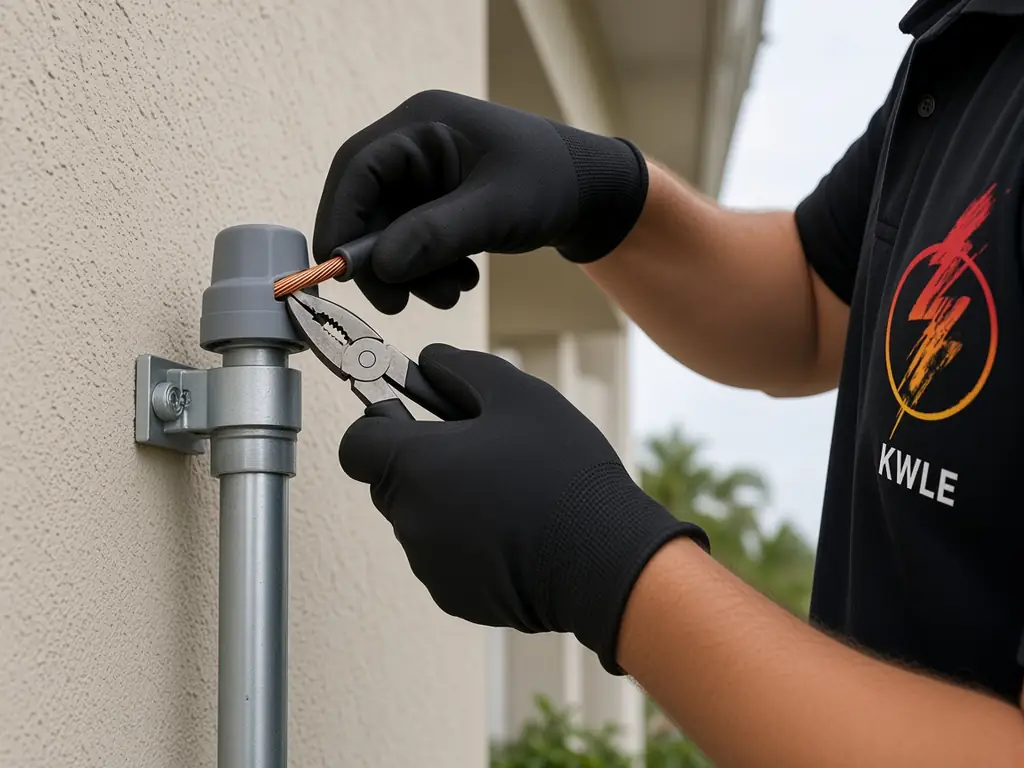
Weatherhead Repair in Indian Shores: a mast cap, a drip loop, a coordinated drop
A weatherhead is the cap at the top of a service mast, where the incoming drop forms a drip loop and enters the riser. On a rare single-family wall, or on a building mast the association actually owns, salt air and wind chew the cap, the clamp, and the conductors at the insulator. We replace the listed cap and the failed parts, and we coordinate the utility drop so the conductors are not live while we work.
Mast jobs that belong on this page
- Florida electrical contractor license EC13014717, licensed & insured
- Woman-owned business based at 6248 Seminole Blvd, Seminole FL 33772
- 2-year workmanship warranty, 5 years with a Member Care Plan
- SPAN Authorized Installer and Home Depot preferred contractor
- Open 24/7 for electrical emergencies: call or text (727) 476-7079
- A cracked, missing, or rusted weatherhead cap.
- A drip loop that is too tight, frayed, or sitting on the cap.
- A rusted mast clamp, insulator, or riser nipple at the cap.
- A short section of riser that has to change with the cap.
- A building or house mast the owner or the association has asked us to repair.
Caps, a porcelain or polymer insulator, and a drip that actually drops
We install a listed weatherhead cap that fits the riser size, with a listed insulator or bushing. The drip loop has to drop below the cap so water is not running into the mast. A tight, pretty loop that sits on the cap is not a finished landing. Conductor size and type have to match the service; we do not land a thin tail on a heavier drop.
Meter sockets, service upgrades, and main breakers sit elsewhere
Meter base replacement, electrical service upgrade, and main breaker replacement live on separate pages. The scope here is the mast cap and the riser at the drop. If the meter can or the service amperage also has to change, we flag that and send you to that write-up.
How a weatherhead visit runs
We arrange the outage with the serving utility and, if a mid-rise rule applies, with the building. Once the overhead drop is released, we open or replace the cap, land the conductors with a listed clamp, and remake a drip loop that actually drips. After the drop is put back up, we look for a tight cap and a dry mast. The visit terms belong on the paperwork.
Mid-rise stacks, a shared mast, and a house that may not have one
Buildings of ten or more units are the norm in this town. Many stacks take service in a way that has no individual weatherhead on a unit balcony. A house meter or a common-area mast may be the only one on the property. We will not climb a neighbor’s mast or treat a decorative pipe as a service riser.
Weatherhead repairs we decline
We will not leave a cracked cap and a new clamp and call the mast finished. A meter-can job is not hidden inside this ticket. We will not work a live drop. If the riser itself is failed down to the meter, we stop and talk about that length or a service step before we put a pretty cap on a tired pipe.
Drip loops, a service-drop clamp, and a mast that has to stay plumb
The drop clamp and the cap have to leave the mast plumb and the loop free of a porch fascia or a balcony edge. We keep the mast supported, and we do not use a cable TV arm or a loose standoff as the only support. A leaning mast is a reason to talk about a new riser, not only a cap.
Salt air, a frozen fitting, and a nipple that crumbles in the wrench
Fitting threads here freeze in salt air. We replace a crumbled nipple rather than force it and oval the riser. A listed coupling and a new short nipple are honest parts, not extras we hide. Dielectric grease is used only where the listing allows it, not as a substitute for a new cap.
Utility release, a seal, and a building that has to grant roof or wall access
The serving utility has to take the drop down and later remake their connection at the cap. This article is not a utility how-to, and it does not list a utility desk. A mid-rise wall or a mast above a balcony may also need a word from the building before we set a ladder. We ask.
Job file, a photo of the failed cap, and a note of the riser trade size
The file keeps a photo of the failed cap, the riser trade size, and the new listing. A later visit should not have to guess whether the mast is 2-inch or 2-1/2-inch, or whether the insulator was porcelain or polymer.
Guy kits, a weatherhead reducing bushing, and a triplex or a SE cable at the cap
Some masts need a guy or a listed standoff so the drop does not pull the pipe over. A reducing bushing is used only when the cap and the riser sizes differ and the listing allows that mix. Overhead triplex or a service-entrance cable is landed as listed, with the neutral or the messenger handled the way that service requires. We do not guess the lay of the conductors.
Mast flashing at a wall or a chase, and a cap that still sheds water
Where the mast leaves a wall or a chase, the flashing or the boot is checked so the new cap is not sitting above a leak. We do not leave a cap that ponds water at the insulator. A listed hood or a slightly taller cap is used when that is the honest way to keep the drip clear of a balcony rail.
Gooseneck kits, a 2-inch rigid riser, and a messenger that must stay with the drop
Some older masts here use a gooseneck instead of a bolt-on cap, and we only refresh that form when the listing still allows it. A 2-inch or 2-1/2-inch rigid riser gets a coupling and a support that can take the drop tension. The messenger or the bare neutral of an overhead triplex stays with the serving utility’s drop; we do not cut it as if it were a house conductor. A listed mast kit, when the pipe itself is tired, is called out before the cap comes off.
A service-entrance cap with a listed knockout for a 2-inch riser is not forced onto a smaller pipe with a field washer. We pick the cap that matches the trade size. A split-bolt or a listed tap at the drip is used only when the listing allows it, not as a homemade splice in the weather.
A rain-tight thread or a listed sealing fitting at the top of the riser keeps spray from running down the inside of the pipe. We do not wrap the cap threads in leftover tape and call that a seal. A listed rain hood, when the cap sits under a balcony drip, is a better answer than a larger wad of sealant.
Questions we hear in Indian Shores
Do you provide weatherhead repair in Indian Shores? Yes, where a real service mast exists. We repair or replace listed caps, drip loops, and related mast parts, and we coordinate the utility drop. Many mid-rise units have no individual weatherhead, and we will tell you that at the look-over.
Should I use the meter-socket or service-upgrade page instead? No. Those subjects live on separate pages. The scope here is the mast cap and the riser. If the can or the service amperage also has to change, we flag that.
Does the serving utility have to be involved? Yes. The overhead drop has to come down while we work and go back up after. We arrange that step.
I have a mid-rise condo. Do I even have a weatherhead? Often no, not on the unit itself. We will confirm whether there is a house mast or a building riser the association owns.
The mast is leaning. Is a new cap enough? Not if the pipe itself has pulled over. We will say when a riser or a support has to change with the cap.
How do I arrange a weatherhead visit? Call or text (727) 476-7079 and send a picture of the mast cap and the wall or the building location. The shop on Seminole Blvd is about 4 miles from this town.
Crews roll out from our shop on Seminole Blvd, about 4 miles from town, and work along the Tom Stuart Causeway, Gulf Boulevard, the Intracoastal and the Gulf shore. We also take calls in Redington Shores, Largo, Madeira Beach, North Redington Beach and Bay Pines.
Back to the service: Weatherhead Repair in the Tampa Bay area. For a full list in this town, visit Indian Shores electrician services.
Nearby towns: Seminole
Call or text (727) 476-7079 for weatherhead repair in Indian Shores, or book online. Shop hours 7 AM–5 PM, weekend service, 24/7 emergency calls.