
Need thermal imaging electrical inspection in Indian Shores? Keywest Lights & Electric provides thermal imaging electrical inspection in Indian Shores when a shop, a mid-rise house cabinet, or a tenant can needs an infrared scan of loaded connections, with a written list of findings. We are a licensed, woman-owned shop. This ticket is the scan and the report. It is not a repair visit, not a home-electrical-inspection walkthrough, and not a building-wide energy audit. We scan under load, we note the hot spots, and we tell you what should be opened or repaired on a separate ticket.
Request thermal imaging electrical inspection in Indian Shores
Tell us what you need and where the work is. A licensed electrician will reply with next steps and a time to visit.
If you need more than this job, see our Indian Shores work on a commercial electrician visit, commercial generator installation, a home charging circuit and generator installation.
Call or text (727) 476-7079 · open 24/7 for emergencies · request a quote online
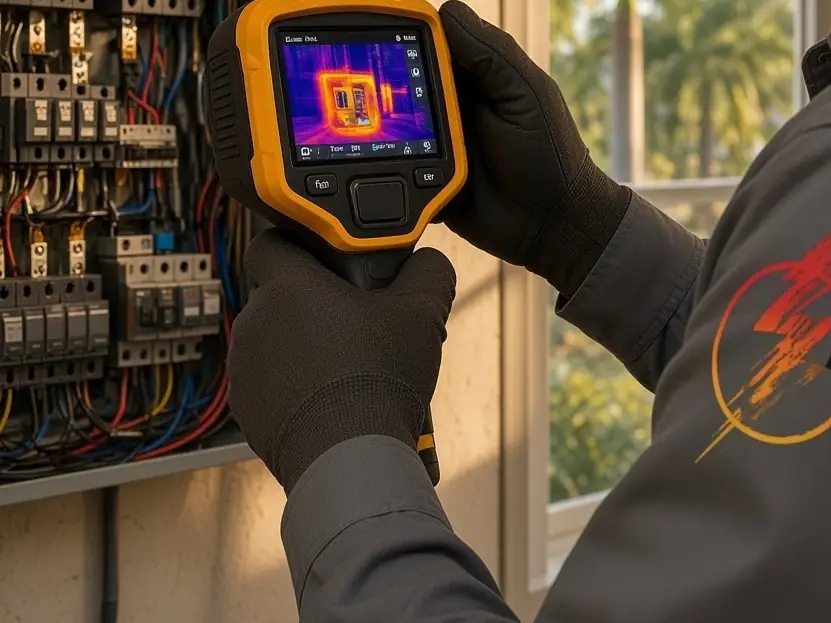
Thermal Imaging Electrical Inspection in Indian Shores: a loaded scan, a hot-spot note, a written report
An infrared scan here is often a mid-rise house cabinet, a tenant can, or a small shop panel along Gulf Boulevard. We open only what we are allowed to open, we put a real load on the gear when we can, and we record radiometric images of the lugs, the breakers, and the incoming landing. A qualitative scan is still useful when a full lab-style study is not the request. The close of this visit is a short written list, not a handful of phone photos with no notes.
What you get from this infrared visit
- Florida electrical contractor license EC13014717, licensed & insured
- Woman-owned business based at 6248 Seminole Blvd, Seminole FL 33772
- 2-year workmanship warranty, 5 years with a Member Care Plan
- SPAN Authorized Installer and Home Depot preferred contractor
- Open 24/7 for electrical emergencies: call or text (727) 476-7079
- A loaded infrared scan of a panel, a disconnect, or a similar piece of gear.
- Radiometric images and a written list of findings.
- A note on any connection that should be opened, torqued, or repaired later.
- A walk-through of the images with you or with the building contact.
How the scan is done
We confirm access and we confirm which cans we may open. A cover-on scan through an IR window is used when a window is present; otherwise we scan with the dead-front off and with safe clearances. We want load on the gear. A dark, unloaded can hides a loose lug. We do not invent a severity scale we cannot support, and we do not call a reflection a fault.
Repairs, home inspections, and a full building survey sit on other pages
Commercial electrical repair, a home electrical inspection, and a wider facility survey each have a separate page. If a hot lug needs a repair the same day, we can talk about that as a follow-up ticket. This visit stays the scan and the report, so the findings are not mixed with a parts swap and then lost.
Mid-rise house gear, a tenant can we may not own, and a seasonal dark shop
A mid-rise house cabinet may need building approval before we open it. A tenant can is easier when the suite owns it. A seasonal shop that has been dark may not have enough load for a useful scan, and we will say so rather than deliver a blank report. Salt air and a warm outdoor can can also skew a reading; we account for that in the notes.
Scans we will not treat as this visit
We will not scan a de-energized, unloaded can and call it a complete inspection. We will not use a phone camera as a substitute for a radiometric imager. We will not open a sealed utility compartment we do not have a right to open, and we do not name a specific utility. A medical or a legal “certified report” with a formal stamp is a different product, and we will not sell this visit as that document.
A radiometric JPEG, an emissivity setting, and a delta-T note
Each finding is saved as a radiometric file, not only as a screen shot. Emissivity is set for the surface we are looking at, commonly around 0.95 on a dull lug, and we note when a shiny surface made the number less certain. A delta-T against a similar loaded phase is recorded in the notes, in plain language, so a later repair tech can find the same spot.
Load-on methods, a 20-amp shop bank, and an IR window
When we can, we turn on the shop lighting, a compressor, or a 20-amp shop bank so the lugs are actually carrying current. An IR window, if the can already has one, lets us scan without a full cover-off. We do not drill a window on this ticket unless that add is already agreed.
A written findings list, a palette note, and a follow-up repair path
The report lists each hot or questionable spot, the image number, and a plain recommended next step, such as a torque pass or a repair visit. The palette we used is noted so a later image can be compared. Pricing and the repair itself stay off this page; the findings belong on the report.
A mid-rise meter room, a tight closet, and a cover that has to go back on
We work in the room we are given, we keep a safe clearance, and we put every cover back on. A flashlight and a labeled photo of the directory help the later repair. We do not leave a dead-front off in a public corridor.
A 320×240 radiometric core, a 30 Hz frame rate, and a 0.05 C sensitivity
A 320×240 radiometric core is the usual imager we bring for this visit. A 30 Hz frame rate helps on a live can. A 0.05 C sensitivity is useful on a lightly loaded lug, and we note when the load was too small for a firm reading.
A gold-sticker target, a clamp-on load note, and a PDF findings sheet
A gold-sticker target, or a matte tape patch, is used when a shiny lug is throwing the emissivity off. A clamp-on load note lists the amps on each phase at the time of the image. A PDF findings sheet, with the image numbers, is what you keep after the visit.
A 9 Hz mode is used only when a higher-speed frame is not needed. A 45-degree lens is used in a tight closet. A span-and-level lock on the imager keeps one can comparable from image to image. A dew-point note is added when a cool, wet room could fake a reading.
An isotherm band, a spot-meter, an area-box average, a fusion overlay, and a NETD note are used when they help the finding, and they are named in the report so a later tech can repeat the shot. Reflected-temperature is written down when a shiny bus made the number less certain.
Questions we hear in Indian Shores
Do you provide thermal imaging electrical inspection in Indian Shores? Yes. We scan panels and connections under load and we give you a written list of findings, with radiometric images.
Is this the same as a repair visit or a home electrical inspection? No. A repair ticket and a general home inspection are described on other pages. This visit is the infrared scan and the report.
Do I need the building loaded for the scan to work? Yes, a real load makes a much better scan. If a seasonal shop is dark, we will tell you the scan may not show much, and we can reschedule when the gear is in use.
How do I start a thermal imaging electrical inspection? Call or text (727) 476-7079 and tell us which cans you want scanned and who can provide access. Our shop in Seminole is about 4 miles from town.
Crews roll out from our shop on Seminole Blvd, about 4 miles from town, and work along the Intracoastal, Gulf Boulevard, the Gulf shore and the Tom Stuart Causeway. We also take calls in North Redington Beach, Seminole, Redington Shores, Largo and Redington Beach.
Back to the service: Thermal Imaging Electrical Inspection in the Tampa Bay area. For a full list in this town, visit Indian Shores electrician services.
Nearby towns: Seminole
Call or text (727) 476-7079 for thermal imaging electrical inspection in Indian Shores, or book online. Shop hours 7 AM–5 PM, weekend service, 24/7 emergency calls.