
Need storm damage electrical repair in Indian Shores? Keywest Lights & Electric provides storm damage electrical repair in Indian Shores when wind, rain, or a fallen limb has left a panel, a mast, a device, or a run unsafe or dead. Our licensed, woman-owned crew treats this as a storm-related repair, not a general after-hours dispatch page, not a weatherhead-only ticket, and not a whole-unit remodel. We make the site safe, isolate damaged gear, and repair or replace the listed parts that actually failed.
Request storm damage electrical repair in Indian Shores
Tell us what you need and where the work is. A licensed electrician will reply with next steps and a time to visit.
While we are in Indian Shores, the same crew can take commercial electrical service, commercial generator installation, a home charging circuit and a backup generator install.
Call or text (727) 476-7079 · open 24/7 for emergencies · request a quote online
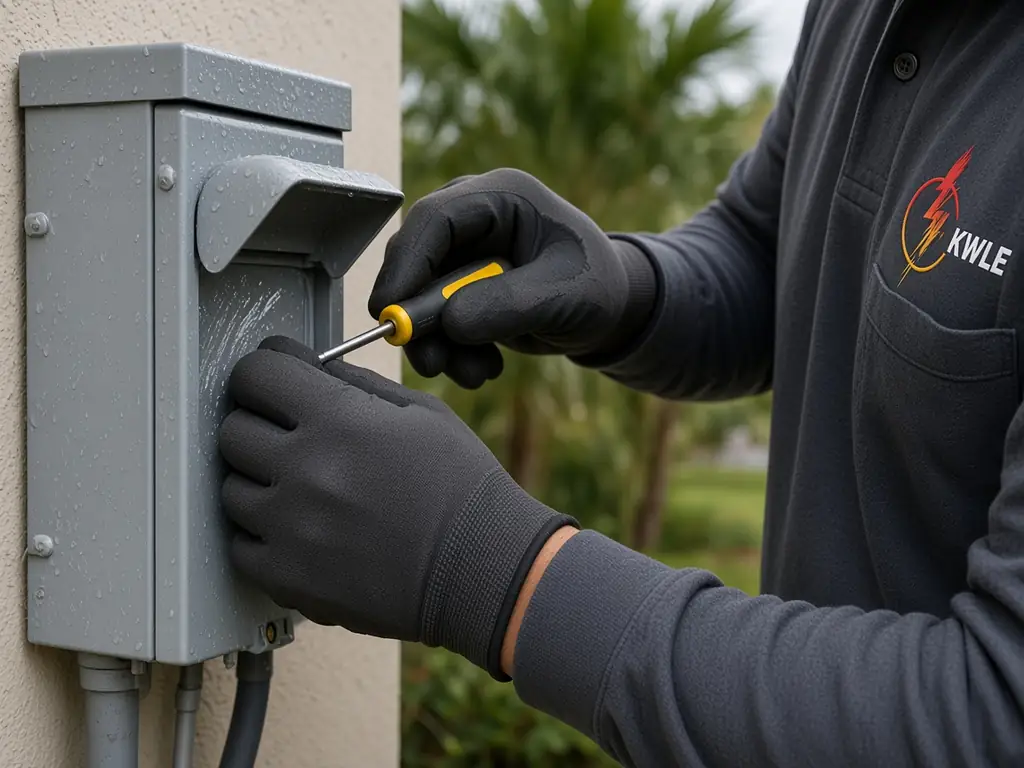
Storm Damage Electrical Repair in Indian Shores: a safe-off, a wet cabinet, a listed repair
A barrier-island storm can drive rain into a tired can, pull a drop, soak a balcony disconnect, or leave a unit with a dead run and a wet carpet. We start with a safe-off and a look at what is actually wet or torn, not a guess from the street. Temporary power, if it is even possible, is a listed, agreed step, not an extension cord across a puddle.
Storm jobs that belong on this page
- Florida electrical contractor license EC13014717, licensed & insured
- Woman-owned business based at 6248 Seminole Blvd, Seminole FL 33772
- 2-year workmanship warranty, 5 years with a Member Care Plan
- SPAN Authorized Installer and Home Depot preferred contractor
- Open 24/7 for electrical emergencies: call or text (727) 476-7079
- A panel, a disconnect, or a meter area that took on rain.
- A mast, a drop, or a balcony run pulled by wind or a limb.
- Devices and boxes that were soaked or torn off a wall.
- A unit that is partly dead after a storm, with a clear storm cause.
- A safe-off and a listed repair plan when the building is still wet.
Safe-off first, then a map of what failed
We isolate damaged gear, test for water in a cabinet, and open only what we can open safely. A wet bus is dried and inspected, or the cabinet is called out for replacement. A scorched or bent mast is handled with the utility if a drop is involved. We write down what is failed so the repair is a list, not a hope.
Emergency dispatch, weatherhead-only work, and remodel packages sit elsewhere
Emergency electrician, weatherhead repair, and whole-home remodel electrical sit on separate pages. The scope here is storm-related electrical repair. If you only need an after-hours safe-off with no storm damage, use the emergency write-up. If the only failure is a mast cap, use the weatherhead page.
How the repair visit runs
We confirm the site is safe to enter, isolate the failed parts, and quote the listed repair before we start a large swap. Small device replacements can often happen in the same visit once the branch is dry and sound. Larger cabinet or mast work is planned with the building and, when needed, the utility. Pricing terms belong on the paperwork, not in this article.
Mid-rise balconies, a soaked disconnect, and a building that has to know
A soaked condenser disconnect on a balcony, or a wet can in a meter room, may be a building issue as well as a unit issue. We tell the building when a common space is involved. We do not leave a wet can closed and energized because someone wants the air unit on tonight.
Storm repairs we decline
We will not energize a cabinet that still has standing water in the bus. An extension cord through a wet corridor is not a repair. We will not treat a long-standing code problem as “storm damage” just because a storm went by. If the damage is structural or is a line-side utility drop, we stop at our side of the work and say so.
Wet devices, a silted box, and a branch that has to be opened
A soaked receptacle or a silted exterior box is replaced, not dried with a towel and put back. We open the next landing when water may have run down the cable. A GFCI that trips after a storm may be telling you the run is still wet; we find that cause rather than stack reset buttons.
Seasonal units, a closed door, and a storm that sat unnoticed
Seasonal units here can sit closed. A storm can soak a can or a balcony device that no one sees for weeks. We still start with a safe-off and a dry-out, and we do not skip the look just because the owner was off the island.
Electric heat, a wet cabinet, and a unit that cannot just be “turned back on”
Electric heat is common here. A wet cabinet that also feeds heat is not a casual re-energize. We dry, inspect, and test, and we will say when a cabinet or a feeder has to be replaced before heat can run again.
Job notes, a photo of the damage, and a list of what was replaced
We photograph the damage as found, list the parts we replaced, and leave notes the owner and the building can use later. A vague “storm visit” line helps no one when a later claim or a later repair needs the facts.
Temporary listed power, a generator, and a line we will not blur
A portable generator or an interlock is a different write-up and is only in the plan if we agreed. Temporary lighting or a listed temp board, when it is even allowed, is called out as its own step. We do not backfeed a panel with a generator cord as a “storm fix.”
Corrosion after the fact, a salt-wet can, and a lid that will not tight up
Salt spray after a storm can lock a lid or pit a lug in a few days. We treat that as part of the storm repair when it is the clear cause. A can that will not close gets a new enclosure, not a larger wad of tape.
Silty meter rooms, a blown balcony lid, and a limb on a service mast
After a blow, we often find silt in a low meter-room can, a balcony disconnect lid torn off its hinge, or a limb resting on a house mast. Each of those is a different landing, and we treat them as separate line items on the list. A wet directory card is photographed and then replaced so the next person can still find the heat and the water-heater branches. We do not leave a lid hanging on one screw because “the storm is over.”
A soaked AFCI or a rusted outdoor GFCI is replaced after the run is dry, not reset in a puddle. We bag wet parts and keep them with the job notes if you need a record of what failed. A temporary plywood cover over a torn can is not a finished repair; the listed enclosure comes next.
A bent balcony rail that is leaning on a disconnect is a building item, and we will say so rather than try to straighten steel as an electrical repair. Our work starts after the can is clear of that rail. A shop-vac of standing water in a can is only a first step; the bus and the lugs still have to be inspected before anything is turned back on. A chlorine smell or a fine sand in a can, after a surge over a seawall, is rinsed only as far as a listed cleaning of the enclosure allows, then the parts are judged, not just wiped.
Questions we hear in Indian Shores
Do you provide storm damage electrical repair in Indian Shores? Yes. We safe-off wet or torn electrical gear after a storm, then we repair or replace the listed parts that actually failed, including devices, disconnects, and, when needed, cabinets or mast parts.
Is this the same as an emergency electrician visit or a weatherhead-only repair? No. Those subjects sit on separate pages. The scope here is storm-related electrical repair.
Can you just turn the power back on so the unit can dry out with the air running? Not if the cabinet or a run is still wet. We will say what has to be dry and listed before we re-energize.
A limb pulled the drop. Is that your work or the utility’s? The drop itself is a utility item. We coordinate and we repair the mast or the house-side parts that failed with it.
I was off the island and just found a soaked balcony disconnect. Is it too late to call this storm damage? Call anyway. We still start with a safe-off and an honest look. We will not label a long-standing failure as storm work if that is not what we see.
How do I reach you after storm damage? Call or text (727) 476-7079 and tell us what is wet, dead, or torn, plus a picture if you can take one safely. We roll from Seminole, about 4 miles away.
Crews roll out from our shop on Seminole Blvd, about 4 miles from town, and work along the Intracoastal, the Tom Stuart Causeway, the Gulf shore and Gulf Boulevard. We also take calls in Redington Beach, Redington Shores, North Redington Beach, Indian Rocks Beach and Seminole.
Back to the service: Storm Damage Electrical Repair in the Tampa Bay area. For a full list in this town, visit Indian Shores electrician services.
Nearby towns: Bay Pines · Seminole
Call or text (727) 476-7079 for storm damage electrical repair in Indian Shores, or book online. Shop hours 7 AM–5 PM, weekend service, 24/7 emergency calls.