
Planning mini split electrical installation in Tampa Bay? Keywest Lights & Electric wires ductless mini split air conditioners across Pinellas, Hillsborough and Pasco counties: dedicated circuits, outdoor disconnects and interconnect wiring. We are a woman-owned contractor under license EC13014717, and we work with your HVAC installer.
Request mini split electrical installation in Tampa Bay
Tell us what you need and where the work is. A licensed electrician will reply with next steps and a time to visit.
Call or text (727) 476-7079 · open 24/7 for emergencies · request a quote online
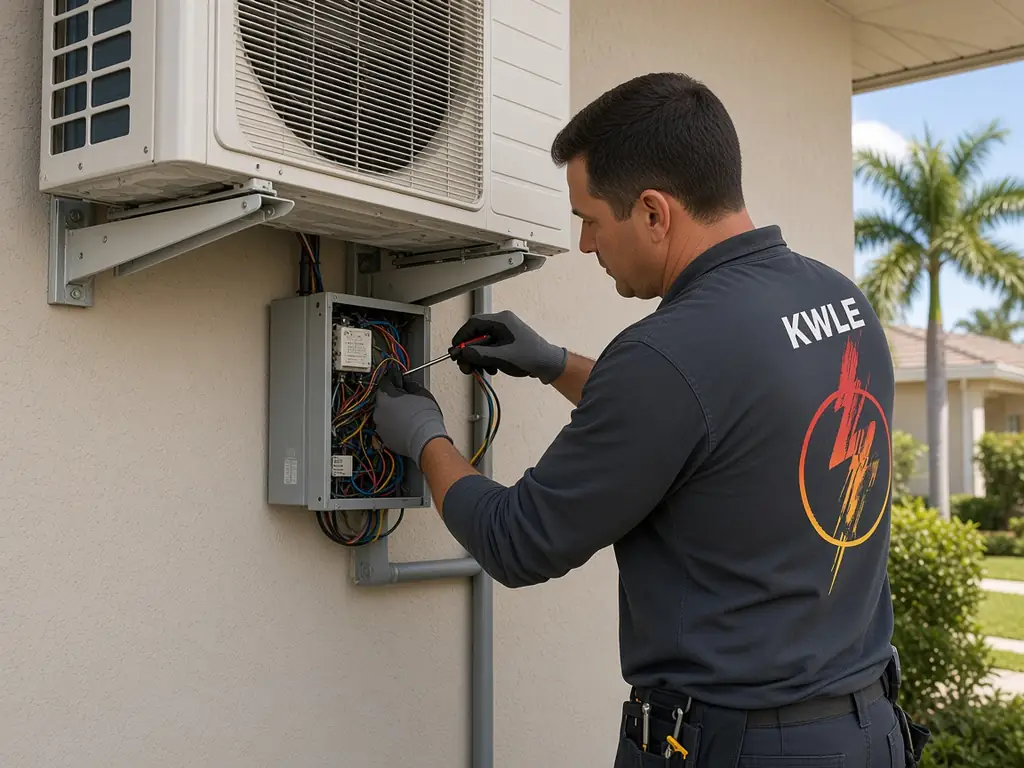
Mini split electrical installation in Tampa Bay: the power side of ductless cooling
Mini splits cool or heat a room without ducts. They are popular for additions, garages, lanais and older homes. The HVAC installer mounts the equipment, and an electrician provides the circuit, the disconnect and often the low-voltage interconnect. A correct setup runs quietly and efficiently.
What the electrical work includes
- Dedicated circuit: a breaker and wire sized to the unit.
- Outdoor disconnect: within sight of the condenser.
- Whip and conduit: weatherproof connection to the unit.
- Interconnect cable: power and control between indoor and outdoor units.
- Surge protection: protection for the control boards.
- Condensate pump power: when a pump is used.
- Multi-zone systems: one outdoor unit with several indoor heads.
Sizing the circuit
- Florida electrical contractor license EC13014717, licensed & insured
- Woman-owned business based at 6248 Seminole Blvd, Seminole FL 33772
- 2-year workmanship warranty, 5 years with a Member Care Plan
- SPAN Authorized Installer and Home Depot preferred contractor
- Open 24/7 for electrical emergencies: call or text (727) 476-7079
The unit’s label lists minimum circuit ampacity and maximum overcurrent protection. A small one-zone unit may use a 15 or 20-amp circuit. A larger multi-zone unit may need 30 amps or more. We match the breaker and the wire to the label, with a margin for long runs.
Voltage choices
Mini splits come in 115, 208 and 230 volts. Residential units are usually 230 volts, and some small ones run on 115. We confirm the voltage on the label, check the panel and run the correct circuit. A mismatch ruins the equipment, so we check before installation.
Indoor and outdoor wiring
The outdoor unit connects to the indoor unit with a cable that carries power and control signals. The cable must be the correct gauge and length. We run it through the wall with the refrigerant lines and seal the penetration. Neat routing in a line set cover looks clean and protects the cable.
Panels, space and capacity
A mini split adds load. We calculate the home’s total demand, check for space in the panel and add a subpanel or an upgrade when needed. Older panels with little room may call for a plan before you order the equipment.
Garages, workshops and additions
Mini splits are a favorite for garages, workshops, home gyms and room additions. We plan the circuit with other garage wiring and add outlets and lights at the same time. A single plan saves trenching and patching.
Quotes, permits and warranty
New circuits need a permit. Our workmanship carries a 2-year warranty, or 5 years with a Member Care Plan.
Heat pump efficiency and what it means for wiring
Mini splits are heat pumps, which move heat instead of making it. They use less electricity than resistance heaters and can cool and heat. Their inverter compressors ramp up and down smoothly, so starting current is gentle. The wiring still needs correct sizing, proper terminal torque and clean connections.
Mounting the outdoor unit
The outdoor unit sits on a pad, a bracket or the ground with feet. It needs clearance for airflow and a path for the line set. We coordinate the disconnect location with the HVAC installer, so the box does not block the unit’s service panel. We also place the whip so it does not bend sharply.
Controls, thermostats and smart features
Remote controls, Wi-Fi adapters and wall thermostats add convenience. Some units need a power source for a wired control. We run low-voltage wire where specified and leave the network side to the installer or owner, with a strong signal where required.
Efficiency, noise and comfort
Place indoor heads away from direct sunlight and furniture, and aim airflow so people are not blasted. Outdoor units run quietly but should not sit under a bedroom window. We discuss locations with you before we run wire, since moving a unit later costs time.
Electrical code details that matter
The disconnect must be within sight of the unit, mounted at a safe height and clear of obstructions. Conduit must be supported, and cable must be protected from damage. The circuit needs correct grounding, and the panel must be labeled. Inspectors look for these items, and we build the job to pass the first time.
Planning several indoor heads
Multi-zone systems serve a bedroom, an office and a living room from one outdoor unit. Each indoor head has its own line set and interconnect cable. We label every cable at both ends, so a technician can trace it years later. A clear plan keeps zone mix-ups out of the system.
Common mistakes we see
Typical errors include a breaker that is too small, wire that is too thin for a long run, a missing disconnect, an interconnect cable spliced in a damp spot, and a unit hung on a wall with no power provision. We fix these, label every connection and make sure the system meets inspection.
Condos, apartments and rentals
Multifamily buildings have rules about exterior units, shared walls and roofs. Owners must ask boards or landlords for permission and sometimes hire licensed contractors. We provide a clear scope, certificates and photos, so approvals go smoothly and installation does not stall.
Troubleshooting a unit that will not start
If the indoor head blinks an error, the cause may be a tripped breaker, a loose terminal, a bad interconnect or a failed control board. We test voltage at the disconnect, the terminal block and the signal wire, then tell you whether the issue is electrical or mechanical, so you call the right trade.
Common questions
Does a mini split need its own circuit? Yes. Most need a dedicated breaker sized to the unit label.
Do I need a disconnect? Yes, within sight of the outdoor unit in most cases.
Who installs the line set and refrigerant? A licensed HVAC contractor. We install the electrical parts and coordinate with them.
Can a mini split run on 115 volts? Some small units can. Many residential units need 230 volts.
Can I add a mini split to a full panel? Maybe. We can add a subpanel or upgrade the panel when needed.
Do multi-zone units need a bigger circuit? Often yes. The label tells us the size.
How long does the electrical work take? Usually a few hours to a day.
Can you power a condensate pump? Yes. We install an outlet or a connection and set a safety switch.
Local pages: mini split electrical installation in Seminole, our home base. See also Pinellas County, Hillsborough County and Pasco County service areas, or browse all electrical services.
Call or text (727) 476-7079 for mini split electrical installation in Tampa Bay, or book online. Business hours 7 AM–5 PM, weekend service, 24/7 emergency calls.