
Need low voltage data cabling in Greenbriar? Low voltage data cabling in Greenbriar is a structured cable run in a ranch or a small office: a network drop at a desk, a media cabinet, or a hidden TV or camera cable in a finished wall. This is signal cable, not a power branch. We keep those two systems out of the same bored pass, we test each drop, and we leave a label a later tech can follow.
Request low voltage data cabling in Greenbriar
Tell us what you need and where the work is. A licensed electrician will reply with next steps and a time to visit.
Homeowners in Greenbriar also book commercial electrician, commercial generator installation, EV charging circuits, generator interlock transfer switch, JellyFish lighting on the eaves, a new breaker panel, home battery backup, solar wiring support, generator installation, 240v outlet installation, aluminum wiring repair, apartment multifamily electrical and appliance wiring hookup.
Call or text (727) 476-7079 · open 24/7 for emergencies · request a quote online
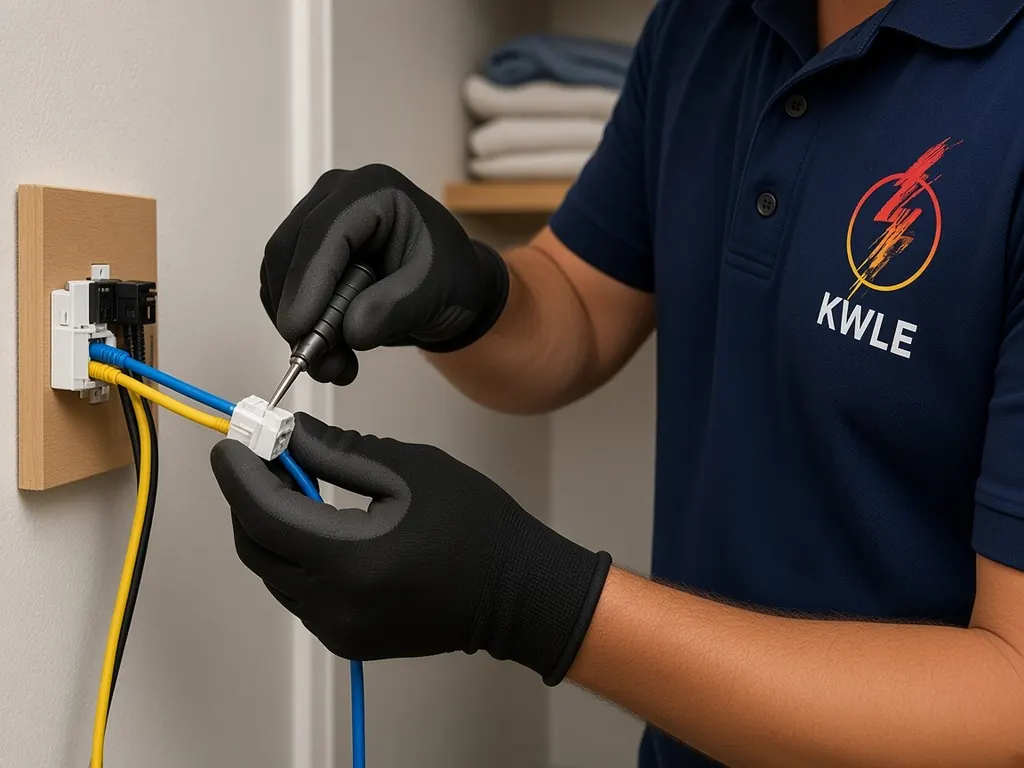
Low voltage data cabling in Greenbriar is a tested drop, not a power outlet
A new power receptacle is a different page. On this page we pull Cat cable or a listed coaxial or camera lead, terminate it, and test it. We do not configure a router, a camera, or a wireless system. The owner or the vendor who sold that gear handles the setup.
What we usually pull
A desk drop to a small patch field, a TV hide from a wall box to a media cabinet, a camera lead to an eave soffit, and a short run to a workbench in the garage. In a 1960s or 1970s ranch the walls are finished and the attic is often shallow, so we fish from a closet or a cabinet rather than opening a long run of drywall.
How we pick a fish route
- Florida electrical contractor license EC13014717, licensed & insured
- Woman-owned business based at 6248 Seminole Blvd, Seminole FL 33772
- 2-year workmanship warranty, 5 years with a Member Care Plan
- SPAN Authorized Installer and Home Depot preferred contractor
- Open 24/7 for electrical emergencies: call or text (727) 476-7079
We walk the path, pick a fish route that misses a duct or a tight truss, and mark jack heights with you. A media cabinet location is chosen so a patch field can be reached later. We do not hide a bundle in an attic where a future roof leak would sit on it without a drip loop.
How each drop is proved
Each data drop is checked for continuity and wire map, and a failed pair is reterminated or replaced, not left as a maybe. You leave with a simple port map: room, jack number, and the patch-field port. A tone-out is done in front of you so a later move of the desk still makes sense.
Power cable stays off this route
A data cable is not stapled to a 120-volt run, and it does not share a bored hole with a power cable. A metal plate protects a shallow pass. We will not use a power-cable leftover as a pull string for a data drop if that leftover is still live.
The drop record
The jack map, the test result, and a photo of the patch field go in the data-drop file. A new jack, a new cabinet, or a camera lead is listed on that close-out. A later tech can tone a port without opening a wall.
Once the ports are labeled
We plug a tester in only after the jacks are seated and labeled. If a drop we installed fails in the first week, text (727) 476-7079. Name the jack number. We return to that pull. Labor on the cable and the terminations lasts two years, or five under Member Care.
What to send before we fish
Share the street, a sketch or a photo of the desk or TV wall, and where you want the patch field. Note whether the attic is reachable. Tell us if a camera vendor already chose a mount.
What we will not promise
We will not promise a wireless coverage map, a camera view, or a streaming setup. We will not pull a data cable through a wet eave without a listed outdoor-rated jacket and a drip loop. We will not leave an unlabeled bundle in a cabinet.
A keystone jack is punched to the T568B map unless you already have the other map in the house, and then we match what you have. A surface raceway is used only when a fish is not possible and you accept a visible path. A fire-stop pad is used when a cable passes a garage ceiling into the house attic.
A stapled Cat run is fastened with listed cable staples that do not pinch the jacket. A bend radius is kept at the patch field so a later patch cord does not kink the pair. A spare pull string is left in a long wall fish for a second drop the owner may want next year.
An outdoor-rated jacket is used for a camera lead that exits at an eave soffit, and a drip loop is formed before the mount. A gel-filled or outdoor-rated connector is used only when the location is actually wet. A mid-span attic splice is landed in a listed low-voltage box, not taped in a joist bay.
A six-port patch field in a coat closet is labeled left-to-right to match the jack map. A coaxial drop for an antenna or a cable handoff is swept with a simple tester and capped if the owner is not ready to land a modem. A structured-media enclosure is bonded to the house electrode system when the listing and the enclosure require it.
A grommet at a desk grommet hole keeps a bundle from sawing on the particle-board edge. A Velcro wrap, not a tight zip-tie, is used at the patch field so a later port change does not crush a pair. A toner and a wand are used to confirm a dusty unlabeled jack before we cut it out.
A camera lead that shares an eave soffit with a future light still gets its own jacket and its own drip loop. A poe injector, if the owner already has one, is given a receptacle on a power page if one is missing; we do not land a 120-volt device on this cable page. A 110-block or a patch panel is chosen from the port count, not from a leftover scrap.
A hallway TV in a small office gets a hide behind the set and a jack at chair height so a later tech can unplug it. A labeled faceplate color is matched to the room’s existing plates when we can. A short service loop is left in the attic at each drop so a later trim change has slack.
A fish rod with a rounded leader is used in a finished ranch wall so the paper face of the drywall is not punched from behind. A low-voltage mounting bracket, not a full electrical box, is used at a data jack unless a deep device is required. A toner battery is checked before we close a wall so we are not guessing at a dead toner.
Common questions
Do the new ports get a written result? Yes. Each drop is checked for continuity and wire map, and you leave with a port map.
Can a TV or camera lead be hidden in a finished ranch wall? Yes, when we can fish from an attic, a closet, or a cabinet. A path we cannot fish is quoted with a small opening or a surface raceway.
Is this a new power receptacle? No. A power receptacle has its own page. This page is signal cable.
Will you configure my cameras or my wireless network? No. We pull and check the cable. Setup belongs to you or to the vendor who sold the gear.
How do we request the pull? Share a sketch of the desk or the TV wall on the form, or text (727) 476-7079. Name where the patch field should sit.
The drive from our shop at 6248 Seminole Blvd is about 13 miles. In Greenbriar we work along the Safety Harbor side, the Dunedin side and the Clearwater edge of the community. From here we also reach Dunedin, Palm Harbor, Safety Harbor, Clearwater and Oldsmar.
Up: Low Voltage Data Cabling across Tampa Bay · For everything we do locally, see Clearwater electrical service.
Nearby: Tierra Verde · South Highpoint · Bear Creek · Indian Shores
Call or text (727) 476-7079 for low voltage data cabling in Greenbriar, or book online. Business hours 7 AM–5 PM, weekend service, 24/7 emergency calls.