
Adding a bedroom, a primary suite, a second story or a place for Mom? The first electrical question is whether your service can carry it.
An addition is new construction bolted onto an older house, and its wiring has to work with both. Keywest Lights & Electric handles the electrical for room additions, in-law suites, second-story additions and garage conversions in Pinellas County and across Tampa Bay. We begin with a load calculation and end with a passed final inspection, and we coordinate with your builder at every stage between.
(727) 476-7079 · Send plans or request service online
Request a quote
Tell us what you need and where you are. A licensed electrician will call or text you back to set a time. For an emergency, call (727) 476-7079, 24/7.
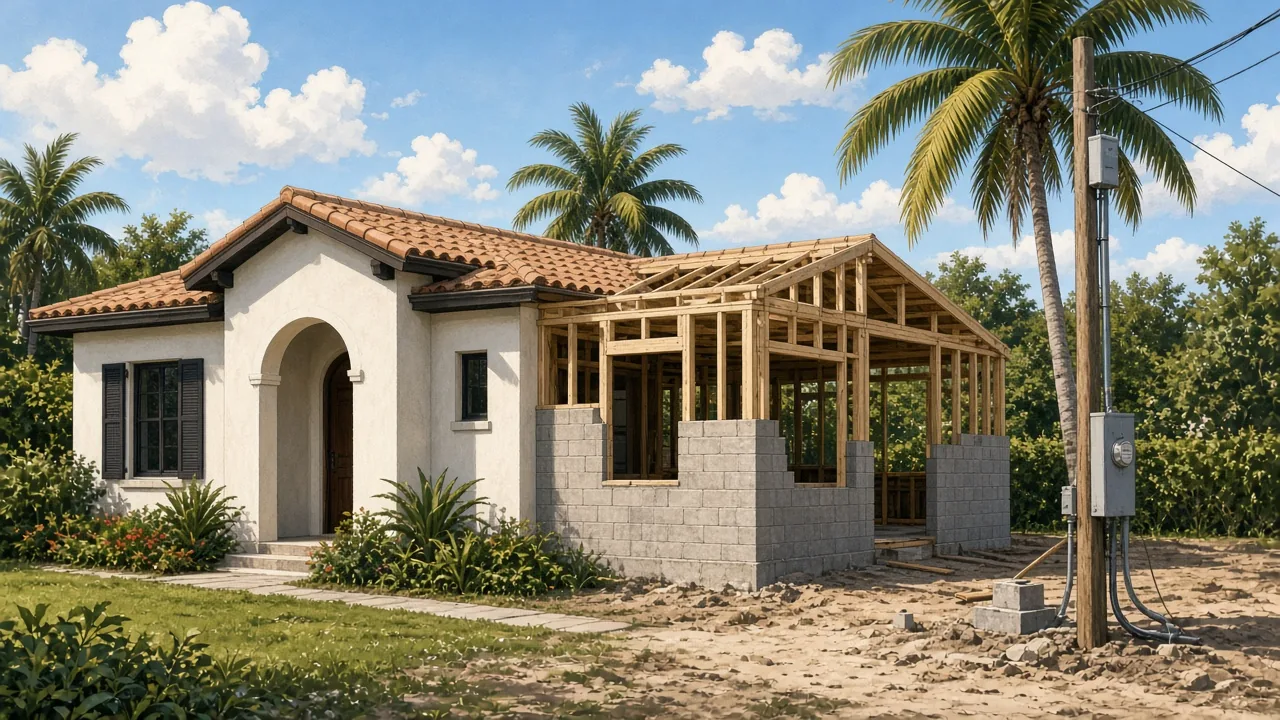
Step one: will the panel and service carry it?
Every addition adds load: lights and receptacles, a mini-split or bigger air handler, and sometimes a kitchenette, laundry or EV charger. The National Electrical Code has a method specifically for adding loads to an existing home, and we run it before quoting, from your actual panel schedule and appliance data. The outcome is one of three answers: new circuits off your existing panel, a new or larger panel, or a service upgrade arranged with Duke Energy, TECO or your electric co-op.
Flood zones and the Pinellas 49% rule
Hurricane Helene put record water into coastal Pinellas in September 2024; the NOAA gauge at Clearwater Beach peaked at 6.67 feet above mean higher high water. If your house is in a flood zone, the 50% (substantial improvement) rule applies, with Pinellas County using a 49% threshold: when the improvement cost reaches that share of the building’s value, the whole structure must meet current flood rules. An addition is usually the biggest piece of that cost, so raise it with your designer before the drawings are final.
Inside the new rooms
- Circuits from the main panel or a new subpanel, sized from the load calculation
- Tamper-resistant receptacles spaced for living space, on AFCI-protected circuits
- A dedicated circuit and disconnect for the mini-split or new condenser
- Recessed lights, fan-rated ceiling boxes and exterior lights at new doors
- Interconnected smoke alarms, plus carbon monoxide alarms where state law calls for them
- Data, TV, doorbell and camera cable while the framing is open
Temporary power and the tie-in
Framers and other trades need power on day one. We set a temporary service or a protected construction outlet, then tie the new space into the house once rough-in is ready, keeping the existing rooms powered throughout.
Why additions are common here
Census Bureau estimates show Pasco County has grown about 20% since 2020 and Hillsborough about 7.8%, much of it families that soon need more room. In built-out Pinellas, with its older housing and few empty lots, adding on is often the only way to get space without moving. We wire additions in all three counties and work with each permit office’s process.
Most additions run through a general contractor, and we join the team as the licensed electrical sub (EC13014717): plan review, an electrical quote, and rough-in matched to the framing schedule. Owner-builders are welcome. Our workmanship warranty is 2 years, or 5 years for Member Care Plan members. Woman-owned, in Seminole since 2010.
Questions about addition wiring
Will my addition need a bigger electrical service?
Not always. We count the existing house plus the new space, its air conditioning and any new appliances using the National Electrical Code method for existing dwellings. Many 150- and 200-amp services carry a bedroom addition with room to spare. A suite with its own kitchenette, or a house on an older 100-amp service, is more likely to need an upgrade or a subpanel.
Subpanel or new circuits from the main panel?
A subpanel makes sense when the addition is far from the main panel, the main panel is out of spaces, or the addition is an in-law suite that should have its own shutoff. Otherwise, new circuits from the main panel are simpler. We recommend one after seeing the plans and the panel.
Does an addition need carbon monoxide alarms?
Under Florida Statute 553.885, an addition built on a home with a fuel-burning appliance, a fireplace or an attached garage needs a carbon monoxide alarm within 10 feet of each sleeping room in the addition. New smoke alarms are required as well, and the building code may require the existing alarms to be updated too.
Is my addition affected by Pinellas County flood rules?
If the house is in a flood zone, yes. Pinellas County counts additions toward its 49% substantial improvement threshold, and electrical equipment in the new space must meet the flood elevation rules. Check the flood zone before the plans are drawn.
Can you convert our garage into a bedroom or office?
Yes. Electrically it is a small addition: receptacles spaced for a habitable room, AFCI protection, lighting, smoke alarms and usually a mini-split circuit. If the washer, dryer or water heater lived in the garage, we plan where those circuits go next.
Who pulls the permit, us or the builder?
We pull the electrical permit for our scope and meet the inspector for rough and final. The general contractor or owner-builder holds the building permit for the addition itself.
Adding on? Call (727) 476-7079.
Related: Whole-home remodels · New home construction · Remodels & additions · Residential construction division
Where we work: Pinellas County · Hillsborough County · Pasco County