
Standby generators, transfer switches and portable generator hookups for Pinellas County homes and businesses, permitted with your city or the county and wired so generator power can never back-feed the utility lines.
Call (727) 476-7079 to talk through a generator hookup · Request service online
What Helene and Milton showed
The National Hurricane Center’s reports on the 2024 storms tell the story. Hurricane Helene’s surge in September set new records on the Clearwater and St. Petersburg tide gauges, and Hurricane Milton (Oct 9–10), which made landfall on Siesta Key, brought hurricane conditions from Clearwater Beach and Tampa south, with a storm-total rainfall maximum of 20.40 inches near St. Petersburg. A generator can’t keep water out, but it can keep the refrigerator, fans, lights, medical equipment and a well or lift pump running while the grid is down, as long as it’s connected the right way.
Choosing a hookup
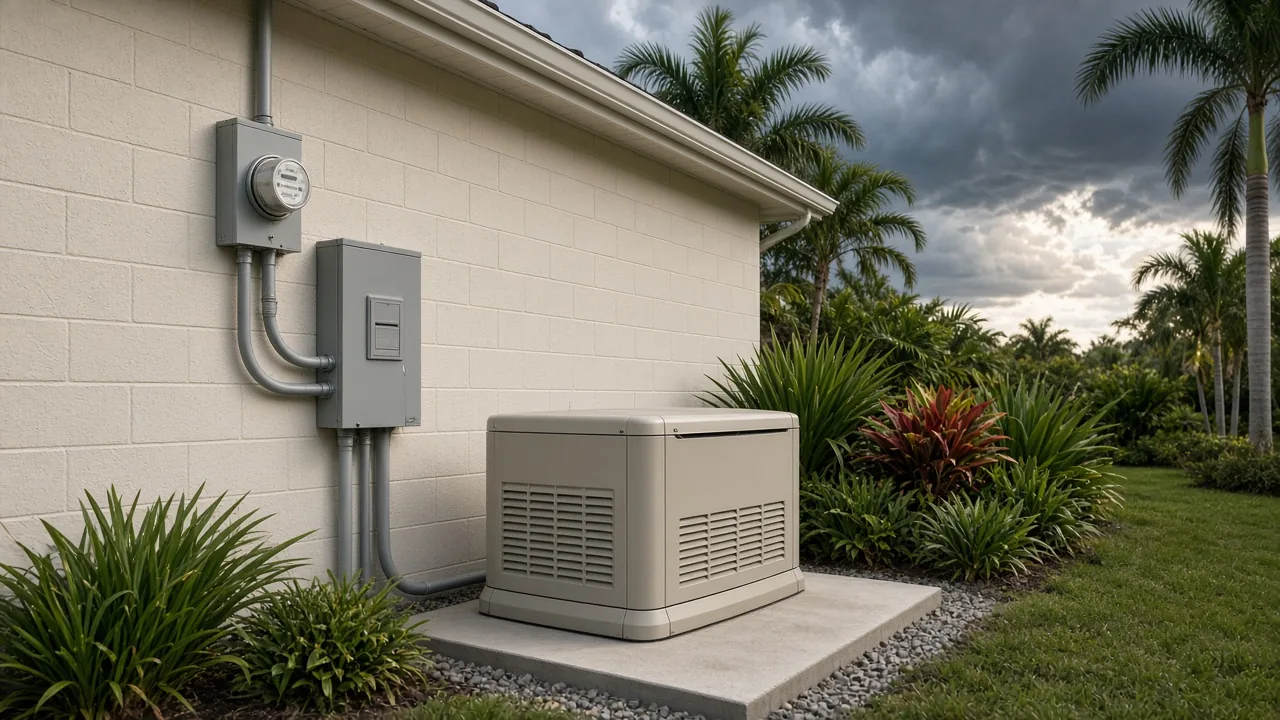
- Standby generator with an automatic transfer switch. Starts by itself and runs the whole house or an essential-loads panel.
- Portable generator, inlet box and interlock. The generator plugs into an outdoor inlet, and a listed interlock on your panel keeps the main and generator breakers from ever being on together.
- Portable generator and manual transfer switch. A short list of fixed circuits switched over by hand, useful when no listed interlock exists for your panel.
Never back-feed through a dryer outlet with a double-male cord. It can energize the lines crews are working on.
Where the equipment goes
Pinellas County says everyone here lives in a flood zone, and its high-risk areas are A and V zones, with wave-action building criteria in Coastal A and V zones. The county keeps its own floodplain maps and development rules, and cities have their own processes, so before we set a pad or mount an inlet and transfer switch, we check your flood zone and the rules that come with it. Evacuation zones (A through E, from the county’s Know Your Zone tool) are a separate question: a generator is for riding out an outage at home, not a reason to stay when your zone is told to leave.
Permits through your city or BDRS
Inside most incorporated cities, the city building department issues the permit. For unincorporated Pinellas and several smaller cities, it’s the county’s Building & Development Review Services at 440 Court St in Clearwater, with applications, plan uploads and inspection requests handled in the county Access Portal. On larger jobs, the county also expects a Notice of Commencement, recorded with the Clerk and uploaded before the first inspection, once the job is over the state threshold. Generator wiring is done to the code in force: the Florida Building Code 8th Edition (2020 NEC) today; the 9th Edition (2023 NEC) is expected on Dec 31, 2026.
Duke or TECO: coordinating the disconnect
A service-rated transfer switch ahead of the main panel means working on the service, and that means the utility. Duke Energy Florida serves Pinellas and Tampa Electric serves parts of it, so we go by your bill. Under Duke’s rules, only Duke can remove a meter seal, and it won’t restore service until the required local inspection is done. In Tampa Electric territory, the disconnect and reconnect are arranged ahead of time, and TECO reconnects after the building inspection passes. We schedule all of that with whichever company serves your address.
After a storm: repairs and the 49% rule
If a generator, transfer switch or panel took on water, keep it off until it’s inspected. For homes in unincorporated Pinellas, keep the paperwork in mind too: the county treats a home as substantially damaged when repairs reach 49% of the structure’s market value (land excluded), and the cost of utility and service equipment counts toward that figure. Cities run their own substantial-damage process. We itemize electrical repairs so your permit file is clear.
Keywest Lights & Electric is a licensed (EC13014717), insured, woman-owned business. Our workmanship warranty is 2 years, or 5 years for Member Care Plan members. Financing available through Acorn Finance, subject to credit approval. Outside Pinellas, we also install generator hookups in Hillsborough and Pasco counties, and our Pinellas County electrician page covers permits and utilities county-wide.
Generator questions from Pinellas County
Do generator hookups need a permit in Pinellas County? Yes. Standby generators, inlets, interlocks and transfer switches are permitted electrical work. The permit comes from your city’s building department, or from Pinellas County BDRS for unincorporated addresses and the cities that permit through the county. Gas piping for a standby unit is separate gas work under its own permit.
Will the power company be involved? Sometimes. A whole-house transfer switch at the service usually means a planned disconnect and reconnect. Duke Energy and Tampa Electric each have their own process, and which one applies depends on your address.
My generator or transfer switch was under water. Can I use it? No. Leave it off and have it inspected first. Water-damaged electrical equipment can fail or start a fire when it’s energized again.
Should I get a standby or a portable setup? A standby unit with an automatic transfer switch takes over on its own. A portable generator with an inlet and an interlock or transfer switch costs less and runs the circuits you choose. Our generator installation page compares them in detail.
Can you combine a generator hookup with a panel upgrade? Yes. If your panel needs replacing anyway, doing both together means one permit process and one round of utility coordination where a disconnect is needed.
Plan your hookup before the next storm: call (727) 476-7079 or request service online.
Related: Generator Installation · Whole-House Surge Protection · EV Chargers in Pinellas County · Panel Upgrades · Pinellas County