
Need Federal Pacific panel replacement in Pinellas County? Book Keywest Lights & Electric: we’re woman-owned, hold license EC13014717 and take Pinellas County jobs. Census ACS shows 5.8% of Pinellas County housing built since 2010.
Request a quote in Pinellas County
Tell us what you need and where you are. A licensed electrician will call or text you back to set a time. For an emergency, call (727) 476-7079, 24/7.
Pinellas split off as Florida’s 48th county in 1912 and now ranks densest, 3,425 residents per square mile by its own count. Of 520,107 homes in the ACS, the seventies built 25.4% and the fifties 13.9%, the decades when older trouble-prone panels were going in. The county median year built is 1977 or earlier.
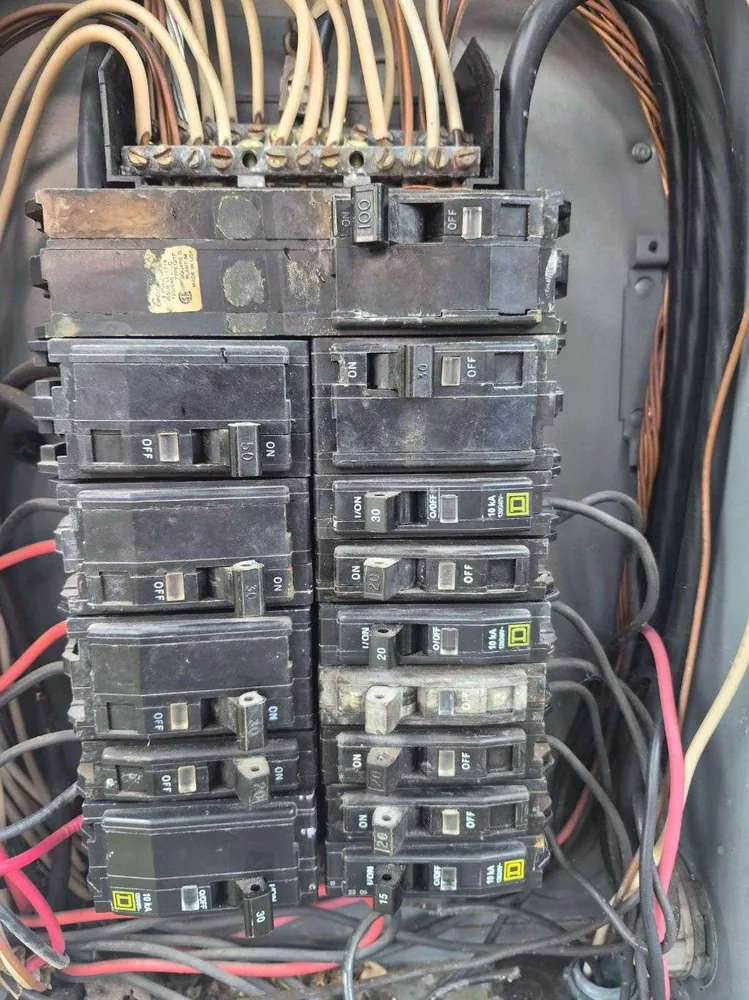
Federal Pacific panel replacement in Pinellas County: the CPSC record.
A 1983 CPSC release (revised 2011) stated agency tests confirmed numerous older trouble-prone breakers failed certain calibration requirements; the agency then ended its inquiry with no safety ruling. Its advice fits any panel: when a breaker trips, find out why.
On a 4-point.
The 4-point form Citizens uses asks who made the main panel. Each insurer sets its own response to an older trouble-prone answer.
Our scope.
Old enclosure and breakers out, new equipment in, grounding and bonding corrected, every circuit labeled, plus a surge device. Older trouble-prone boxes get identical treatment. We pull the permit.
How to tell what panel you have.
Open the panel door and look at the maker’s label inside. If it names one of the older panel lines this page covers, or the label is missing or rusted, send us a photo of the label and breakers and we can usually tell you what you have. Please don’t remove the inner cover to look; that exposes live parts.
In Pinellas, where the median home was built in 1977 and about a quarter of homes date from the 1970s, these panels still turn up in original houses and in condo units that were never updated. For a replacement, we pull the permit, schedule the power shutoff, swap the enclosure and breakers, correct grounding and bonding, label the circuits and arrange the inspection. If the meter has to be pulled, we coordinate that with your power company.
If you are selling, a home inspector may note the panel brand in the report, and buyers’ insurers can ask about it too. Replacing it before listing lets you hand over a permit record and an inspection sign-off.
Source: U.S. Census Bureau, ACS 2020–2024 (DP04).
County housing counts here are drawn from the 2020–2024 ACS 5-year estimates, tables DP04 and DP05. Every older trouble-prone change-out ends with a whole-house surge protector on the new panel. Keywest is a woman-owned shop under Florida license EC13014717, and replacement labor is covered for 2 years, or 5 with Member Care. Send a photo of your panel label or call (727) 476-7079.
See also: Problem-brand panel replacement · problem-brand panel replacement in Hillsborough County · Pasco County problem-brand panel replacement · panel upgrades for Seminole · Pinellas County area we serve
Nearby, we also handle Clearwater electrical service, electrician in Feather Sound, electrician in St. Petersburg and Tierra Verde electrical service. Other Pinellas County services: commercial electrician service for Pinellas County, EV charger installation for Pinellas County, generator installation in Pinellas County and generator interlocks and transfer switches in Pinellas County.
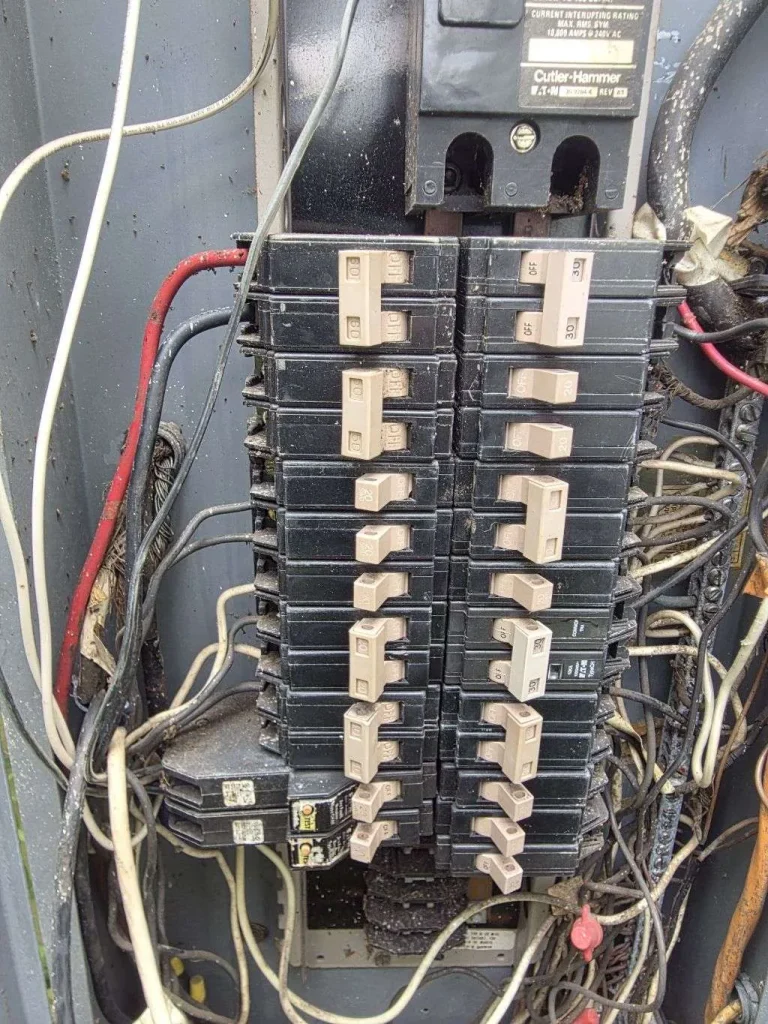
Panel upgrade in Pinellas County: an outside-wall can with salt film, and a tight condo closet can, photographed as two different starting points.
Problem-brand panel replacement in Pinellas County starts with a photograph of the can where it actually sits. An outside-wall can with salt film is not written up the same way as a tight condo closet can.
The folder tab describes the equipment as problem-brand or trouble-prone, so a later 4-point examiner can find the before photo without guessing at a model name.
A 1970s house can we will not leave unlabeled in the folder after it comes off the wall.
When a 1970s house can comes off the wall, it is not left unlabeled in the folder. The before photo and the new legend are dated the same day.
If a 4-point or an insurer later asks what was there, those two papers are already together.
A condo closet we will not block with the old can or the new carton.
In a condo closet the old can and the new carton are not left in the walkway. The closet is photographed clear at the end of the day.
If the closet also holds a water heater or a stacked washer, that crowding is written on the ticket so the new can is placed with that in mind.
The before photo, the new legend, and the closet-or-wall label leave as one clipped set.
The before photo, the new legend, and the closet-or-wall label leave as one clipped set. The legend date is written on all three.
From that date the swap is covered for two years of workmanship, or five with Member Care.
If a later 4-point examiner wants the wall as it looked before the swap.
If a later 4-point examiner wants the wall as it looked before the swap, ring (727) 476-7079 and mention the Pinellas problem-brand set.
The dated photo and the new legend are sent together, with the closet-or-wall label on top.
A salt-film wipe, photographed before and after a dry cloth, on an outside-wall can.
On an outside-wall can, a salt-film wipe is photographed before and after a dry cloth, so the film is visible in the packet.
The cloth is discarded. The two photos stay with the before shot of the can.
A closet crowding sketch, with the water heater and the stacked washer shown as boxes.
In a tight condo closet, a crowding sketch shows the water heater and the stacked washer as boxes, and the new can is drawn with those boxes in mind.
A later visitor can see why the can sits where it sits.
A trouble-prone tab on the packet, written in those words, not as a model guess.
A tab on the packet is written as problem-brand or trouble-prone, not as a model guess.
A later 4-point examiner can find the packet by that tab even if a model name was never added.
A condo closet floor drain, noted so the new can is not set over it.
A condo closet floor drain is noted so the new can is not set over it, and the crowding sketch already shows that drain as a small circle.
The drain stays usable after the swap.
An outside-wall drip cap, photographed after it is fitted, so the salt-film can is not left open at the top.
An outside-wall drip cap is photographed after it is fitted, so the salt-film can is not left open at the top.
The after photo of the cap sits with the before-and-after wipe photos.
A 4-point checkbox photocopy, added only when the owner already has the form, never filled in as a sample.
A 4-point checkbox photocopy is added only when the owner already has the form. A sample form is not filled in for the packet.
The before photo and the new legend are still the papers a later examiner is sent, with the closet-or-wall label on top.
A tight-closet ceiling strut we will not use as a temporary hook for the old can.
A tight-closet ceiling strut is not used as a temporary hook for the old can. The can leaves the closet and is staged in the hall, then removed.
The end-of-day closet photo already shows the walkway clear; a can hanging from a strut would fail that photo.
A rust-through patch at a knockout, photographed with a scale card, on an outside-wall can.
On an outside-wall can, a rust-through patch at a knockout is photographed with a scale card, so the size of the opening is visible later.
The scale card is our card, then removed. The photo stays with the salt-film wipe pair.
Common questions in Pinellas County.
Does problem-brand panel replacement in Pinellas County get written up the same way for a house and a condo closet? No. An outside-wall can with salt film and a tight condo closet can are photographed as two different starting points. The folder describes the equipment as problem-brand or trouble-prone and keeps the before photo with the new legend, dated the same day, for a later 4-point or insurer request.
Why do so many Pinellas homes still have original panels? The county’s housing is older than most: the median home was built in 1977, and the 1970s alone account for about a quarter of it (Census ACS). Plenty of those panels have never been swapped.
Can you replace a panel in a Pinellas condo unit? Yes, once the association approves. The panel inside your unit is usually yours; anything on common walls or the meter bank is the building’s call.
Is a problem panel a reason to add surge protection? Every replacement we do includes a whole-house surge protector on the new panel, so you get it either way.