
Need electric range wiring in Indian Shores? Keywest Lights & Electric provides electric range wiring in Indian Shores when a kitchen needs a listed 240-volt range receptacle or a listed whip, sized to the range nameplate. We are a licensed, woman-owned shop. This is a range branch, not a dryer hookup, not a general 240-volt outlet, and not a whole kitchen remodel package. We read the range listing, set the right 14-50 body or a whip, and leave a “range” directory line you can find.
Request electric range wiring in Indian Shores
Tell us what you need and where the work is. A licensed electrician will reply with next steps and a time to visit.
Related Indian Shores services include commercial electrical service, commercial generator installation, a home charging circuit and a backup generator install.
Call or text (727) 476-7079 · open 24/7 for emergencies · request a quote online
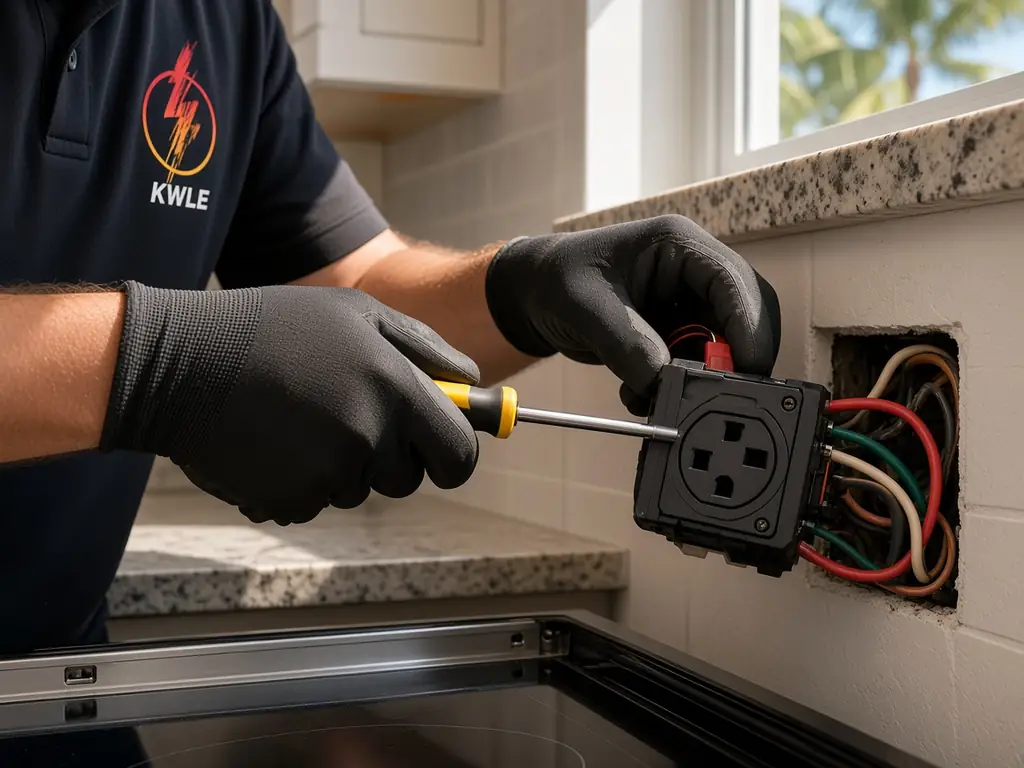
Electric Range Wiring in Indian Shores: a kitchen landing, a nameplate, a matched run
A range in a mid-rise kitchen here often still sits on a 3-prong face or a tired box behind a slide-in unit. We pull the range out far enough to see the landing, then we set a 14-50 kitchen body or a factory-style whip when that is what the range requires. A loose 10-50 or 14-50 leftover behind a heavy range is a common heat problem, and we will not leave it as-is.
Kitchen work that belongs here
- Florida electrical contractor license EC13014717, licensed & insured
- Woman-owned business based at 6248 Seminole Blvd, Seminole FL 33772
- 2-year workmanship warranty, 5 years with a Member Care Plan
- SPAN Authorized Installer and Home Depot preferred contractor
- Open 24/7 for electrical emergencies: call or text (727) 476-7079
- A new 4-prong range receptacle behind a freestanding or a slide-in range.
- A listed whip to a range that is hardwired rather than cord-and-plug.
- A replacement of a scorched, loose, or outdated 3-prong kitchen face.
- A move of the landing when a new cabinet run changes the range location.
- A 40- or 50-amp two-pole and a copper size that must match a larger modern range.
Nameplates, a 40- or 50-amp branch, and a cord or a whip
We read the range listing and pick a 40- or 50-amp branch that fits that sheet, not a guess. A 40-amp range on a tired 30-amp leftover, or a 50-amp range on a thin 8 AWG when 6 AWG is required, is a mismatch we will correct or decline. The cord or the whip has to match the 14-50 (or the listed) landing. We do not invent an adapter path.
Dryer outlets, generic 240-volt points, and kitchen remodels sit elsewhere
Dryer outlet installation, 240-volt outlet installation, and kitchen remodel electrical sit on separate pages. The scope here is the range branch in a kitchen. If the whole kitchen is open for a remodel, the range landing can be part of that larger map, and we will say so.
What we do behind the range
We isolate the branch, pull the range with protection for the floor, and open the old box. The new landing is set at a height and an offset that let the range sit flush against the wall without pinching the cord or the whip. We test voltage, polarity, and the ground path. Pricing terms belong on the paperwork, not in this article.
Slide-in units, a flush back, and a box that sits in the recess
Slide-in ranges want the receptacle in a shallow recess, not proud of the wall. We use a box and a face that can sit in that recess, and we do not leave a surface body that holds the range off the counter. A whip is routed so a drawer or a warming drawer, if there is one, does not chafe it.
Range landings we decline
A 14-50 kitchen body is not landed on leftover 8/2 or 6/2 with the ground omitted. A scorched kitchen conductor does not get tucked behind a new range while we close the gap. The branch is not sized by “what the last range used” when the new listing is higher. If the unit cabinet cannot carry the new kitchen load, we pause and talk about capacity.
Four-wire runs, a range box, and a clamp that holds the jacket
A new kitchen run is 6/3 or 8/3 with ground, or a listed raceway, landed with a clamp. Mid-rise kitchens often have a short path through a cabinet chase or a finished wall, and we fish that path rather than surface a cable across a backsplash. A shared chase is an ask, not a surprise cut.
Electric heat, a busy kitchen, and a range that was undersized in 1981
Kitchens remodeled on this island often add a larger range than the 1981-era map allowed, while electric heat is already the norm. We treat the new kitchen branch as a load question. A feeder that is already warm is a reason to stop and look at the service or a subpanel, not a reason to hope.
Protection devices, a kitchen location, and a test before the range slides in
The kitchen branch gets the protection the rules and the location require. We test the 14-50 or the whip before the range is pushed in, because a failure found after the unit is in place is a much longer day. A directory line that says “range” is part of the close-out.
Anti-tip brackets, a strain relief, and a floor that must stay clean
We refit an anti-tip bracket when the range used one, and we use a listed strain relief on a whip. Cardboard or a pad protects the mid-rise floor while the range is out. A scratched vinyl or a cracked tile is a miss we work not to make.
3-prong leftovers and a ground that must be real
A jumper at a three-pin range face is not a substitute for an equipment ground. We remove that jumper when we update the landing, and we run a real ground or we explain the honest limit. The invoice states the work, not a price in this article.
NEMA 14-50 versus a 14-60, a tight recess, and a filler plate
Most ranges here take a 14-50 face. A rare higher-nameplate unit may want something else, and we follow the listing rather than force a 14-50. A filler or an extender ring keeps the recess neat when the old box is too deep or too shallow. The range never sits on the cord.
6 AWG copper, a tight 50-amp breaker body, and a range-cord clamp
A 6 AWG copper run is dressed with a bend radius that can sneak behind a slide-in without a kink. The 50-amp breaker body, when that is the listing, is a unit the cabinet is actually listed to take. The range-cord clamp at the appliance is tightened to the jacket, not to the conductors.
8 AWG versus 6 AWG, a 40-amp frame, and a clock that still needs a neutral
Many ranges here want a 40-amp or 50-amp two-pole, on 8 AWG or 6 AWG copper at the temperature rating the breaker and the lugs allow. The 120-volt clock, oven light, and controls need a real neutral, so a 6-50 (hot-hot-ground, no neutral) is not a substitute we will use. A range hood, a microwave, or a counter receptacle is a different branch and is not parked on the range landing.
Questions we hear in Indian Shores
Do you provide electric range wiring in Indian Shores? Yes. We install listed range receptacles or listed whips in kitchens, sized to the nameplate, and we test the landing before the range goes back in.
Should I use the page for a dryer outlet or a kitchen remodel instead? No. Those subjects sit on separate pages. The scope here is the range branch itself.
My new range wants a 4-prong cord or a whip. Can you update a 3-prong wall box? Often yes, with a 6/3 or 8/3-with-ground run. A 14-50 kitchen body is not left on leftover 8/2 or 6/2.
Will the range still sit flush against the wall? That is part of the plan. We set the box in the recess a slide-in unit needs, and we route the cord or the whip so it is not pinched.
What if the panel or the feeder cannot carry a larger range plus electric heat? We flag that from the load calc and talk about a cabinet or feeder step before we land a larger kitchen branch.
How do I request a range-wiring visit? Call or text (727) 476-7079 and send the range listing plate plus a photo behind the current unit if you can. The drive from our Seminole shop is about 4 miles.
Crews roll out from our shop on Seminole Blvd, about 4 miles from town, and work along the Intracoastal, the Tom Stuart Causeway, Gulf Boulevard and the Gulf shore. We also take calls in Seminole, Madeira Beach, Indian Rocks Beach, Bay Pines and Redington Beach.
Back to the service: Electric Range Wiring in the Tampa Bay area. For a full list in this town, visit Indian Shores electrician services.
Nearby towns: Bay Pines · Seminole
Call or text (727) 476-7079 for electric range wiring in Indian Shores, or book online. Shop hours 7 AM–5 PM, weekend service, 24/7 emergency calls.