
Thinking about attic fan installation in Tampa Bay? Keywest Lights & Electric wires and installs attic fans across Pinellas, Hillsborough and Pasco counties: gable-mounted and powered units with thermostats and humidistats on safe circuits. We are a woman-owned contractor under license EC13014717, and we coordinate with your insulation and cooling contractors.
Request attic fan installation in Tampa Bay
Tell us what you need and where the work is. A licensed electrician will reply with next steps and a time to visit.
Call or text (727) 476-7079 · open 24/7 for emergencies · request a quote online
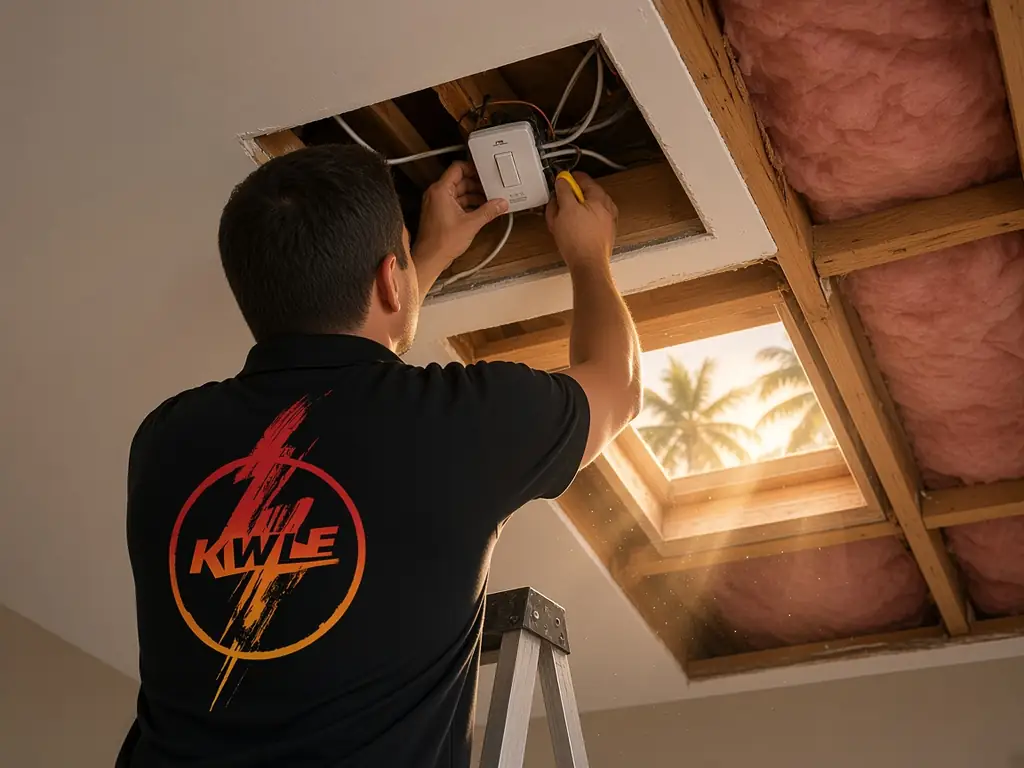
Attic fan installation in Tampa Bay: move the heat out
A Florida attic can climb past 140 degrees on a summer afternoon. That heat bakes the ceiling below, strains the air conditioner and ages wiring, ducts and insulation. A powered attic fan pulls hot air out and draws cooler air in through the soffits. It needs a proper circuit, a thermostat and safe wiring in a space that is hot, dusty and hard to reach.
Types of attic ventilation
- Gable-mounted fans: mounted in a vent opening at the end wall.
- Powered roof-mounted fans: installed through the roof deck.
- Solar-assisted fans: a panel runs the motor, sometimes with a backup.
- Whole-house fans: pull air through windows into the attic.
- Ridge and soffit systems: passive airflow without a motor.
- Humidity-controlled fans: run when moisture is high.
What the electrical side includes
- Florida electrical contractor license EC13014717, licensed & insured
- Woman-owned business based at 6248 Seminole Blvd, Seminole FL 33772
- 2-year workmanship warranty, 5 years with a Member Care Plan
- SPAN Authorized Installer and Home Depot preferred contractor
- Open 24/7 for electrical emergencies: call or text (727) 476-7079
The fan needs a dedicated or lightly loaded circuit, a junction box, a thermostat set near 100 to 110 degrees and sometimes a humidistat. We run the cable through the attic, secure it away from hot surfaces and insulation, and place a switch or a disconnect where it is easy to reach. Every connection goes inside a box with a cover.
Thermostats and controls
A thermostat turns the fan on when the attic is hot and off when it cools. A humidistat adds control during damp weather. Smart controls can log temperature and send alerts. We mount sensors in the shaded, central part of the attic, label each control and test the fan at several temperatures.
Safe wiring in a hot space
Attic wiring faces heat, dust and rodents. We use cable rated for the temperature, protect it with conduit where it crosses walkways and keep it off the ceiling insulation. Splices live in boxes. We also keep wires clear of the fan blades and the motor housing and confirm the fan is grounded.
Balance of intake and exhaust
A fan without enough intake pulls air from the house instead of outdoors, which wastes cooled air. Soffit vents should provide intake area equal to or larger than the fan needs. We check vents for blockage by insulation and recommend baffles or added vents where necessary, before the fan goes in.
Solar attic fans
Solar fans use a panel to run a motor and need no household wiring in many cases. Some models include an option for a backup connection. We install any needed wiring, protect it and confirm the panel’s orientation for steady sun. Solar panel work beyond a small fan is handled with licensed partners.
Replacing a failed fan
An old fan may squeal, run slowly, never turn on or run all night. Causes include a seized motor, a bad thermostat, a loose wire or a tripped breaker. We test the circuit and the motor, replace what failed and make sure the thermostat still works.
Quotes, permits and warranty
New circuits need a permit. Our workmanship carries a 2-year warranty, or 5 years with a Member Care Plan.
Rodents, wasps and wire damage
Squirrels, rats and roof rats chew insulation and leave droppings around fan motors and cable. Wasps build nests inside housings. Before we install or repair a fan, we inspect for damage, replace chewed wire and screen openings with metal mesh. We also recommend a pest professional when infestations are active.
Noise, vibration and balance
A new fan should hum quietly. Squeals and rattles come from loose mounting, bent blades or worn bearings. We mount motors on rubber isolators when the design allows, tighten fasteners and check blade clearance. A smooth, quiet fan is more likely to last and less likely to annoy you at night.
Ceiling hatches, ducts and kitchen exhaust
Fans pull air from wherever it is easiest. Open ceiling hatches, loose duct boots and leaky can lights give them a path from the living space. We seal hatches with weatherstripping, mark leaky penetrations for your insulation contractor and make sure bath and kitchen fans vent outside, not into the attic.
Energy use and operating hours
A typical attic fan motor uses a small amount of power compared with an air conditioner, but it runs many hours on hot days. A thermostat keeps hours down. Variable-speed motors can ramp up and down, and some include a low-power mode. We discuss which type suits your attic and habits.
Garages, workshops and detached buildings
Sheds, workshops and detached garages with unfinished attics get just as hot. A small gable fan on a thermostat can help protect tools, paint and stored items. We wire these from the nearest panel or subpanel with weatherproof cable and a clearly labeled switch.
Common questions
Do attic fans actually lower cooling use? They can reduce attic heat, which may help, but results depend on insulation, air sealing and intake vents. We discuss options before installation.
Do I need a thermostat? Yes. A thermostat keeps the fan from running when it is not needed.
Can a fan pull conditioned air out of the house? If the attic has gaps to the living space and low intake, yes. Air sealing and venting prevent it.
Are solar fans wired? Many need little wiring. Some include a backup connection, which we install.
Can you replace my noisy fan? Yes. We replace motors, thermostats and wiring.
Do you work in tight attics? Yes, with proper safety gear and early-morning schedules in summer.
How long does installation take? Many jobs take a few hours, longer for new circuits.
Do I need a permit? A new circuit does. We handle it.
Local pages: attic fan installation in Seminole, our home base. See also Pinellas County, Hillsborough County and Pasco County service areas, or browse all electrical services. Related: attic fan installation.
Call or text (727) 476-7079 for attic fan installation in Tampa Bay, or book online. Business hours 7 AM–5 PM, weekend service, 24/7 emergency calls.