
Need storefront sign electrical in Indian Shores? Keywest Lights & Electric provides storefront sign electrical in Indian Shores when a shop needs a listed sign circuit, a disconnect in sight of the sign, and a timer or a photocell that actually controls it. We are a licensed, woman-owned shop. This ticket is the sign feed and the control, not a full commercial lighting layout, not a general shop repair, and not a permanent eave-lighting display, which has its own page. We coordinate the facade, the association if the building requires it, and a weather-rated path from the can to the letters or the cabinet.
Request storefront sign electrical in Indian Shores
Tell us what you need and where the work is. A licensed electrician will reply with next steps and a time to visit.
From the Seminole shop we also do a commercial electrician visit, commercial generator installation, a home charging circuit and a backup generator install in Indian Shores.
Call or text (727) 476-7079 · open 24/7 for emergencies · request a quote online
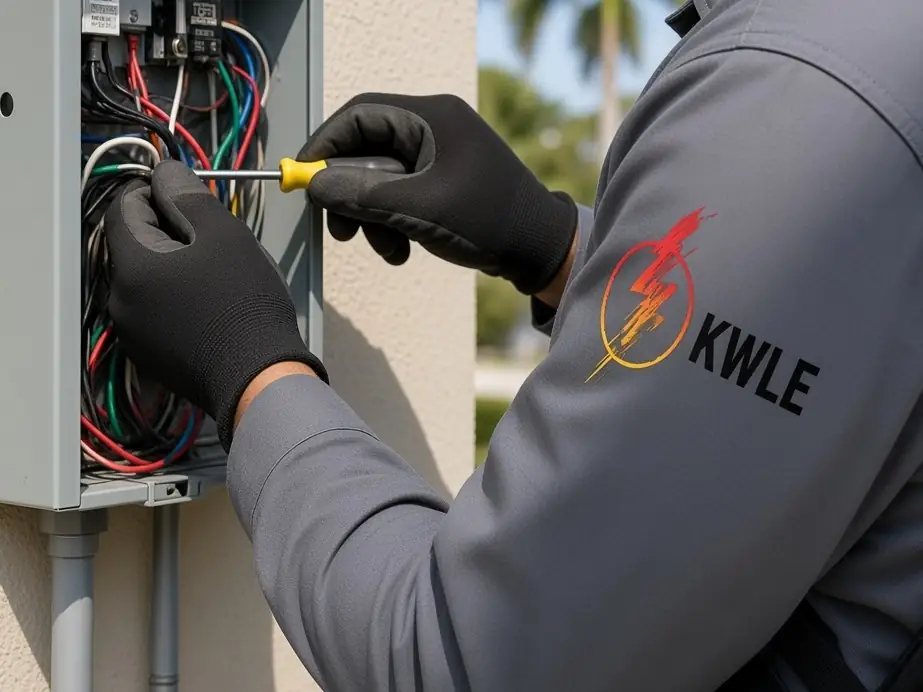
Storefront Sign Electrical in Indian Shores: a sign circuit, a visible disconnect, a dusk control
A storefront sign here is often a set of channel letters, a small cabinet, or a blade sign on a Gulf Boulevard shop, sometimes on a mid-rise ground-floor facade. The work is a dedicated sign branch, a listed disconnect that a later tech can reach without a scavenger hunt, and a photocell or a time clock. We do not steal a lighting leftover and call it a sign circuit. We also ask about the look the building will accept before we punch a facade.
Sign work we handle here
- Florida electrical contractor license EC13014717, licensed & insured
- Woman-owned business based at 6248 Seminole Blvd, Seminole FL 33772
- 2-year workmanship warranty, 5 years with a Member Care Plan
- SPAN Authorized Installer and Home Depot preferred contractor
- Open 24/7 for electrical emergencies: call or text (727) 476-7079
- A dedicated sign circuit and a listed disconnect in sight of the sign.
- A photocell, a time clock, or both, as the owner wants the sign to run.
- A weather-rated path to channel letters, a raceway, or a cabinet sign.
- A repair of an existing sign feed when the sign itself is staying.
How a sign feed is planned
We look at the sign listing and at the can. A 20-amp sign branch is common; a larger landing is used when the listing needs it. The disconnect is placed in sight of the sign, or as the listing and the layout require, not in a locked back room two halls away. A photocell is aimed at the sky, not at a porch light that will keep the sign dark. A mid-rise facade may need a written ok from the association, and we ask before we drill.
Commercial lighting, shop repairs, and permanent eave lighting are on other pages
Commercial lighting installation, commercial electrical repair, and permanent lighting on the eaves and soffits each have a separate page. If the whole suite needs new troffers, use the suite-lighting page. If the sign is fine and a shop circuit is dead, use the repair page.
Mid-rise facades, a salt-air blade, and a look the building has to accept
A ground-floor sign on a mid-rise is a common case here, and the association may have a rule about size, location, or raceways. We ask. Salt air eats cheap fittings on a blade sign or on exposed letters; we use listed, weather-rated bodies. A seasonal shop may want a time clock so the sign is not lit all summer while the suite is empty.
Sign feeds we will not leave in place
We will not feed a sign from a random lighting leftover. We will not skip the disconnect. We will not bury a joint in a wet letter with no listed enclosure. An indoor-dry time clock in a wet soffit, or a photocell aimed at a neighbor’s flood, is not a control we will leave.
Channel letters, a 60-VA LED supply, and a raceway or a back-can
Channel letters often use a listed LED supply, sometimes in the 60-VA class, mounted in a listed enclosure, not loose in a wet letter. A raceway or a back-can is used when that is the listed path. We do not staple a low-voltage LED lead across a stucco face and hope.
A disconnect in sight, a 20-amp sign breaker, and a labeled directory line
The disconnect is in sight of the sign whenever the layout can make that true. A 20-amp sign breaker is the usual branch, and it is labeled “sign” on the directory, not “circ 7.” We test the on and off at the breaker, at the disconnect, and at the control.
A photocell button, a 24-hour time clock, and a hand-off switch
A photocell button, or a stem photocell, is listed for the location and is aimed at the sky. A 24-hour or a 7-day time clock is used when the owner wants a hard off at a set hour. A hand-off-auto switch, when it is in the plan, lets staff test the sign at noon without fighting the photocell.
A mid-rise punch list, a facade sleeve, and a night aim
We sleeve the facade penetration, we seal it, and we aim or we watch the sign at dusk when we can. A leftover hole is not a finish. The sign map is written on the work ticket.
A 60-watt class LED module, a 12-volt secondary, a wet-listed splice box, and a 1/2-inch Myers hub
A 60-watt class LED module is common in channel letters. A 12-volt secondary, when the supply uses one, stays in a listed enclosure. A wet-listed splice box and a 1/2-inch Myers hub are used at the facade, not a dry indoor box on the stucco.
A 7-day quartz clock, a HOA-auto switch, and a 20-amp GFCI when the location requires it
A 7-day quartz clock, or a digital astronomic clock, is used when the owner wants a hard off. A HO-A-auto (hand-off-auto) switch is labeled so staff can test at noon. A 20-amp GFCI is added only when the location requires it, and it is not used as a substitute for the sign disconnect.
A 120-volt primary, a class-2 secondary, a wet-location strain relief, and a 3/8-inch greenfield whip are used when the sign listing calls for that path. A neon remnant, if one is still on the facade, is treated as a listed repair or a removal, not as a leftover to “just relight.”
A sealtite whip, an LB condulet, a weathertight-bushing, an SMD module, and a retainer-clip are used when the sign listing calls for that path. An acrylic-face cabinet, if the sign is a box rather than letters, still gets a listed disconnect and a listed control.
A pigtail-whip, a water-tight cord-grip, a drain-weephole, a raceway-cover, and a letter-return are used when the sign listing names them. A stand-off spacer keeps a letter off a wet stucco face.
A service-window, a lexan face, and a pixel-controller
A service-window in a cabinet sign, when one exists, stays accessible, not hidden behind a new fascia. A ballast-access door, a weep-baffle, a hinge-rail, and a lexan face are used when the cabinet listing names them. A transformer-shelf stays dry and listed, not in a wet letter can. A remote-driver closet, a dimming-interface, a RGBW module, and a pixel-controller are used only when the sign listing names that control.
A 277-volt sign we will not land on 120, a 15-amp neon leftover, and a dusk-trim pot
A 277-volt sign is not landed on a 120-volt shop can, and we will say so. A 15-amp neon leftover is not a new LED letter feed. A dusk-trim pot, when the photocell has one, is aimed and is not left at the factory stop. A potted-driver and a conformal-coat board are used only when the letter listing names them.
A drip-skirt, a kep-nut, and a halo-lit letter
A drip-skirt, a kep-nut, a star-washer, and a thumb-screw are used when the sign listing names them too. A 15-amp fascia-wash leftover is not a letter feed. A 20-amp awning-sign branch is pulled only if that awning sign is already agreed. A 12-volt halo-lit letter is landed only if the letter listing calls for that supply. A j-hook is used only if the listing names one.
Questions we hear in Indian Shores
Do you provide storefront sign electrical in Indian Shores? Yes. We install or repair the sign circuit, the disconnect, and the dusk or timer control for a shop sign, including channel letters and cabinet signs.
Is this the same as a suite lighting package or a general shop call? No. A suite lighting layout and a general shop repair are described on other pages. This visit is the sign feed and its control.
Does the mid-rise association have to approve the sign? Often yes, when the sign is on a shared facade. We ask before we drill, and we will not punch a wall that the building has already refused.
How do I start a storefront sign electrical visit? Call or text (727) 476-7079 and send a photo of the sign or the proposed letters and the shop address. Our shop in Seminole is about 4 miles from town.
Crews roll out from our shop on Seminole Blvd, about 4 miles from town, and work along Gulf Boulevard, the Tom Stuart Causeway, the Intracoastal and the Gulf shore. We also take calls in Seminole, Bay Pines, Redington Shores, Indian Rocks Beach and North Redington Beach.
Back to the service: Storefront Sign Electrical in the Tampa Bay area. For a full list in this town, visit Indian Shores electrician services.
Nearby towns: Seminole
Call or text (727) 476-7079 for storefront sign electrical in Indian Shores, or book online. Shop hours 7 AM–5 PM, weekend service, 24/7 emergency calls.