
Need partial power outage repair in Bear Creek? Keywest Lights & Electric handles partial power outage repair in Bear Creek when one room, one wall or one branch is dead and the rest of the house is still on. We are woman-owned and licensed, based a short drive away on Seminole Blvd.
Request partial power outage repair in Bear Creek
Tell us what you need and where the work is. A licensed electrician will reply with next steps and a time to visit.
In Bear Creek, we also take backup generator hookups, JellyFish lighting, battery backup installation and solar installation. Other pages for this area cover commercial electrician, commercial generator installation and ev charger installation.
Call or text (727) 476-7079 · open 24/7 for emergencies · request a quote online
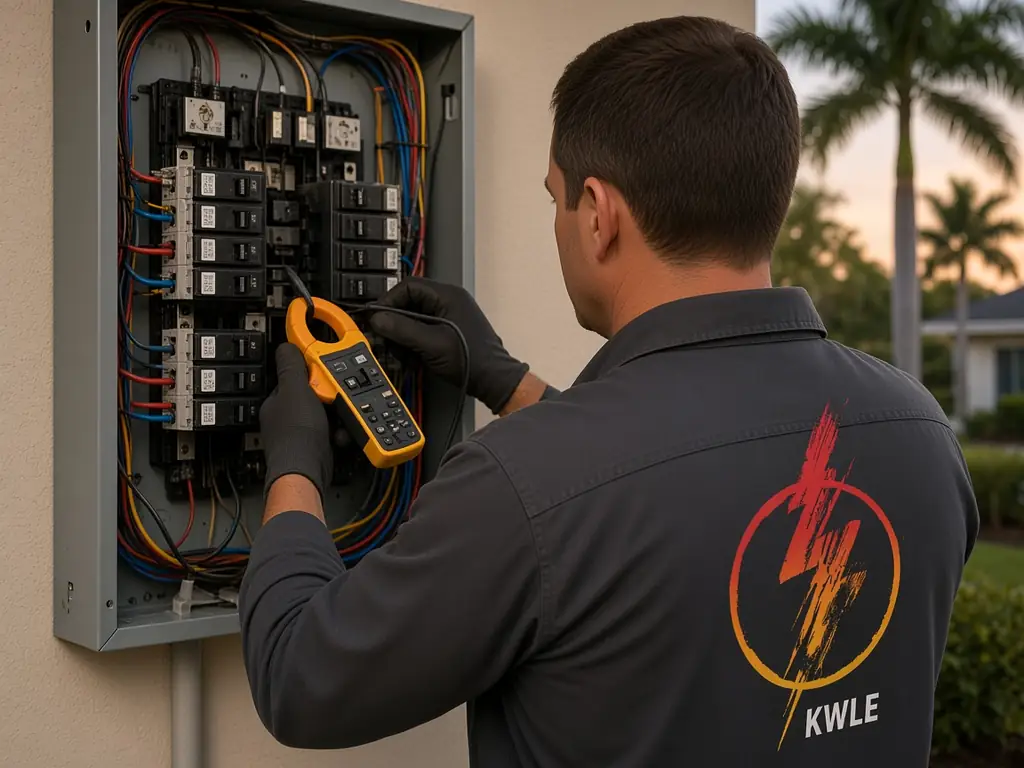
Partial power outage repair in Bear Creek: find the open, then repair it
A partial outage is not a whole-house blackout. Half a kitchen, a dead bedroom wall or a garage that went dark while the living room stayed on is the usual call. We start at the cabinet, we see which breakers are tripped or which landings are dead, and we trace the open. We do not reset a breaker all afternoon and call that a repair. We do not treat this as a full emergency outage when half the house is already on; that work has its own page.
What the trace usually turns up
- A tripped or weak breaker: we test it, and we replace it when it is the fault.
- An open neutral or a loose landing: at the can, at a splice or at a device.
- A burned backstab: a mid-century device that finally let go.
- A shared wall or a later add-on: a splice that failed in a closet or an attic.
- A wet exterior box: a porch or a garage branch that opened after weather.
This is not a full-house outage and not only a breaker swap
- Florida electrical contractor license EC13014717, licensed & insured
- Woman-owned business based at 6248 Seminole Blvd, Seminole FL 33772
- 2-year workmanship warranty, 5 years with a Member Care Plan
- SPAN Authorized Installer and Home Depot preferred contractor
- Open 24/7 for electrical emergencies: call or text (727) 476-7079
If the whole house is dark, start with our emergency electrician page. If you already know a single breaker is bad, the breaker-replacement page may be enough. This page is the trace: one branch or one room is dead, and we have to find out why.
Mid-century backstabs and a loose neutral
Most houses here date to the 1950s through the 1970s. A backstab that finally opened, or a loose neutral on a shared bar, is a common cause. We pull devices on that branch, we check the can and we repair the open. We do not leave a loose neutral as a “watch this” note.
Shared walls, a condo stack and a neighbor’s work
In a building with many units, a partial outage can live in a meter room or a shared chase. We ask for access. We do not open a neighbor’s wall without a yes. If the open is on the house side of the meter, we say so and we stop at that line.
How we trace it
We map the dead devices, we test the cabinet and we follow the branch through closets, attics and opened boxes. We tell you what we found before we cut a finished wall. A toner or a listed tester is a tool, not a guess.
Paperwork
A device repair or a breaker swap can stay modest. A new run or a cabinet repair usually needs a permit. We tell you which applies before we go past the first fix.
Labor coverage
Trace-and-repair labor is covered for two years, and five if you enroll in the Member Care Plan. Devices and breakers stay on manufacturer terms.
After power is back on the branch
If the same wall dies again in the first days, tell us. We would rather find a second loose device than leave a hidden open on the same run.
Open neutrals, a shared bar and a voltage we will not ignore
A dim, uneven or “half-bright” room can be an open neutral. We treat that as urgent. We do not keep resetting a breaker while the voltage on the branch is not honest.
Attic splices, a buried wirenut and a later add-on
A later window unit or a garage add-on often hides a splice that was never in a listed box. We put that joint in a listed, accessible box. We do not bury a wirenut in insulation and leave.
A clamp meter, a noncontact detector and a written map
We use a clamp meter and a noncontact voltage detector as we trace. We write a short map of the dead branch. The next visit should not start from zero if a second device on the same run is tired.
Wildlife, plaster and a nicked cable
A mid-century plaster wall or an attic run can hide a nicked cable. We repair what we can see. We do not fish a new run blindly through a damaged span and hope.
A shared kitchen, a dead half and an open neutral
A kitchen with half the devices dead, or a room that is dim and uneven, is often an open neutral. We treat that as urgent. We check the bar in the can and the devices on that branch. We do not keep resetting a breaker while the voltage is not honest.
A toner, a fish tape and a nicked span
When the open is in a wall, we use a toner and, if we have to pull a new span, a fish tape or a glow rod only on an honest path. We do not force a rod through a hidden splice.
AFCI, a GFCI and a cascade trip
A cascade trip can look like a partial outage. We see which protector opened — a branch AFCI, a GFCI or a standard breaker — and we repair the fault, not only the trip. We label the reset so the next event is easier to read.
Aluminum branches and a loose lug
If a mid-century branch is aluminum, we check the lug and the device listing. A loose aluminum landing is a common open. We pigtail with a listed connector. We do not leave a loose lug as a “watch this” note.
A multiwire branch and a borrowed neutral
A mid-century multiwire branch can hide a borrowed neutral. If we find one, we tell you and we repair it honestly. We do not land a new device on a borrowed neutral and call the wall safe.
Backfed devices, a feed-through and a dead downstream string
A dead string of receptacles can start at one backstab or a failed feed-through. We open that first device, we pigtail with a listed connector and we test downstream. We do not swap the last dead receptacle first and hope.
Attic cans, a slider and a loose fixture feed
A partial outage in a hall can be a loose feed in an attic can or a slider box. We check those before we open a finished wall. We put the joint in a listed, accessible box.
Water in a porch box and a green film
A porch or garage branch that died after weather often has water and a green film in the box. We replace the device and the box if the enclosure is tired. We do not dry it with a rag and leave the same open fittings.
A tandem breaker and a directory that lies
A tandem or slimline breaker can hide a mislabeled branch. We test which landing is actually dead. We write the directory so the next outage is easier to trace.
Knob remnants, cloth cable and a later splice
On an older cottage, a later splice can land on leftover cloth or a knob remnant. We isolate that and we replace the span with listed cable. We do not leave a live, undocumented joint in an attic.
A subfeed lug and a garage that died
A garage or a later addition may hang on a subfeed lug or a small feeder. If that lug is loose, half the addition can go dark. We tighten or we replace the landing, and we torque it to the listed value.
Continuity, polarity and a megohm check
We check continuity and polarity on the dead branch, and we use a megohm or insulation check when a nicked span is the suspect. An ammeter tells us if a borrowed load is still trying to run. A loose locknut, a missing grommet or a splayed end with no ferrule is a common open at a box.
A deadfront, a busbar and a tired landing
If the open is in the can, we look at the deadfront, the busbar and the landing. A slimline or tandem that was added later can hide a loose stab. We tighten it to the listed value, or we replace the landing. A Phillips, a Robertson or a hex or Allen key is for the listed screw, not for “gosh-tight” on a soft bar.
A plug-on stab, a utensil drawer and a surprise open
A dead kitchen wall can start at a plug-on stab in the can, or at a receptacle behind a utensil drawer that no one opens. We check both. A heat-shrink boot or a star washer is only used where the listing allows it, not as a way to pack a loose landing.
Common questions
Do you handle partial power outage repair in and around Bear Creek? Yes, when one room or one branch is dead and the rest of the house is still on. Call or text (727) 476-7079 with a photo of the directory if you can.
The whole house is dark. Is this the right page? No. Start with our emergency electrician page for a full outage.
Do you just reset the breaker? No. We find the open and we repair it. A reset is a test, not the fix.
Can the outage be in a shared meter room? Yes, in a multi-unit building. We ask for access, and we stop at the line we do not control.
How do we get this trace on the calendar? Send the address, which rooms are dead and a photo of the cabinet if you can, or call or text (727) 476-7079.
Our trucks leave the shop on Seminole Blvd, about 6 miles from Bear Creek, and work near Bear Creek and Boca Ciega Bay. We also serve South Pasadena, St. Pete Beach, Kenneth City, Treasure Island and Gulfport.
Up: Partial Power Outage Repair across Tampa Bay.
Call or text (727) 476-7079 for partial power outage repair in Bear Creek, or book online. Business hours 7 AM–5 PM, weekend service, 24/7 emergency calls.