St. Pete’s waterfront neighborhoods each have their own kind of roofline. Snell Isle has Mediterranean-inspired homes on seawalled lots, Old Northeast has bungalows and Colonial Revival houses a few blocks from the Vinoy, and Shore Acres has low-lying streets where the bay is never far away. Keywest Lights & Electric installs JellyFish Lighting across the city from our base in Seminole. We are an Authorized Dealer of JellyFish Lighting and an independent, licensed electrical contractor (EC13014717), not JellyFish Lighting, the company.
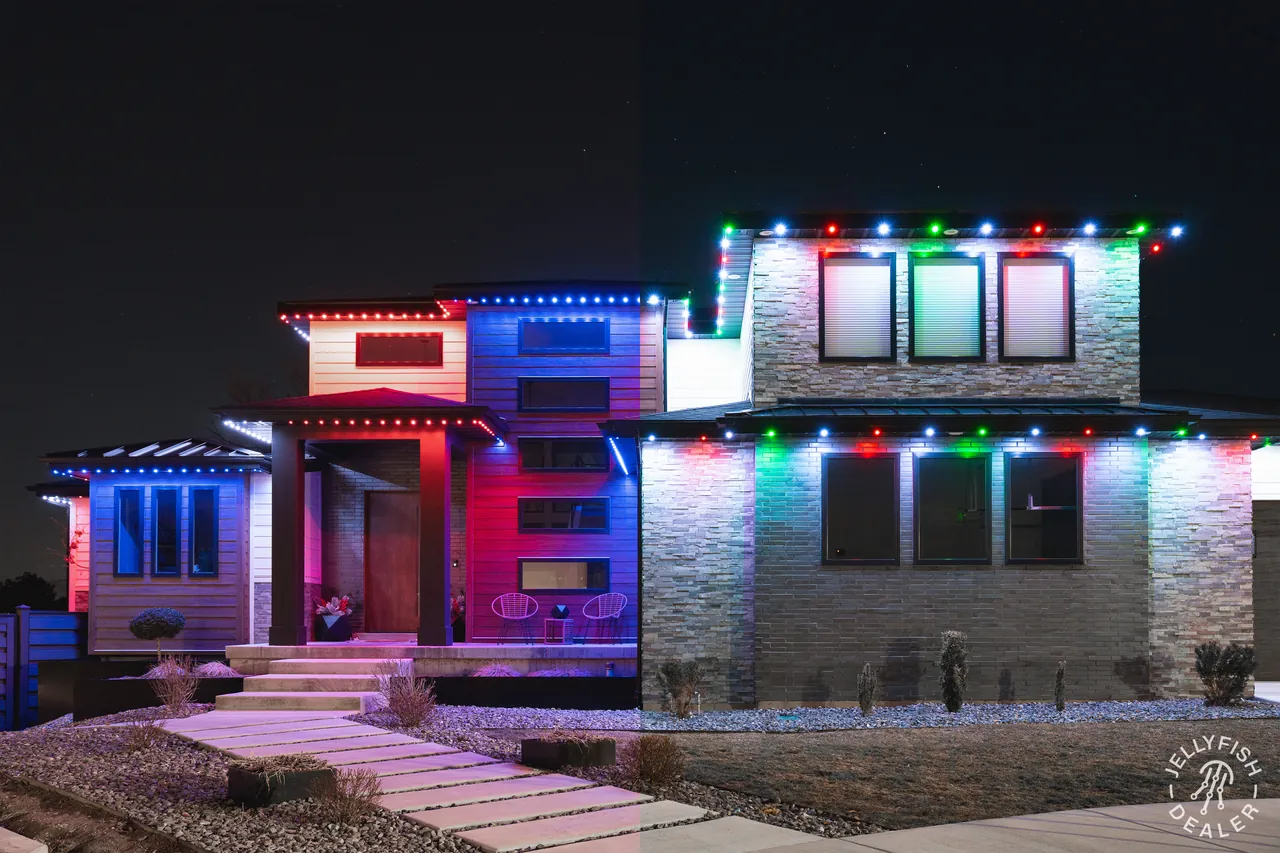
The lights stay up all year and earn their keep on ordinary nights: a warm glow on the trim, a brighter white over the driveway and back door, and steady color for a business. Holiday scenes are one more setting in the app, ready when you want them.
Lighting a St. Pete home or storefront? Call (727) 476-7079 or request a free estimate online.

Keywest Lights & Electric is an Authorized Dealer of JellyFish Lighting. We are not JellyFish Lighting.
Snell Isle: Mediterranean homes on seawalls
C. Perry Snell bought the land in 1911 and began developing it in 1925. Only about 39 of the 275 planned acres sat above high tide, so most of the island was built up with dredged fill and seawalls, and it was planned as a waterfront community inspired by Mediterranean architecture. Many lots back onto Tampa Bay or Coffee Pot Bayou, so a lit roofline here is seen from the water as much as from the street.
On waterfront homes like these we take extra care with the details: the track color is matched to the soffit, runs between roof sections go through the attic where the house allows, and the light spacing is chosen to suit the scale of the facade.
Old Northeast: bungalows, Colonial Revival and historic review
The North Shore Historic District, listed on the National Register in 2003, runs from 4th St N and 5th Ave N to Tampa Bay and up to 30th Ave N. The National Park Service lists its styles as Bungalow/Craftsman and Colonial Revival, built between 1900 and 1949. Inside it, the city has designated local districts such as the 200 block of 10th Ave NE and the 700 block of 18th Ave NE, where exterior changes need a Certificate of Appropriateness. We check your address before we schedule.
Craftsman bungalows have wide, deep eaves that are ideal for a track, and a 2700K warm white makes porch columns and trim look the way they were meant to. The neighborhood is also close to the city’s Holidays in the Sunshine City displays in North and South Straub Parks, Pioneer Park and the St. Pete Pier, so December scenes here have good company.
Shore Acres: low ground, high-mounted power
The city describes Shore Acres as a neighborhood that experiences recurrent flooding, and its Shore Acres Resiliency Infrastructure Project adds a stormwater pump station and box culverts and raises a seawall section and roads near Connecticut Ave NE. According to a Bay News 9 report on a city presentation, the neighborhood was built in the 1920s on marsh with about three feet of fill, and more than 1,200 of its 2,863 homes flooded during Idalia in 2023.
That shapes how we install. The controller and power supply go high on an inside wall, never near the floor, and the outlet feeding them has GFCI protection. If your home has been elevated, the eaves sit higher than before, which we plan for at the estimate.
Lighting and sign rules in St. Pete
St. Petersburg’s outdoor lighting code aims to keep light pollution down, so our everyday scenes for homes use lights aimed straight down from the soffit at a moderate brightness, with nothing pointed at a neighbor’s windows. For businesses, the city’s sign code prohibits lighting that changes intensity, brightness, color or direction. A shop or restaurant gets one steady brand color on a schedule, and we check the code for the address before we set anything up.
Wind, salt air and storm tides
Pinellas County’s local building code amendment sets a 145 mph design wind speed for typical homes, which places all of St. Pete in the wind-borne debris region, and Helene set a record 6.31-foot water level above high tide at the St. Petersburg gauge in 2024. We fasten the track to solid framing along the soffit or fascia, use corrosion-resistant hardware near the bay, and keep every connection sealed.
From estimate to first scene
- Estimate: we measure the roofline, check the soffit and trim, and pick the controller spot with you.
- Proposal: footage, track, spacing and any electrical work, in writing.
- Approvals: if your block is in a local historic district or your home has deed restrictions, we help with what the review needs.
- Install and setup: power, track and lights, then we program your everyday, security and holiday scenes in the app.
You get JellyFish Lighting’s 5-year parts warranty on the roofline lights, controllers and power supplies, and our own workmanship warranty covers the install for 2 years, or 5 years for Member Care Plan members.
St. Petersburg JellyFish Lighting FAQ
Do sea turtle lighting rules apply on Snell Isle or in Shore Acres? Not the way they do on the Gulf beaches. These neighborhoods face Tampa Bay, not a nesting beach, and St. Petersburg is not on FWC’s list of cities with a sea turtle lighting ordinance. If you also own a place on the Gulf, we set that home up with turtle-friendly schedules that keep the lights off near the beach from May 1 through October 31.
My home is in a local historic district in Old Northeast. Can I still add permanent lights? Usually, yes. Exterior changes in St. Pete’s local historic districts need a Certificate of Appropriateness, so we check whether your block is in one before we schedule. The track is color-matched to the soffit and sits behind the trim, which keeps the change small.
Can a Central Avenue shop use color-changing JellyFish lights? Not on the building. St. Petersburg’s sign code prohibits sign lighting that changes intensity, brightness, color or direction. We set businesses up with one steady brand color on a schedule and check the code for your address first.
My street floods. Where does the controller go? Indoors and up high. The controller and power supply mount on an inside wall, usually in the garage, well above the floor, and plug into a GFCI-protected outlet. The lights and track are sealed for outdoor use, and the wiring stays inside the track or the attic.
Do I need a new outlet for the lights? Only if there isn’t a suitable one near the controller spot. When we add a new outlet or dedicated circuit, that work requires an electrical permit. We pull it and handle the inspection for you.
Read more about the system on our JellyFish Lighting page and our permanent lighting overview. Elsewhere in the county, see JellyFish Lighting in Pinellas County, and for everything else we do in the city, our St. Petersburg electrician page.
Ready to light your St. Pete home? Call (727) 476-7079 or book a free estimate online.
JellyFish Lighting is a trademark of JellyFish Lighting. Keywest Lights & Electric is an independent Authorized Dealer and is not JellyFish Lighting, the company.