
Request a free estimate.
Tell us your address and whether the home is one or two stories. Add a front photo for a free design preview. A licensed electrician will call or text you back.
We can bond work up to $1 million and take projects up to $2 million.
Comparing the best permanent Christmas lights? Skip the brand battle and check the features that decide how a system looks. Lasts and works on your house. This guide from Keywest Lights & Electric. A licensed electrical contractor in Seminole. Lists what to look for in any permanent outdoor lighting system. From how it mounts to the warranty. 2 Years.
Want Tampa Bay glowing before Hanukkah and Christmas? Get on our schedule early. After signing, the JellyFish order is placed. We book your install date when it arrives.
Want to see a system on your home? Get a free design preview or request a free estimate.
What “best” should mean for a permanent system.
Searches for the best permanent Christmas lights or the best permanent outdoor lights tend to compare app screenshots and color demos. Those matter, but a permanent system stays on your house for years. Outdoors. Through Florida sun. Salt air and storm season. So the best system for your house is the one that looks right by day. Holds up outside. Is easy to run. Has someone local standing behind it. Below are the features worth checking on any system. Whatever name is on the box.
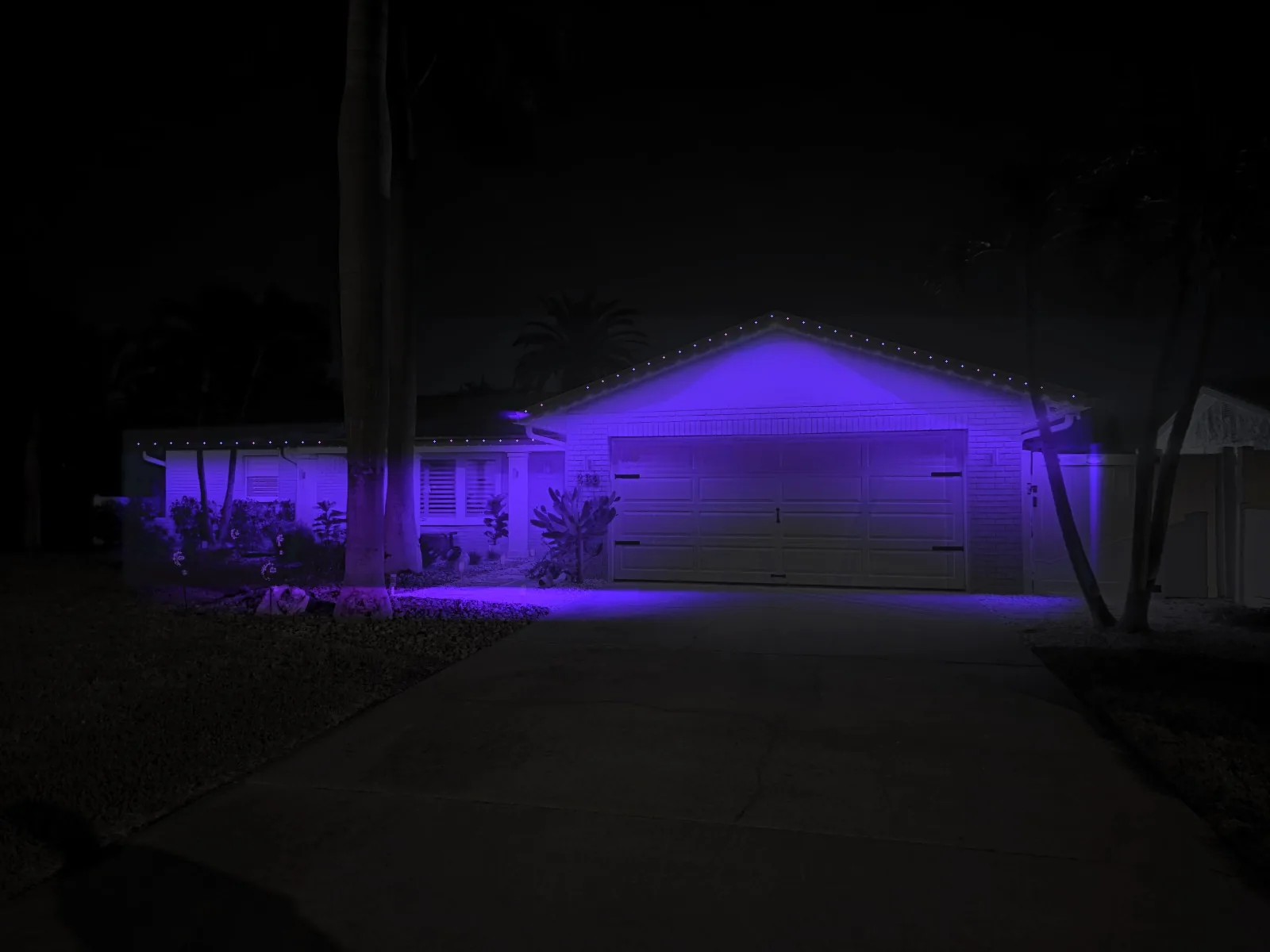
Along with permanent Christmas light installation. We set up Hanukkah scenes that start at sundown, ready for all eight nights. Want a look first? The free design preview shows permanent house Christmas lights on a photo of your home.
How it mounts, and where.
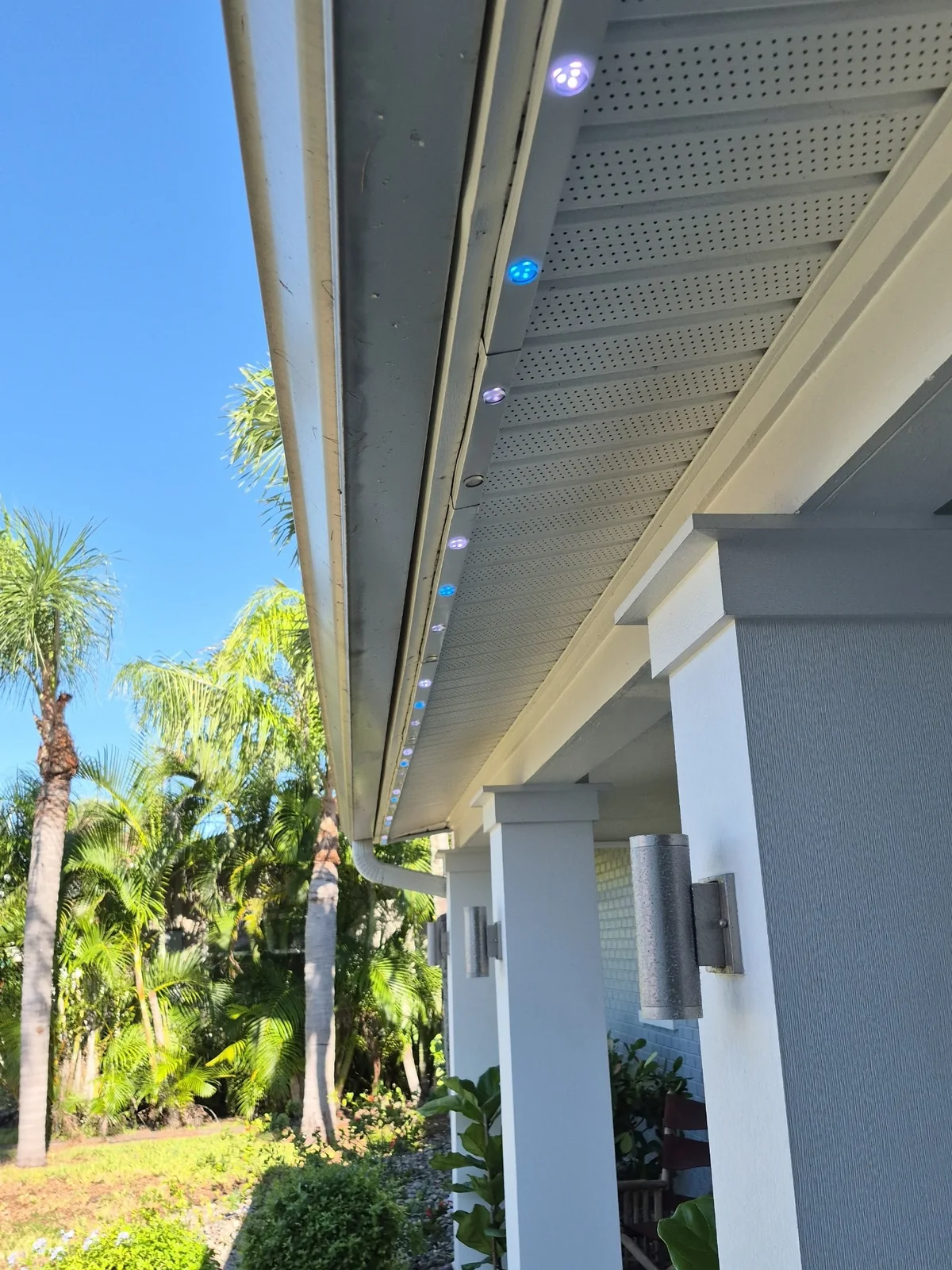
Look for a low-profile channel that fastens beneath the soffit and up the gable rakes. The track stays under the eaves and soffit and up the gable rakes. Fasteners through shingles or tile are a leak risk you don’t need. The channel should come in colors that match common trim. So it reads as part of the house in daylight. Ask how the ends, corners and gable rakes are finished. Clean corners are the difference between a system that looks built-in and one that looks added on.
Individually addressable lights.
The better systems let every light be set on its own. That’s what makes patterns, chases, a two-color candy-cane look or a soft fade possible. It’s also what lets one run be warm white while another is bright security white. Systems that only change a whole strand at once are more limited. If you want holiday scenes plus everyday accent lighting. Individual control is close to essential.
Light quality: whites, brightness and diodes.
Color demos are easy. A good everyday white is harder. Ask whether the system can produce a true warm white and a cooler security white. And whether brightness dims smoothly down to a subtle glow. Lights that combine several diodes per bulb tend to mix colors and whites more evenly. See the lights in person or on video at night. Not just in photos, before you decide.
Spacing choices.
Spacing between lights changes the whole look. Tighter spacing gives a fuller, classic holiday line. Wider spacing gives a quieter accent that suits everyday use. A system that offers several spacing options lets the installer match the look to your house and your neighborhood rather than forcing one style.
Built for outdoor life in Florida.
Ask how the lights and connections are sealed against rain and humidity. How they hold up to strong sun. What fasteners are used near salt air. Connections should sit inside the channel, out of standing water. The electronics, meaning the controller and power supplies, usually belong in the garage. When a garage won’t work, a weatherproof outdoor box protects the controller.
Power and the controller.
A well-designed system usually runs its controller from an ordinary garage outlet and steps the power down to low voltage for the lights. When a garage won’t work, a weatherproof outdoor box protects the controller. Ask where the controller goes, how many power supplies a large house needs. Who checks that the outlet is GFCI-protected. If a new receptacle or circuit is needed, that’s electrical work. It should be done by a licensed electrician with a permit when required. You may also like what goes into a permanent lighting quote. For more ideas, read eave lighting for Tampa Bay churches and schools.
The app, schedules and smart-home control.
You’ll use the app far more than you’ll look at the hardware. Check that it can schedule scenes by date and by sunset. Store a full calendar of holidays. Adjust brightness. And split the house into zones if you want that. Smart-home and voice support is a plus if you already use a voice assistant or a home-automation system. Ask whether the controller gets feature updates over time.
Serviceability and warranty.
Find out what happens when one light fails. On a good system. The rest stay lit and a single light can be swapped without replacing a whole run. Then read the warranty in two parts. The manufacturer’s parts coverage and the installer’s workmanship coverage. Both matter, and both are only as good as the company that honors them. Ask who you call and how quickly they respond.
Storm season and beach rules.
In Pinellas, a permanent system should ride out summer storms without anyone climbing up to take it down. That means a channel screwed firmly into sound trim, no loose strands, and electronics indoors. For Gulf-front homes, the app should make it easy to keep beach-facing lights dark through sea turtle nesting season. Then bring them back for the holidays. Ask any installer how they handle both.
The daytime test.
Most of the time your lights are off. So judge a system by how the house looks at noon. Ask to see daytime photos of real installs, not just night shots. The channel should be hard to spot from the street. No visible wire runs, no plug strips and no gaps at the corners. If the daytime look isn’t right, the nighttime show won’t make up for it.
Store-bought kits versus a professional install.
Retail kits can be a fine choice for a renter or a simple single-story eave. A professional system costs more up front but adds design. Clean mounting. Proper power and local service. Consider the height of your eaves. The number of corners. Whether you want the electrical side done by a licensed electrician. How long you plan to stay in the house.
What we install, and why.
Keywest Lights & Electric is an Authorized Dealer of JellyFish Lighting. It’s the system we install, because it checks the boxes above for Pinellas homes. A trim-matched channel beneath the soffit. Individually addressable lights. Strong whites. Several spacing options. A controller that usually sits in the garage, or in a weatherproof outdoor box when needed and a parts warranty backed by the manufacturer. With our own workmanship warranty on top. We’re an independent licensed electrical contractor based in Seminole, not the JellyFish company. See our JellyFish Lighting page for details.
Weighing a permanent system for a Tampa Bay home?
One existing garage outlet powers the system. And the control hub sits right beside it. What a good install looks like on a Tampa Bay home. A straight, evenly spaced line on each eave and gable rake. With every fastener in the fascia and soffit and none in the shingles.
Because summer storms come with living here. The JellyFish track goes on low-profile and tight to the front trim. We treat it as electrical work first. So wiring is checked before any light goes up. A clean result comes down to careful spacing along the eave line and gable rakes. Who does the work matters too. KWLE is a woman-owned electrical contractor under Florida license EC13014717. Our install labor is covered 2 years. Questions go to (727) 476-7079.
Placement is part of what makes a system the best.
A well-made light can still look wrong if it is mounted in the wrong place. Ask any installer to mark the plan on a photo of your house before you sign. On our designs the track follows the eaves and soffit and climbs the gable rakes. And nothing fastens through shingles or tile. Check that the plan stops at natural breaks. Such as a downspout or an inside corner. So the line looks intentional by day as well as at night.
Service after the sale matters as much as the hardware.
The best system is one a local team will look after. Before choosing, ask who you call if a single light goes dark in year three. Who comes out to look at it. And who handles the warranty paperwork. With JellyFish through KWLE. You get the 5-year JellyFish manufacturer warranty plus our 2-year workmanship warranty. Many companies stop at 1 year on workmanship, but we stand behind our work.
Timing is the last test. Once any HOA approval is in and the proposal is signed. We order the material and schedule the install. A system that’s right on paper but installed after Christmas Eve. Thursday. December 24. Misses the season you bought it for.
Comparing written proposals side by side.
Once two or three companies have looked at the house. Line their written proposals up and check that each one answers the same questions. Which eaves and gable rakes are included, and which are left dark? What light spacing. And is it the same on every run? Where will the controller and power supplies go. Is any new outlet or circuit included or listed separately? Who installs it: the company’s own employees or a subcontracted crew? Who prepares the HOA paperwork? What does the parts warranty cover. What does the workmanship warranty cover, and for how long?
A proposal that leaves these blank is hard to compare. The gaps tend to surface on install day. Ask for a marked-up photo of your house showing every run. It is the fastest way to see whether two proposals actually describe the same job.
Warning signs while you shop.
A few things should slow you down. Pressure to sign on the spot, or a special offer that only lasts until the salesperson leaves. A plan that does not keep every run under the eaves and up the gable rakes, or that fastens anything through shingles or tile. No license number on the proposal for the electrical part of the work. Only nighttime photos, with no daylight view of how the track looks on a finished house. A warranty that names the manufacturer but says nothing about who comes out when a light goes dark.
None of these alone settles it. A company that is careful about the house is usually careful about all of them. For our own process from preview to app setup, see the JellyFish Lighting page. The permanent vs seasonal guide covers the other choice.
Glare, aim and the view from next door.
A system can look perfect from your driveway and still bother the house across the street. Before you choose, ask how bright the lights get at the top of their range and how that brightness can be turned down. Lights tucked under the soffit mostly light the trim and the wall below. And the overhang limits how much shines upward or off to the side. Ask, too, whether brightness can be set by section. A run facing a neighbor’s front window can stay lower than the rest of the house.
On a demo, look at the lights from an angle. Not only head-on. Since a bare diode can look harsh from the side while a lens spreads the light more evenly. A good installer will talk about where the light lands. Not just how much of it there is.
Will parts still fit in ten years?
Permanent lighting is meant to stay up for many years. Ask how the system will be supported long after the sale. Will a replacement light in year eight match the color and brightness of the ones beside it? Can the controller be replaced on its own, without taking down the track? If the manufacturer updates its lights, do the new ones fit the existing channel? Ask whether the app is still maintained and updated. And what happens when your phone’s operating system changes.
Then ask the installer where its replacement parts come from and how a warranty claim actually works. Who files it, who comes out. And what the visit involves once the workmanship warranty ends. Clear, written answers are a better sign than a long spec sheet. With JellyFish, we walk you through the 5-year parts warranty and our 2-year workmanship warranty before you sign.
Whose name is on the app account?
Ask this before you sign. When the job is finished. Whose email owns the app account that runs your lights? It should be yours. If an installer sets the controller up under a company login and shares it with you. You may lose control if that company closes, moves on or stops answering. The same goes for a builder or a previous owner. A good install connects the controller to your home Wi-Fi under an account you create. An email you plan to keep for years.
You can then add your spouse, a relative or a house sitter as you choose. The installer may keep a service note of your system’s layout. It shouldn’t need your password to help you. If you buy a house that already has a system. Ask the seller to remove their account before closing. The controller can be set up fresh under yours.
What a finished install should leave you with.
The last half hour of install day matters as much as the hardware. Before the crew leaves. You should have the app on your phone and know how to switch scenes. Change brightness and set an off time. You should know where the controller is, which breaker feeds its outlet. How the lights are split if there is more than one zone. Your first schedule should already be loaded. So the house lights itself that evening without you touching anything.
Ask for the layout photo of the runs. The written warranty with its terms (ours is 2 years on workmanship. JellyFish covers parts for 5 years), and a number to call for service. If an installer drives away without walking you through those points. The system may be well made. You were not set up to use it.
Ask how it handles light pollution.
A good permanent lighting system should be easy on the night sky and on your neighbors. DarkSky International, the group that works against light pollution. Sums up responsible outdoor lighting in five principles. Light should be useful, targeted, low level, controlled and warm-colored. Use them as a checklist when you compare systems. Useful means you light the house, not the whole block. Targeted means the light points where it’s needed. Lights tucked under the eave that aim down along the house spill far less than fixtures pointed outward or up.
Low level means brightness you can turn down in the app. Not just on or off. Controlled means a real schedule with an off time. The house goes dark at 10 or 11 instead of running all night. Warm-colored means a true warm white. Is gentler on wildlife and on tired eyes than a harsh blue-white. Ask each installer to show you those settings on a phone before you sign. With JellyFish on the eave. All five are part of everyday use. And beach homes already depend on them in turtle season.
The Up Helly Aa test for patterns.
Here’s a fun way to test a system’s patterns before you buy. Up Helly Aa is the fire festival held in Lerwick. In Scotland’s Shetland Islands. On the last Tuesday of January; in 2027 that’s January 26. After dark, a squad of guizers in Viking dress leads a torchlit procession through town. The torches are thrown into a full-size replica Viking galley. Which burns into the night.
Ask the installer to show you a flame pattern like that on a real house. Orange, red and amber lights that flicker unevenly. Not in lockstep. With no visible stepping or lag between sections. A system that can make a believable fire can also make a calm candle glow for Hanukkah or a slow ember look for a fall evening. Watch how individual lights change up close. Systems that group several lights together move in chunky blocks. And it shows from the street. If your family has Shetland or Scottish roots. It’s also a fine scene for January 26 itself. A few weeks after the Christmas colors have been put away for the year.
Checklist before you choose a permanent lighting installer
- Confirm a licensed electrical contractor will do the work. We use license EC13014717.
- Look at how the track follows the eaves, soffits and gable rakes. Clean corners are the difference between a system that looks built-in and one that looks added on.
- Ask for a preview on a photo of the actual house, not a stock photo, through a free design preview.
- Get the workmanship and manufacturer warranties in writing. Most companies give 1-year workmanship; KWLE gives 2, plus JellyFish’s 5-year manufacturer warranty.
- Make sure you can change scenes from a phone after the crew leaves, so Christmas, other holidays and a quieter everyday look do not require another ladder visit.
Questions and answers.
I searched permanent Christmas lights near me; do you cover Tampa Bay?
Our team comes from Seminole. So Tampa Bay is in our regular service area for permanent holiday lights.
How quickly can Christmas light installers reach Tampa Bay?
Our crew is based in Seminole, so Tampa Bay addresses are within easy reach. Once the proposal is signed, we order your JellyFish material and schedule the install.
Which permanent system is best? The right one for your house mounts beneath the soffit. Along the eaves and up the gable rakes. Has individually addressable lights. Produces good whites as well as colors, holds up outdoors. Comes with both a parts warranty and a local installer’s workmanship warranty.
Are permanent outdoor lights worth it? If you decorate for several holidays a year or want everyday accent and security light. The answer is yes. If you only want lights for a few weeks once. Seasonal strands may be simpler.
What should I ask an installer before choosing a system? Ask where the lights mount. Who does the electrical work and whether it’s licensed. The controller goes, how single-light failures are handled. What the parts and workmanship warranties cover.
Do permanent lights damage the house? They shouldn’t. A good install fastens the channel into sound fascia or soffit and never into the roof. Soft or rotted trim should be repaired before anything is mounted.
Can I see a system on my own house before buying? Yes. Send a photo for our free design preview and see your home lit up in about a minute.
What makes Tampa Bay homeowners trade seasonal Christmas light installers for JellyFish? Seasonal Christmas light service is a two-trip job each year. Up before the holidays and down after. The JellyFish track stays fixed along the trim through every season. And you choose scenes in the app. You get color for every holiday and a gentle white the rest of the year.
How are JellyFish lights installed on a house? The track is fastened under the eaves and soffit and up the gable rakes. The controller usually sits in the garage on an existing outlet. When a garage won’t work, a weatherproof outdoor box protects it. Nothing is fastened through shingles or tile. And after that one visit the scenes run from the app.
What warranty should a permanent lighting system have? Look for both a manufacturer parts warranty and an installer workmanship warranty. JellyFish covers parts for 5 years. Where many companies give 1 year on workmanship. KWLE adds 2 years because we stand behind our work.
What should a written proposal for permanent lights include? Every run marked on a photo, the light spacing. The controller goes, any electrical work listed separately. Who installs it, and both warranties in writing.
Is it a bad sign if an installer only shows night photos? Ask for daylight photos too. The lights are off most hours. So how the track looks at noon matters as much as the night view.
Will permanent lights shine into my neighbor’s windows? They shouldn’t. Under-soffit lights mostly light your trim and wall. A run facing a neighbor can be set lower.
How do I know replacement parts will match later? Ask whether new lights fit the same track and match in color. Whether the controller can be swapped alone. Get the answers in writing.
Whose name should the app account be in? Yours. The controller should be set up under an account you create with an email you plan to keep. Not under the installer’s login.
What should I have when the installer leaves? The app on your phone. Your first schedule loaded. The controller and breaker location. The layout photo. The written warranty and a number to call for service.
How do I know a permanent light system is dark-sky friendly? Check that it aims down at the house. Dims in the app. Runs on a schedule with an off time and offers a true warm white.
What’s a good test of a system’s color patterns? Ask to see a flame pattern like Up Helly Aa’s torches. Orange, red and amber flickering unevenly, with no lag between sections.
Related: permanent outdoor lighting. permanent Christmas lights in Pinellas County. Salt air and permanent lights. What affects the cost.
Compare it on your own house. Upload a photo on our free design preview page and see the lights on your home before you decide.
Where we install: Pinellas County, Hillsborough County and Pasco County.
Call or text (727) 476-7079. We take on projects up to $2 million and carry $1 million in bonding.