Tampa’s best-known neighborhoods were built to be looked at: Mediterranean Revival villas on Davis Islands, Craftsman bungalows and Queen Anne houses in Hyde Park, single-family homes and estates on Harbour Island and deed-restricted homes in Avila. Keywest Lights & Electric installs JellyFish Lighting on homes like these as an Authorized Dealer of JellyFish Lighting and a licensed electrical contractor (EC13014717) based in Seminole. We are not JellyFish Lighting, the company. In Tampa, every JellyFish install is a planned project: a free estimate, a written proposal, then an install date on the calendar.
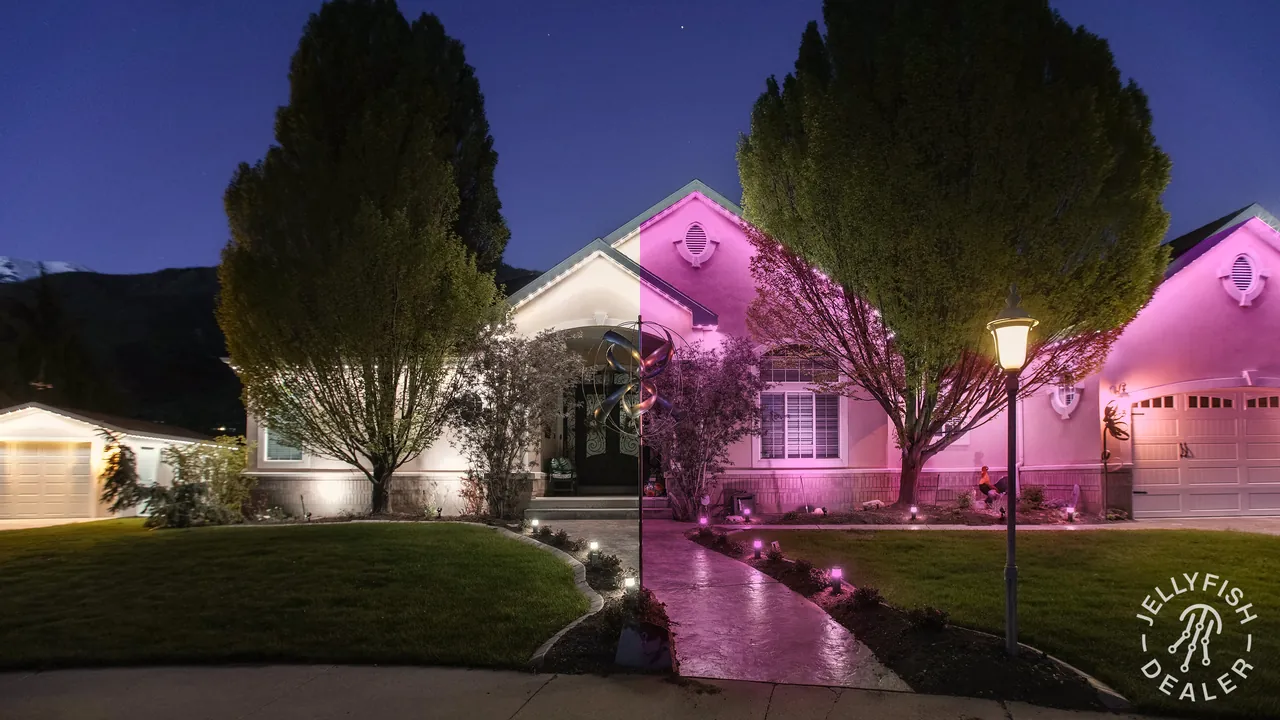
Think of it as architectural lighting that also does holidays. On most nights a warm white preset traces the roofline and shows off stucco, tile and trim. On others a brighter white lights the driveway, entry and side yard for security. When the season comes, the same lights switch to Christmas or game-day colors, then go back to white without a ladder in sight.
Planning lights for a Tampa home? Call (727) 476-7079 or request a free estimate online.
Keywest Lights & Electric is an Authorized Dealer of JellyFish Lighting. We are not JellyFish Lighting.
Davis Islands: Mediterranean Revival on man-made islands
D.P. Davis laid out the islands in the 1920s with Mediterranean architecture, “Venetian” canals and winding, palm-lined avenues. A National Register listing from 1989 covers 21 of the islands’ Mediterranean Revival buildings, among them a 1925 villa at 116 W. Davis Blvd designed by Franklin O. Adams Jr. The style pairs stucco and clay tile with flat roof sections drained by decorative scuppers, and sometimes towers, so one house can call for two kinds of track: a standard run tucked under a tile eave, and a 45-degree track where a flat section leaves no soffit to mount into.
Davis Islands also has a front-row seat for the Holiday Lighted Boat Parade, which in 2025 started near the lighthouse off the islands before heading past Harbour Island and up the river. A roofline that glows in holiday color that night, and in warm white the rest of the year, fits right in.
Hyde Park and South Tampa: historic trim, warm white
Hyde Park is one of Tampa’s four local historic districts, reviewed by the city’s Architectural Review Commission. Its design guidelines describe a mix of Queen Anne, Tudor, Colonial, Mediterranean Revival, Prairie and Craftsman bungalow homes. Most roofs are gabled or hipped, eaves are often enclosed, some have carved brackets or exposed rafter tails, and wood fascia is common.
The guidelines also speak to lighting: no floodlighting a facade, no harsh light spilling onto neighbors, and nothing that distracts from the street. That is where a downward-facing roofline light earns its place. We set everyday scenes to 2700K or 3000K warm white, keep the track tight to the trim, and on open eaves with exposed rafter tails we plan each run at the estimate so it sits cleanly.
Farther south, ZIP 33629 is about 80% owner-occupied and roughly 70% single-family detached, with a median build year of 1973, according to Census estimates.
Harbour Island: a downtown island with its own association
Harbour Island was once Seddon Island, a rail yard and phosphate terminal at the mouth of the Hillsborough River. A 1985 report described it as a 177-acre island formed by channel dredging, and the first phase of today’s community broke ground that year. Homes now range from single-family houses and large estates to apartments and high-rises, with the Harbour Island Community Services Association as the master association.
For single-family homes and townhomes, we put together the track color, mounting location and a simple run layout for the association’s review. On a condo or high-rise, the roofline belongs to the building, so the association makes that call.
Avila and Carrollwood: deed restrictions and 1980s rooflines
Avila is a deed-restricted community governed by a recorded Declaration from 1979, amended and restated by its property owners’ association in 2014. It takes its name and inspiration from the walled city of Ávila in Spain, and its streets are named for Spanish cities. Before we install there, we send the association the product and layout details it asks for.
Around it, Carrollwood’s housing is younger than South Tampa’s. Census figures for the Carrollwood CDP put the median home at 1984, with 41.6% built in the 1980s and 59.2% single-family detached. We check the soffit material on each home at the estimate and match the track color to it.
Businesses: one steady color
Tampa’s six downtown bridges are lit every night under the Lights on Tampa program, and the Fortune Taylor Bridge cycles through color palettes you can watch from the Riverwalk. Private businesses play by different rules. Tampa’s sign code treats a sign lit by lights that change color, flash or alternate as an “activated sign” and prohibits it, and unincorporated Hillsborough, which includes Carrollwood, bans animated signs, color changes included. So on a storefront, office or restaurant we install steady brand colors on a schedule and check the sign code for your address before setup. Color-changing scenes stay on homes.
Power, wind and the install
JellyFish runs at low voltage from a controller that plugs into a standard outlet indoors. We confirm that outlet has GFCI protection, or add a new outlet or dedicated circuit where the home needs one. Permanent lighting that needs a new outlet or dedicated circuit requires an electrical permit, and we pull it and handle the inspection for you.
Downtown Tampa sits inside Hillsborough’s 140 mph wind-borne debris zone, and Hurricane Helene pushed water to a record 6.86 feet above high tide at Old Port Tampa in 2024. We fasten the track to solid framing instead of clips or tape, use corrosion-resistant hardware near the bay, and mount the controller high on an inside wall.
How a Tampa JellyFish project runs
- Free estimate. We measure each roofline run, look at the eave style, match the track to your trim and find the controller spot.
- Written proposal. Footage, track type, light spacing and any outlet or circuit work, in writing.
- Approvals. If your HOA, association or historic district needs to sign off, we supply the details for the request.
- Install day. Power first, then track and lights, with wiring kept inside the track or the attic.
- App setup. We connect the controller to your Wi-Fi and set your everyday, security and holiday scenes before we leave.
Every install carries JellyFish Lighting’s 5-year parts warranty on the roofline lights, controllers and power supplies, plus our own workmanship warranty: 2 years, or 5 years for Member Care Plan members.
Tampa JellyFish Lighting FAQ
Can I add permanent lights to a home in the Hyde Park historic district? Yes, and the lights suit the district well when they are set up with care. The city’s Hyde Park design guidelines discourage floodlighting a facade and ask that building lighting not intrude on neighbors or distract from the street. JellyFish lights face down from the soffit in a soft warm white, and we go over the guidelines with you before anything is installed.
Do you install JellyFish Lighting on Davis Islands and Harbour Island? Yes. Both are planned projects: we visit for a free estimate, send a written proposal and book an install date with you. Harbour Island has a master association, the Harbour Island Community Services Association, so check its rules before you schedule, and we’ll supply the track color and layout for any request.
Can my Tampa business run color-changing lights on the building? Not on the facade. Tampa’s sign code counts a sign lit by lights that change color, flash or alternate as an “activated sign” and prohibits it, and unincorporated Hillsborough treats color changes as an animated sign. We set business systems to one steady brand color and check the code for your address first.
How soon can you install in Tampa? Tampa installs are scheduled work, not same-day calls. After the estimate and written proposal, we book a date that works for you. If you want lights up for the holidays, call in early fall so the install lands before December.
Will the lights need a new outlet or circuit? Sometimes. The controller plugs into a GFCI-protected outlet indoors, usually in the garage. If there isn’t one in the right place, or the circuit is already busy, we add a new outlet or a dedicated circuit. That work requires an electrical permit, which we pull, and we handle the inspection too.
More on the system itself is on our JellyFish Lighting page, part of our permanent lighting services. For the rest of the county, see JellyFish Lighting in Hillsborough County, and for panels, EV chargers and other work here, our Tampa electrician page.
Ready to light a Tampa home? Call (727) 476-7079 or request your free estimate.
JellyFish Lighting is a trademark of JellyFish Lighting. Keywest Lights & Electric is an independent Authorized Dealer and is not JellyFish Lighting, the company.