
If your lights dim when the A/C kicks on, you are adding an EV charger, or your 1960s bungalow still runs on a 100-amp fuse box, you are not imagining the strain. A 200 Amp Panel Upgrade: Who Needs It and Why is one of the most common electrical questions homeowners and small-business owners ask in St. Petersburg, Seminole, Pinellas County, and the rest of Tampa Bay. This guide explains what a 200-amp service actually is, who needs it, the warning signs to watch for, how Florida weather and older housing stock change the job, what a quality upgrade should include, and how to decide your next step with a licensed electrician.
—
What a 200 Amp Panel Upgrade Means in Plain English
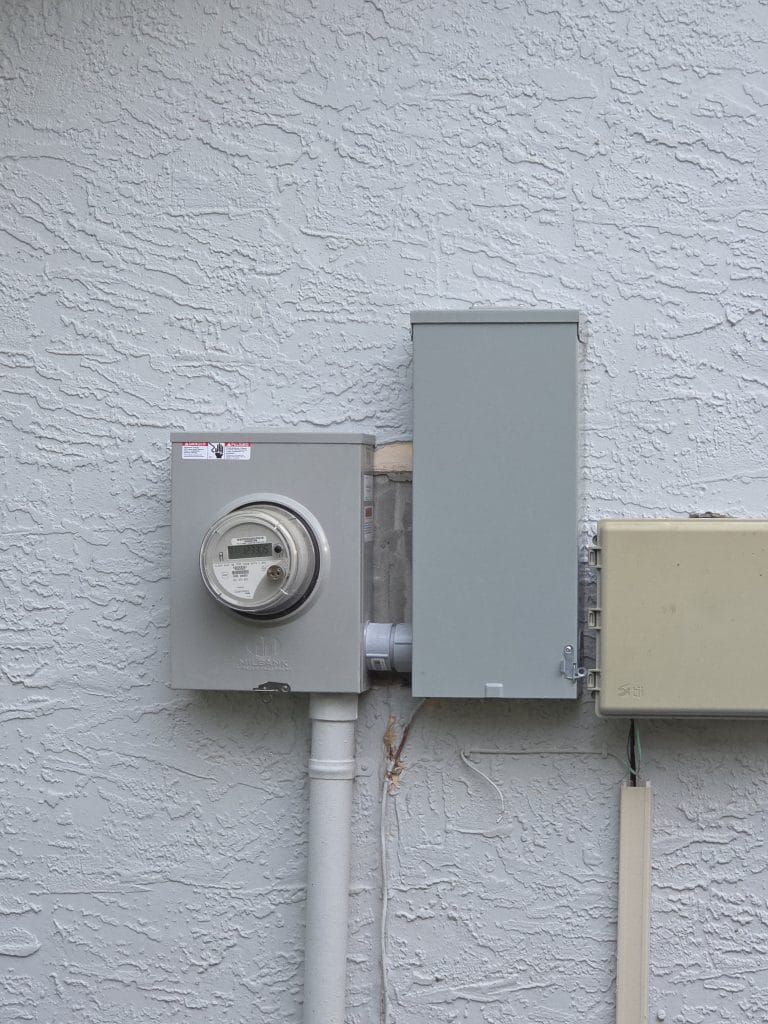
Your electrical panel is the traffic cop for every circuit in the building. Power comes in from the utility, passes through a meter, then hits the main breaker and splits into branch circuits that feed outlets, lighting, HVAC, appliances, and equipment.
Amps measure how much current the service can safely deliver at once. Many older Tampa Bay homes were built with 60-amp or 100-amp service. Some later homes have 150 amps. A 200-amp panel is the modern residential (and many small-commercial) standard. It does not mean every circuit is “faster.” It means the building can run more loads at the same time without overloading the main breaker or the service conductors.
A panel upgrade can mean two related jobs:
- Panel replacement only. The existing service size stays the same, but a worn, full, or unsafe panel is replaced with a new 200-amp-rated panel (sometimes still fed by smaller service conductors until the utility and electrician upgrade those too).
- Service upgrade to 200 amps. The electrician (and often the utility) increase the incoming service: new conductors, often a new meter socket, a new main disconnect or combination meter-main, grounding and bonding updates, and a new 200-amp panel with modern breakers.
- Fuse boxes instead of breakers
- 60-amp or 100-amp services
- Federal Pacific, Zinsco, or other panels with known failure histories
- Two-wire (ungrounded) circuits
- Limited spaces, so every remodel becomes a puzzle
- EV charger (Level 2 chargers commonly need a dedicated 40–60 amp circuit; some commercial or faster units need more)
- New or larger central A/C or heat pump
- Electric range, tankless water heater, or converting from gas
- Pool pump, spa, or hot tub
- Whole-house generator or transfer switch
- Detached garage, ADU, or enclosed Florida room
- Workshop welders, compressors, or kiln circuits
- More lighting and outlet circuits (kitchens and baths need dedicated small-appliance circuits, GFCI protection, and often AFCI)
- Island outlets, under-cabinet lighting, and appliance circuits
- Dedicated circuits for microwave, dishwasher, disposal, wine fridge
- Multiple home-office circuits for computers, networking, and A/C in a converted room
- HVAC upgrades
- Coolers and kitchen equipment
- POS, IT, and security loads
- Emergency lighting and exit signs
- EV chargers for customers or fleet vehicles
- Tenant build-outs that split or rework panels
- Fuse panels
- Overloaded or double-tapped breakers
- Rusted or water-damaged enclosures
- Missing dead fronts or uncovered openings
- Panels with recalled or problem breaker brands
- Inadequate grounding
- Breakers trip when several appliances run together
- Lights dim or flicker when HVAC, microwave, or dryer starts
- You cannot add an EV charger, spa, or new A/C without “finding space”
- Extension cords and power strips are doing the job of missing outlets
- The panel is full; every slot is used
- Burning smell at the panel or outlets
- Warm or hot panel cover, or discoloration around breakers
- Buzzing, crackling, or arcing sounds
- Rust, water stains, or insect nests inside the enclosure
- Breakers that will not reset, or fuses that blow repeatedly
- Loose, melted, or overheated lugs (only a licensed electrician should open and inspect this)
- Unlabeled circuits, missing knockout fillers, or a missing dead-front cover
- Fuse box still in service
- Panel brands associated with failure (have a licensed electrician identify yours; do not assume from photos online)
- Aluminum branch wiring combined with an aging panel (needs evaluation, not DIY “fixes”)
- No whole-house surge protection in a lightning-prone area
- Frequent utility surges and lightning-induced transients
- Flood risk in some neighborhoods; panel height and location matter
- Generators and transfer equipment that must be integrated correctly
- After-storm repairs that sometimes reveal already-marginal panels
- Original knob-and-tube or early NM in parts of the house (less common, but still found)
- Mixed copper and aluminum
- Subpanels in sheds or Florida rooms fed by undersized feeders
- Grounding that was never updated when the service grew
- A permit through the local building department (St. Petersburg, Pinellas County, or the city that has jurisdiction)
- Inspection of the panel, grounding/bonding, working clearances, and often the service entrance
- Coordination with the power company to pull the meter, reconnect, and sometimes upgrade the drop or lateral
- Possible HOA or historic-district rules on exterior equipment appearance (less common, but worth asking)
- Site visit and electrical assessment
- Load calculation (not a guess from “we’ve always been fine”)
- Decision on panel location, main breaker vs. main-lug with separate disconnect, and indoor vs. outdoor equipment
- Utility coordination if the service size or meter socket changes
- New 200-amp panel of a current, well-supported brand with enough spaces
- Correct main breaker or meter-main combination as required
- New or verified service-entrance conductors sized for 200 amps
- Meter socket replacement when the existing can is undersized, damaged, or not approved for the new service
- Proper drip loops, mast, or underground lateral details as applicable
- AFCI and GFCI protection as required for the circuits you are touching or adding
- Correct breaker types for the panel (never mix incompatible brands)
- Whole-service surge protection when specified
- Tamper-resistant receptacles and GFCI updates if outlets are part of the project
- Grounding electrode system check: rods, water pipe bonding, and intersystem bonding as required
- Bonding of metal water and gas piping where code requires it
- Neutral-ground separation correct in subpanels
- Replacement of damaged or undersized grounding conductors
- Neat landing of existing branch circuits, with no double-taps unless the lug is listed for two conductors
- Replacement of damaged cable ends, rusted connectors, and overheated breakers
- Clear, durable circuit labels (not marker on the cover that wipes off)
- Correction of obvious hazards discovered during the upgrade (open junctions, reverse polarity, missing grounds on circuits being reworked)
- Permit and inspections
- Utility reconnect
- Walkthrough: what changed, how to reset breakers, and where the main shutoff is
- Documentation for insurance and future remodels
- Current service size and condition. 100-amp to 200-amp with a sound mast is different from a rusted underground lateral and a failed meter can.
- Panel location. Interior garage vs. exterior wall vs. relocation for clearance or flood elevation.
- Utility fees and equipment. Some upgrades need a new meter, new drop, or trench work. Those costs are not fully in the electrician’s control.
- Number of circuits and whether many cables are too short, damaged, or aluminum and need pigtails or replacement.
- Grounding upgrades (extra rods, replacing a missing water-bond, intersystem bus).
- Add-ons you actually want: EV charger circuit, generator interlock or transfer switch, surge device, extra kitchen circuits, subpanel to a garage.
- Access and finishes. Drywall repair, stucco, or soffit work after a mast change is often separate.
- Permit and inspection fees set by the city or county.
- Occupied vs. vacant building and how long power must be off.
Homeowners usually mean the second job when they search “200 Amp Panel Upgrade: Who Needs It and Why.” That is the work that actually gives you more capacity.
A 200-amp panel also typically gives you more breaker spaces. Older 100-amp panels may have 12–20 slots. A modern 200-amp panel often has 30–42 spaces (or more with tandem/quad breakers where code allows). Extra spaces matter when you add circuits instead of doubling up or using dangerous workarounds.
—
Who Needs a 200 Amp Panel Upgrade?
You do not upgrade “just because 200 is a round number.” You upgrade when the building’s electrical demand, safety, or code path requires more capacity or a safer enclosure.
Older homes in Pinellas County
St. Petersburg, Seminole, Largo, Clearwater, and nearby cities have large stocks of mid-century houses, cottages, and small commercial buildings. Many still have:
If you bought a home built before the 1980s and you have not confirmed service size, assume you may be on 100 amps or less until a licensed electrician checks the main breaker, meter, and service entrance.
Homes adding major loads
These additions often push a 100-amp or even 150-amp service over the edge:
Florida’s long cooling season means HVAC already takes a large share of capacity. Add an EV charger and a kitchen remodel, and a 100-amp panel is often no longer enough.
Remodels, kitchens, and home offices
A remodel does not always require 200 amps, but it often does when you add:
If the existing panel is full, the electrician cannot legally keep stacking double-taps and cheater breakers. A 200-amp panel with spare spaces is the clean way to finish the job.
Small commercial properties
Storefronts, offices, restaurants, and tenant spaces in St. Petersburg and Pinellas Park frequently outgrow original service when they add:
A commercial electrician will calculate load per code, not guess from a breaker count. For many small commercial occupancies, 200 amps is a practical starting point; larger kitchens and retail may need more.
Buyers, insurers, and real-estate transactions
Inspectors and insurers in Tampa Bay commonly flag:
A 200-amp upgrade is often the fix that lets a sale close and reduces the chance of a future claim denial after a storm or fire.
—
Warning Signs: When to Call a Licensed Electrician
Do not wait for a scorch mark. Call a licensed electrician if you notice any of the following.
Capacity and performance
Safety and condition
Age and type
If you smell burning, see smoke, or the panel is hot to the touch, shut off what you can safely reach, keep people away, and treat it as an electrical emergency.
—
Florida and Tampa Bay Considerations
A panel upgrade in Pinellas County is not the same job as one in a dry inland climate. Local conditions change materials, placement, and code details.
Humidity, salt air, and corrosion
Coastal and near-coastal air in St. Petersburg, Seminole, and Clearwater accelerates corrosion on enclosures, lugs, grounding connections, and meter equipment. Exterior panels and meter cans need weather-rated gear, tight seals, and correct NEMA ratings. Interior panels in garages and lanais still see moisture. Rust is not cosmetic; it raises resistance and heat.
Storms, flooding, and surge
Tampa Bay thunderstorms and hurricane season mean:
A quality 200-amp upgrade is a good time to add Type 1 or Type 2 surge protective devices (whole-service surge protection) and to verify grounding electrode systems. Surge devices are not a substitute for a sound panel, but they are cheap insurance next to replacing electronics and HVAC boards.
Older construction and mixed wiring
Many Pinellas homes have been added onto over decades. You may find:
A licensed electrician should load-calculate and inspect feeders, not just swap the can on the wall.
Permits, inspections, and the utility
In Florida, a service or panel upgrade is not a weekend DIY project. Expect:
Skipping the permit can stall a sale, void insurance coverage after a loss, and leave you with work that does not meet the Florida Building Code or NEC as adopted locally.
Working clearances and Florida rooms
Code requires dedicated working space in front of the panel: typically 30 inches wide, 36 inches deep, and 6½ feet high, with a clear path. Panels buried behind storage, water heaters, or enclosed lanai furniture often need relocation as part of the upgrade. That is a cost and design factor, not an optional nicety.
—
What a Quality 200 Amp Panel Upgrade Should Include
“Swap the box” is not a complete job. A quality upgrade, done right the first time, usually includes the items below. Exact scope depends on the house or building.
Planning and calculation
Service equipment
Safety devices and modern protection
Grounding and bonding
Circuit work
Paperwork and finish
If a bid only says “200A panel” with no mention of grounding, permit, load calc, or meter/service conductors, ask what is actually included.
—
Cost Factors (No Guessing Games)
Prices vary by house, city, utility requirements, and how much hidden work appears once the cover comes off. A honest contractor will explain drivers, not a one-size number from the internet.
Factors that change the job:
Be wary of the cheapest number if it skips permit, surge, grounding, or utility coordination. The expensive part of electrical work is doing it twice after a failed inspection