
You flip a breaker back on, and it trips again. Or maybe nothing trips at all, but you smell a faint burning odor near an outlet. Those moments are easy to shrug off. They should not be. Hidden arcing in wiring can start electrical fires without a loud spark or a dramatic short. AFCI circuit breakers exist to catch that kind of trouble early. Homeowners in St. Petersburg and across Pinellas County often first hear about them during a renovation or a panel check. Key West Lights and Electric specifies AFCI where code requires it, and that requirement has grown as safety standards have changed.
What an arc fault is, in plain English
An arc fault is electricity jumping a gap it should not jump. The jump can be tiny. You may never see a flash. You may only notice a warm cover plate, a flickering lamp, or a breaker that will not stay on. Heat from that jump can ignite wood, dust, or insulation inside a wall.
A standard breaker is built to stop large overloads and hard shorts. It is not designed to notice every sputtering, intermittent arc. Those smaller events still get hot. That is why an arc fault is a fire problem more than a “lights went out” problem.
Common hiding places include a nicked cable behind drywall, a staple driven too deep in an attic, a loose wire at an outlet, or a cord pinched under a sofa. Older homes in the Tampa Bay area see another layer of wear: heat, humidity, and years of small repairs. Connections that were snug decades ago can loosen. Insulation can dry out. None of that means a house is unsafe on sight. It does mean hidden arcing is worth taking seriously.
How AFCI circuit breakers work
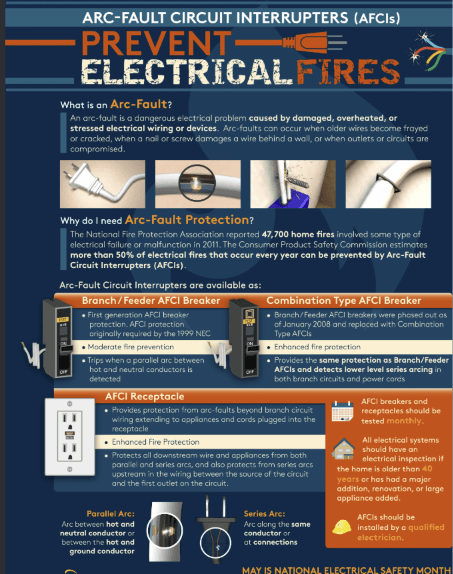
AFCI stands for arc-fault circuit interrupter. AFCI circuit breakers mount in the electrical panel and watch the current on a branch circuit. They look for the electrical “signature” of a dangerous arc. When the pattern matches that signature, the breaker opens and shuts power off.
Most homes today use combination AFCIs. Those devices look for series arcs, which happen along a single conductor, and parallel arcs, which happen between conductors or to ground. You may also see AFCI receptacles. Those outlets can protect devices downstream on the same run. A licensed electrician chooses breakers, receptacles, or both based on the panel, the wiring, and the code in force for the job.
AFCIs can trip for a real fault. They can also trip when a motor or electronic device creates noise that looks similar to an arc. Vacuums, treadmills, and some power tools have caused nuisance trips, especially on older AFCI designs. Newer breakers are better at telling a true arc fault from normal equipment. Repeated trips are still a reason to stop resetting and call a licensed electrician. The goal is to find the cause, not to live with a breaker that chatters all week.
AFCI vs GFCI: different jobs, both important
These two devices get mixed up because both interrupt power for safety. They protect against different hazards.
AFCI protection watches for arcing that can start electrical fires. It is aimed at branch circuits in living spaces, where cords, furniture, and hidden wiring share close quarters.
GFCI protection watches for current leaking to ground, often through water or a person. It is aimed at shock. You expect it in bathrooms, kitchens, garages, outdoors, and other damp locations.
One circuit can need both. Kitchens and laundry rooms are frequent examples. Dual-function breakers combine AFCI and GFCI in a single device. A licensed electrician can say whether a dual-function breaker, separate devices, or a mix of breakers and receptacles fits your panel.
Do not assume GFCI coverage means you are protected from arc faults. You are not. Do not assume an AFCI breaker will protect someone from shock at a wet outdoor outlet. It will not replace GFCI protection. If a home has one type and not the other, that is incomplete protection, not a code trivia issue.
Why this matters in older Florida homes
Plenty of houses in St. Petersburg, Pinellas County, and the wider Tampa Bay area were finished before AFCI rules were common. Their panels may hold only standard thermal-magnetic breakers. Those homes can still be well maintained. They simply do not have the extra arc-detection layer that newer dwelling codes expect in many living areas.
Florida conditions are hard on electrical connections. Attic heat, salt air near the coast, and humidity work on terminations over time. Add pinched cords, aging appliances, and DIY patches from past owners, and you have more chances for an arc fault to develop where nobody is looking.
A remodel that opens walls is a common moment when AFCI rules come into play. So is a panel upgrade. Replacing an obsolete or damaged panel is often the practical time to put AFCI circuit breakers on the living-area circuits that current rules call for. Insurance reviews and home-sale inspections may also flag missing AFCI protection. Treat those notes as a prompt to get a licensed opinion, not as a weekend project.
When AFCI protection is typically required
Electrical codes change, and cities adopt them on their own schedules. In general, AFCI protection has expanded from bedrooms to most living areas in dwelling units. That often includes family rooms, dining rooms, living rooms, dens, bedrooms, sunrooms, recreation rooms, closets, hallways, and similar spaces.
New circuits and certain remodels get the closest look from inspectors. Swapping a single receptacle in an existing wall is not always treated the same as running new cable. The details depend on the scope of work and the code cycle your building department uses.
This is not a homeowner code-reading exercise. A licensed electrician who works locally will know what St. Petersburg and Pinellas County expect for your specific job. Ask what rooms need AFCI, whether dual-function breakers belong on kitchen or laundry circuits, and how shared neutrals will be handled. Multi-wire branch circuits can make AFCI breakers trip if the wiring is not identified and landed correctly.
What belongs to a licensed electrician
AFCI circuit breakers go in the panel. Panel work is not a do-it-yourself task. It involves energized parts, breaker compatibility with that specific panel, and tight, correct connections. The wrong breaker in the wrong enclosure is a safety problem. Mixing brands in ways the manufacturer does not list is another.
Do not attempt a panel upgrade, a service change, aluminum wiring repair, or knob-and-tube replacement yourself. Those jobs require a licensed electrician. If a breaker is hot, buzzing, or will not reset, leave it alone and schedule service.
Outside the panel, simple habits help. Unplug damaged cords. Keep furniture from pinching wires. Use the test button on AFCI and GFCI devices the way the manufacturer describes, often once a month. If a test fails, stop using that circuit and call for help.
A short checklist before you call
Gather this information so a licensed electrician can spend the visit on diagnosis instead of guesswork:
- Note which rooms go dark when a breaker trips, and whether it happens when a certain appliance starts.
- Write down any burning smell, discoloration, or warmth at outlets or the panel. Do not open the panel.
- Look at breaker labels if they are readable from the closed cover. See whether any already say AFCI or dual-function.
- Check visible cords and plugs in the affected room for cuts, pinch points, or loose blades. Do not take outlets apart.
- Have the approximate age of the home and any recent remodel permits, if you still have them.
- List bathrooms, kitchens, garages, and outdoor outlets that already have GFCI protection.
- If a breaker trips twice, leave it off and schedule a licensed electrician rather than resetting it through the day.
Living with AFCI circuit breakers day to day
After they are installed, daily use should feel ordinary. Lights work. Outlets work. The difference is background protection against an arc fault you might never see. If a breaker trips, treat it as a message. If there is no heat, buzzing, or odor, a single reset following the device instructions may be reasonable. If it trips again, leave it off.
Do not tape a breaker on. Do not swap an AFCI breaker for a standard breaker just to stop trips. That removes the protection the device was meant to provide. Nuisance trips deserve a real look at the circuit, the load, and the breaker type, not a workaround.
Facility managers and landlords should log repeated trips the same way they would log a leaking water heater. Tenants may only report that “the power keeps going out.” The underlying issue can be a damaged cord, a failing appliance, or a connection that needs a licensed repair.
If you are planning a remodel, noticing unexplained trips, or wondering whether living-area circuits have arc-fault protection, schedule an inspection or estimate. Key West Lights and Electric serves St. Petersburg, Pinellas County, and the Tampa Bay area. Call (727) 776-0718 or visit https://keywestlights.com/ to set up a visit. A licensed electrician can review your panel, explain AFCI circuit breakers in the context of your home, and outline the next step without pressure.